
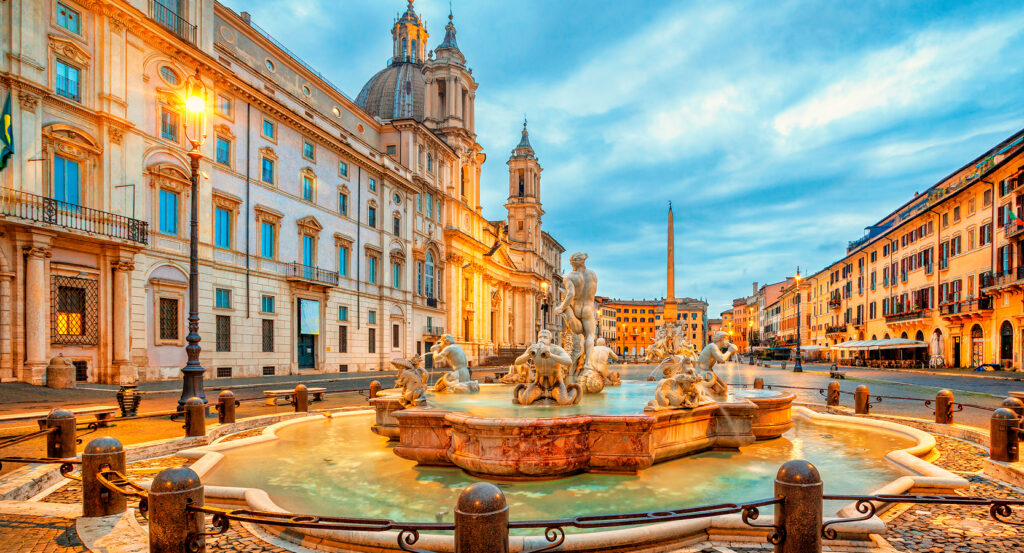
Why you should experience Fontana dei Quattro Fiumi in Rome, Italy.
Fontana dei Quattro Fiumi, or Fountain of the Four Rivers, commands Rome's Piazza Navona, a baroque explosion of motion where marble seems to exhale.
Designed by Gian Lorenzo Bernini in 1651 for Pope Innocent X, the fountain is less a monument than a performance: a volcanic surge of stone, water, and light arranged around a soaring Egyptian obelisk. At its base, four colossal river gods sprawl in dynamic tension, each representing one of the world's great waterways, the Nile, the Ganges, the Danube, and the Río de la Plata, and by extension, the four corners of the known earth. The figures twist and writhe as though caught between awe and agony, while water gushes from beneath them, gliding over carved rock into a radiant pool that mirrors the sky. The design is theatrical but deliberate, chaos suspended in balance, every fold of drapery engineered to guide your gaze upward. Bernini once said that beauty was movement captured at its climax; here, that truth lives, eternally cascading.
What you should know about Fontana dei Quattro Fiumi.
What most travelers don't realize is that Fontana dei Quattro Fiumi was born not only of genius, but of rivalry, art as warfare waged in marble.
Bernini's commission was a coup: he had fallen from papal favor after political scandals, while his rival Borromini held sway at Innocent X's court. Legend says Bernini presented a silver model of the design to the pope's niece, who arranged for her uncle to see it. The moment Innocent laid eyes on the miniature, radiant, alive, irresistible, he reversed his judgment. The project was his again. Every sculpted river tells a story beyond geography: the Nile with his head veiled, symbolizing lands yet undiscovered; the Ganges turning an oar, mastery over navigation; the Danube reaching toward the papal coat of arms, loyalty embodied; the Río de la Plata recoiling from a serpent, a metaphor for colonial uncertainty and greed. Even the obelisk's placement was audacious, balanced atop a hollow core of marble, it defied engineering expectations. Bernini had achieved the impossible: to make stone flow like faith itself.
How to fold Fontana dei Quattro Fiumi into your trip.
To fold Fontana dei Quattro Fiumi into your Roman experience, arrive when Piazza Navona exhales, dawn or midnight, when performance gives way to intimacy.
Stand at a distance first, where you can see how the fountain anchors the elongated curve of the piazza like a heartbeat in motion. Then move closer, circling slowly; each god reveals a different mood, a different philosophy of empire and spirit. Listen to the water's voice, low, constant, hypnotic, masking the city's noise in ancient rhythm. Trace your fingers along the cool marble base, still etched with centuries of touch, then look up toward the obelisk, its hieroglyphs glowing gold in the Roman light. Visit again at night, when the square empties and the fountain belongs to you alone. The shadows will deepen, the marble will glisten, and Bernini's rivers will seem to breathe. In that moment, you'll feel what every artist since has envied, the pulse of eternity caught mid-current, the world rendered fluid by one man's vision.
Where your story begins.
Foresyte Travel reveals places that feel extraordinary long before you arrive.
Experience premium editorial crafted for luxury travelers.




















































































































