Why Four Seasons Hotel Kuala Lumpur matters.
Four Seasons Hotel Kuala Lumpur is a 65-storey vertical resort in the heart of the Golden Triangle, where contemporary hospitality, KLCC Park and Malaysia's most concentrated business district converge within a single skyline-defining address.
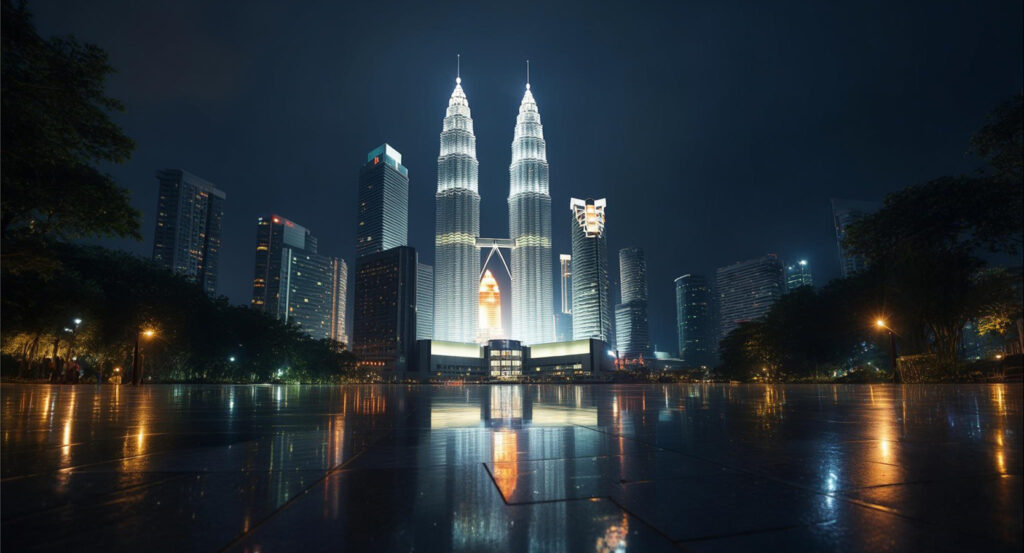
Set along Jalan Ampang near Jalan P. Ramlee and just steps from the Petronas Twin Towers, the 65-storey hotel occupies Kuala Lumpur's Golden Triangle between KLCC Park, the Kuala Lumpur Convention Centre and commercial corridors extending south toward Bukit Bintang and west toward the city centre. KLCC's 20-hectare parkland gives the tower a rare landscape setting within the city's densest commercial quarter, with tropical gardens, water features and jogging paths immediately beyond the property. Elevated rooms and suites turn the skyscraper's vertical position into the primary experiential mechanism, placing Kuala Lumpur's skyline, park canopy and metropolitan horizon within a continuous field of view. The Shoppes at Four Seasons Place extends that urban rhythm through a six-level luxury retail podium directly beneath the hotel, while landscaped approaches soften the transition between Jalan Ampang and the tower interior. The result is a hotel defined by vertical scale, park adjacency, retail integration and direct immersion in Kuala Lumpur's most consequential urban district.
What defines Four Seasons Hotel Kuala Lumpur.
Four Seasons Hotel Kuala Lumpur is best known for its position within a 65-storey mixed-use tower that combines hotel rooms, serviced apartments, private residences and a luxury retail podium. The property opened in July 2018 as Four Seasons Hotels and Resorts' Kuala Lumpur address. NRY Architects shaped the tower's architectural language, while Susan Isaac and Andy Png of Wilson Associates developed the interior design. Floors B1 through 4 contain the retail podium, floors 5 through 7 contain hotel facilities, and floors 8 through 18 contain guest rooms. Floors 19 through 21 contain 27 serviced apartments, while floors 22 through 65 contain 242 private residences. The hotel contains 209 rooms, including 177 guest rooms and 32 suites, within the upper portion of the main tower. The Shoppes at Four Seasons Place establishes a six-level commercial base beneath the hospitality floors and connects the property to Kuala Lumpur's luxury retail economy. KLCC Park extends across 20 hectares beside the tower, supplying tropical gardens, water features and a jogging track to an otherwise intensely urban setting. The Petronas Twin Towers place the hotel within Kuala Lumpur City Centre, where corporate offices, cultural venues and shopping complexes converge. Contemporary interiors incorporate Malaysian undertones through material, pattern and decorative detail without abandoning the precision of a modern metropolitan hotel. This combination of vertical programming, park adjacency and regional design gives Four Seasons Hotel Kuala Lumpur a distinct architectural character within the city's high-rise core.
Yun House anchors the property's culinary character through Cantonese cuisine, pork-free menus and regional ingredients presented within a dining room overlooking KLCC Park. Chef Jimmy Wong brings Hong Kong culinary training to the restaurant's dim sum, seafood, roasted duck and seasonal tasting menus. The MICHELIN-selected restaurant connects Cantonese technique with Malaysian produce, including ingredients from the country's farms, jungles and coastal waters. Curate shifts the focus toward international buffet dining, with Executive Chef John Oh shaping a menu influenced by culinary traditions from Korea, the United States and Vietnam. Bar Trigona translates Malaysian ingredients into cocktails built around local botanicals, honey and sustainable produce. The bar takes its name from the trigona stingless bee, whose honey forms part of Malaysia's distinctive ingredient culture. The Lounge extends the hotel's food program into afternoon tea, pastries and formal social service beneath the tower's contemporary interiors. The Spa pairs Malaysian healing traditions with Valmont facials, Skeyndor treatments, private rainfall showers and heated relaxation areas. A private couples' suite gives the wellness program a more intimate spatial expression within the hotel's upper-level facilities. Together, Yun House, Curate, Bar Trigona, The Lounge and The Spa make Four Seasons Hotel Kuala Lumpur a vertically organized destination for Cantonese cuisine, global dining, Malaysian ingredients and urban wellness.
How Four Seasons Hotel Kuala Lumpur fits.
Four Seasons Hotel Kuala Lumpur works as a refined base for tracing the city's passage from Islamic artistic culture through post-independence national architecture and into the civic space where Malaysian sovereignty entered public life.
Begin at Islamic Arts Museum Malaysia, where 12 permanent galleries place 1,400 years of Islamic artistic production into a 30,000-square-metre institution beside Perdana Botanical Garden. The museum's collection moves from jewellery and textiles to manuscripts, ceramics, arms and architectural fragments, giving decorative objects a chronological relationship to the wider Islamic world. A large-scale model of Masjid al-Haram provides the collection's most imposing architectural artifact and connects miniature representation with the physical traditions of sacred design. Continue to Masjid Negara, completed on 27 August 1965 as a national expression of Malaysia's independence and Islamic identity. Howard Ashley, Hisham Albakri and Baharuddin Abu Kassim shaped the building through reinforced concrete, a 73-metre minaret and a 16-pointed star roof recalling an open umbrella. The mosque's 13-acre garden setting, reflecting pools and 15,000-person capacity expand the building from a prayer hall into a civic statement about a newly independent nation. Tunku Abdul Rahman proposed the mosque as a gesture of gratitude for peaceful independence, while public, corporate and governmental contributions gave the project a deliberately national foundation. Conclude at Merdeka Square, where the Union Jack descended on 31 August 1957 and the Malaysian flag rose above a 100-metre flagpole. The Sultan Abdul Samad Building, completed in 1897 with Moorish arches, copper domes and a clock tower, frames the square with the administrative architecture of the colonial period. The open field converts a former parade ground into the civic stage of Malaysian independence, linking national memory to the surrounding government quarter. The progression moves from Islamic art and sacred representation through a purpose-built national mosque and culminates at the square where independence became a public ceremony, allowing Kuala Lumpur's religious, architectural and political histories to unfold as one continuous civic narrative.
Where your story begins.
Foresyte Travel reveals places that feel extraordinary long before you arrive.
Enjoy editorial crafted for luxury travelers.
Foresyte may earn a commission when you book.