
Why Senbon Torii matters.
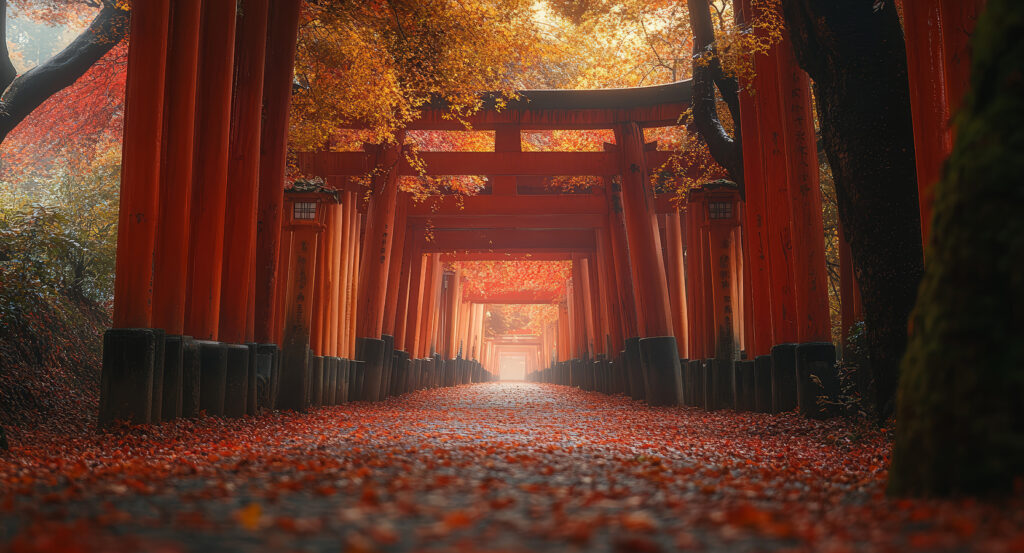
The Senbon Torii, the “thousand gates”, is among the most spellbinding passages on Earth.
Step beneath its first vermilion arch and the world contracts into rhythm and light: gate after gate, beam after beam, a corridor of color that breathes like a living organism. The air inside feels charged, thick with cedar and silence, broken only by the soft shuffle of feet against stone. The light changes, golden in the morning, copper by noon, amber at dusk, as the sun filters through the wooden frames, creating a mirror of sacred geometry. Each torii bears inscriptions of gratitude from merchants, families, and travelers who offered them to Inari, the Shinto deity of rice and prosperity. Together, they form an unbroken chain of devotion stretching up the slopes of Mount Inari. To walk this path is to walk through centuries of prayer, each step a heartbeat, each gate a breath. Time dissolves here. You begin as a visitor, but by the third bend, you feel like a pilgrim.
What defines Senbon Torii.
Though often translated as “a thousand gates,” the Senbon Torii is far more abundant, with over ten thousand torii spanning the trails of Fushimi Inari Taisha.
The custom of dedicating gates began in the Edo period, when traders who prospered under Inari's blessing erected torii to give thanks and ensure continued fortune. Each gate bears its donor's name and the date of dedication painted in bold black kanji, turning the corridor into a living ledger of gratitude. The vermilion color, derived from mercury oxide, was chosen not only for its beauty but for its symbolic power, believed to repel evil and preserve life force. Structurally, the gates are made of Japanese cypress and arranged so closely together that the spaces between them narrow into near darkness, a reminder that faith is often felt most in shadow. As you move deeper into the mountain, the gates thin, giving way to mossy stone paths and small shrines guarded by fox statues, Inari's divine messengers. Few visitors realize that each fox carries something meaningful: a rice key, a scroll, or a jewel, symbols of abundance, wisdom, and spiritual insight. The Senbon Torii isn't simply a sight to behold; it's a pulse of devotion made tangible, a wooden river flowing uphill toward the divine.
How Senbon Torii fits.
To truly feel the Senbon Torii, begin at dawn, when the path is still quiet and the mountain holds its breath.
Enter through the grand Romon Gate of Fushimi Inari Taisha and follow the first ascent beneath the dense canopy of torii. Move slowly; the path is meant to be walked, not rushed. Notice the sound, the soft knock of your footsteps, the sigh of the wind threading through wood, the distant call of crows from the valley below. Pause occasionally to look back, the view through the gates reverses into layers of deep red fading into gold, a visual echo of the journey itself. Midway up, the corridor opens briefly onto a plateau where small vendors sell charms and tea, a modern echo of the pilgrims who once rested here before continuing to the mountain's summit. If you stay until late afternoon, the sunlight will transform the entire passage into something otherworldly, a river of glowing amber suspended between heaven and earth. Return through the gates at twilight, when lanterns flicker to life and shadows stretch long across the path. In that dim, hushed hour, the Senbon Torii feels less like a walkway and more like a prayer, one you don't speak, but move through. To pass beneath these gates is to cross into something timeless: the space where devotion takes form, and Kyoto remembers to breathe.
Where your story begins.
Foresyte Travel reveals places that feel extraordinary long before you arrive.
Enjoy editorial crafted for luxury travelers.
Foresyte may earn a commission when you book.

















































































































