Why Garden of the Gods matters.
Garden of the Gods is a striking natural park where Colorado Springs' Rocky Mountain foothills meet towering sandstone formations, the geological upheaval that created the Front Range and a remarkable conservation legacy that permanently secured one of Colorado's most celebrated landscapes for public enjoyment.
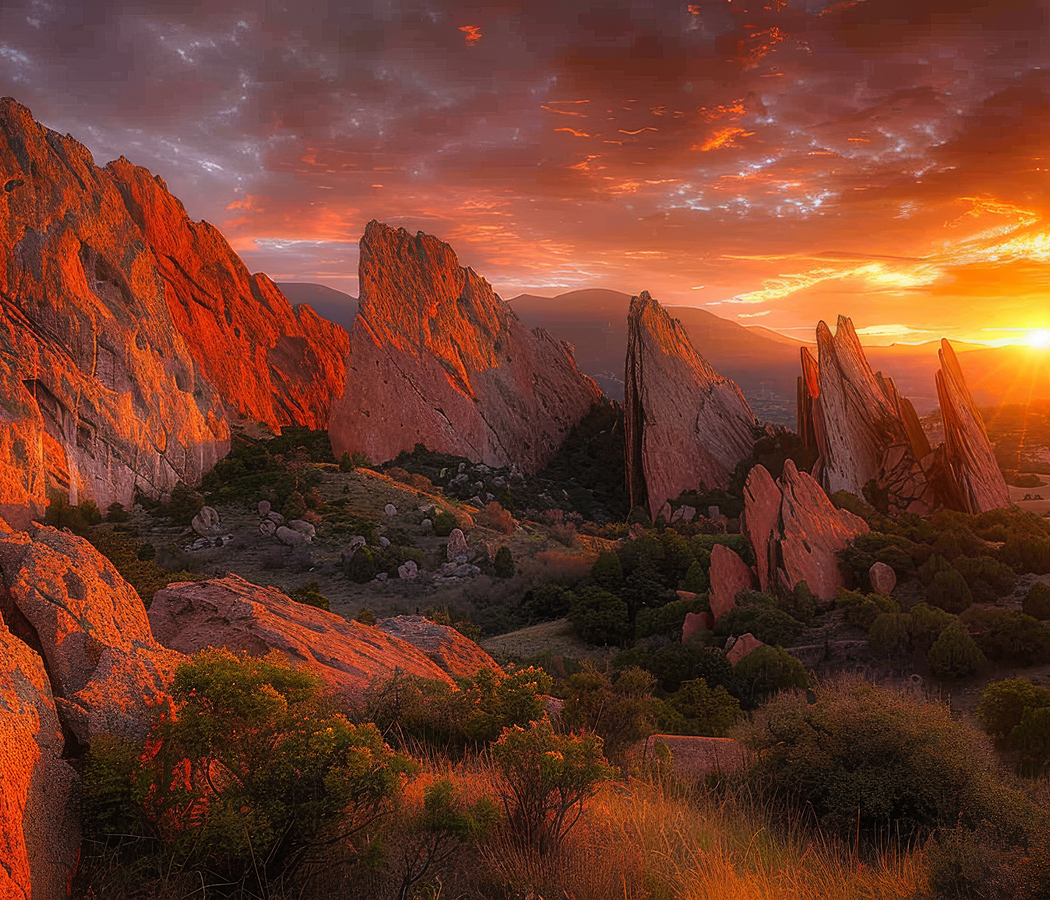
Set along North 30th Street near Gateway Road and just steps from the eastern approach to the Central Garden, the park occupies a broad expanse of foothill terrain northwest of Downtown Colorado Springs, between the residential neighborhoods of Mountain Shadows and Old Colorado City and the eastern slopes of the Rampart Range. Towering red sandstone fins rise abruptly above the surrounding grasslands, their steeply inclined surfaces exposing ancient sedimentary layers shaped by millions of years of geological change. Narrow passages between the formations reveal contrasting bands of red, pink and pale stone, with weathered surfaces, projecting ledges and isolated spires creating a dramatic sequence of natural structures. Pinyon pines, junipers, Gambel oaks and native grasses occupy the lower slopes, establishing a transitional landscape between the high plains and the forested mountains to the west. The result is an expansive natural environment whose sculptural rock formations, expansive mountain views and protected foothill setting make it one of the American West's most distinctive public landscapes.
What defines Garden of the Gods.
Garden of the Gods is best known for its towering sandstone formations, its extraordinary geological history and the permanent public-access protections established through the philanthropy of railroad executive Charles Elliott Perkins and his family. The landscape originated through geological processes extending hundreds of millions of years into the past, when ancient mountains eroded and deposited enormous quantities of sediment across the region. During the late Paleozoic Era, erosion of the Ancestral Rocky Mountains produced sand and gravel deposits that eventually formed substantial layers of sedimentary rock. Subsequent periods introduced shifting dune fields, coastal environments and shallow seas, creating additional formations with contrasting mineral compositions and sedimentary structures. The Fountain Formation, associated with the park's characteristic red sandstone, developed through the accumulation of material eroded from ancient mountain ranges. Iron-bearing minerals contributed to the reddish coloration that distinguishes many of the exposed rock surfaces. During the Laramide Orogeny, beginning 70 million years ago, tectonic forces associated with the uplift of the modern Rocky Mountains tilted previously horizontal sedimentary layers into steeply inclined positions. Continued erosion removed softer surrounding material, exposing resistant sandstone fins, isolated towers and sharply defined ridges. These geological processes created the park's striking contrast between vertical rock formations and the comparatively gentle foothill terrain surrounding them. The landscape also preserves evidence of prehistoric animal life, including dinosaur tracks associated with ancient environments that preceded the modern mountain range. Indigenous peoples occupied and traveled through the Pikes Peak region for thousands of years, with the Ute maintaining particularly substantial historical connections to the surrounding mountains and plains. The area's distinctive formations served as geographic reference points within a landscape associated with hunting, seasonal movement and established Indigenous travel routes. European American settlement expanded during the nineteenth century following gold discoveries and the development of transportation corridors across Colorado Territory. In 1859, surveyors M. S. Beach and Rufus Cable encountered the formations during an expedition associated with the establishment of Colorado City. Beach suggested that the landscape would make an excellent beer garden, prompting Cable to declare that the formations were suitable for the gods to assemble. The name Garden of the Gods subsequently became attached to the area, establishing an enduring association between its geological appearance and the imaginative language of nineteenth-century western exploration.
Charles Elliott Perkins acquired 240 acres within Garden of the Gods in 1879 after encouragement from Colorado Springs founder William Jackson Palmer, whose civic development ambitions included substantial investments in public parks and open space. Perkins, an influential railroad executive associated with the Chicago, Burlington and Quincy Railroad, subsequently expanded his holdings to 480 acres. Although he considered establishing a residence on the property, he preserved the landscape in its natural condition and permitted public access. His correspondence expressed an intention to transfer the land to Colorado Springs for permanent public enjoyment, extending Palmer's broader commitment to the city's landscaped setting. Perkins died in 1907 before completing the donation, leaving his children to fulfill the family's conservation intentions. On December 22, 1909, the Perkins heirs formally conveyed the property to the City of Colorado Springs, establishing a public park under conditions requiring free admission and permanent preservation. The donation became a defining event in Colorado Springs' civic development, protecting an exceptional geological landscape during a period of rapid regional growth. Subsequent municipal acquisitions expanded the original property into a protected park encompassing more than 1,300 acres. The United States Department of the Interior designated Garden of the Gods a National Natural Landmark in 1972, recognizing its outstanding geological significance. Municipal management subsequently developed an extensive trail network, scenic roads and interpretive facilities that support recreation alongside environmental conservation. The Garden of the Gods Foundation became an important partner in funding preservation, education and improvements through a public-private relationship with the city. The park's contemporary conservation program addresses trail erosion, vegetation protection, wildlife habitat and the physical effects of substantial recreational use. Its protected landscape supports mule deer, bighorn sheep, numerous bird species and plant communities associated with the transition between the Great Plains and the southern Rocky Mountains. Garden of the Gods' lasting importance rests in the intersection of geological significance, Indigenous history, nineteenth-century conservation and an unusually enduring public commitment to free access.
How Garden of the Gods fits.
Garden of the Gods works as the natural anchor for a Colorado Springs outing connecting the geological foundations of the Front Range, the city's preserved nineteenth-century agricultural heritage and the dramatic mountain scenery that established the Pikes Peak region as a major destination in the American West.
Begin at Garden of the Gods Visitor & Nature Center, the principal interpretive facility positioned near the park's eastern entrance. The center introduces the region's geological development through educational exhibits addressing sedimentary rock formation, tectonic uplift and the processes responsible for the surrounding sandstone formations. Interactive displays examine the area's natural history, including prehistoric animal life and the ecological communities associated with the Rocky Mountain foothills. Large observation windows provide expansive views across the principal rock formations toward Pikes Peak, establishing a direct visual relationship between the exhibits and the surrounding landscape. Educational programs and interpretive presentations provide additional context for the park's geological and cultural history. Continue to Rock Ledge Ranch Historic Site, the preserved agricultural property occupying a substantial landscape along the park's eastern boundary. The site interprets several periods of regional settlement through historic buildings, reconstructed domestic environments and demonstrations of nineteenth-century agricultural practices. Its structures include a historic farmhouse, agricultural outbuildings and residences associated with successive phases of Colorado's territorial development. Living-history programs explore domestic labor, traditional crafts, livestock management and the changing relationship between settlement and the surrounding foothill environment. The ranch's preserved landscape provides a distinctive perspective on the agricultural communities that developed near Colorado Springs during the nineteenth century. Conclude at Red Rock Canyon Open Space, the extensive municipal park positioned southwest of Garden of the Gods along the western edge of Colorado Springs. The property preserves additional exposures of the region's sedimentary formations, including substantial red sandstone ridges, eroded cliffs and abandoned quarry workings associated with historic building-stone extraction. Its trail network crosses grasslands, wooded slopes and rocky corridors, introducing a more extensive hiking landscape within the same geological region. Former quarry areas preserve physical evidence of the stone industry that supplied construction materials during Colorado Springs' early development. Elevated trails establish broad views toward the Front Range, connecting the region's geological history with its industrial and recreational development. The progression moves from Garden of the Gods Visitor & Nature Center's geological interpretation through Rock Ledge Ranch Historic Site's preserved agricultural heritage and culminates at Red Rock Canyon Open Space's sandstone landscapes, connecting three consequential dimensions of Colorado Springs' natural and cultural development.
Where your story begins.
Foresyte Travel reveals places that feel extraordinary long before you arrive.
Enjoy editorial crafted for luxury travelers.
Foresyte may earn a commission when you book.