
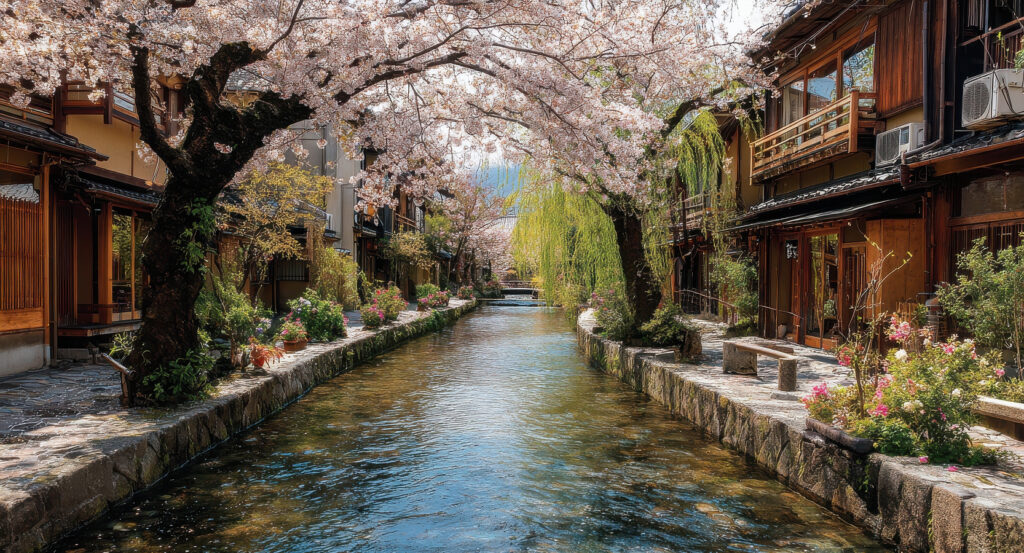
Why Hanamikoji Street matters.
Hanamikoji Street is the living soul of Gion, a single lane where Kyoto's most elusive beauty walks in plain sight.
At twilight, the lanterns begin to glow like suspended fire, casting the narrow cobblestone street in a soft amber haze. The wooden machiya houses that flank the path seem to hum with memory, sliding doors whisper open, the scent of cedar and roasted tea drifts through the air, and laughter rises briefly before disappearing behind bamboo blinds. The street's name means Flower Viewing Lane, and it captures that same fleeting, poetic spirit: beauty meant to be seen, not held. As you walk, you might hear the faint pluck of a shamisen or the soft click of okobo sandals echoing from an unseen alley. Then, like an apparition, a maiko passes, her kimono catching the lantern light, her movements silent and precise. In that moment, centuries collapse into the present. Hanamikoji doesn't perform for visitors; it simply continues to exist, untouched by time's impatience, holding Kyoto's rhythm between dusk and dream.
What defines Hanamikoji Street.
Hanamikoji's history is inseparable from Gion's, it began not as a tourist path but as a lifeline for culture.
Dating back to the Edo period, the street once connected travelers arriving from the Kamo River to Yasaka Shrine, serving as the spiritual artery of eastern Kyoto. Over the centuries, it evolved into the heart of the hanamachi, the geisha district, where teahouses (ochaya) and restaurants (ryotei) became stages for the city's quietest art forms. The machiya architecture that lines Hanamikoji today is meticulously preserved: two-story wooden townhouses with clay-tiled roofs, latticework façades, and noren curtains marking each establishment's entrance. Many of these buildings have been owned by the same families for generations, their identities unadvertised, their doors opening only by introduction. This secrecy isn't exclusion, it's etiquette. Within these walls, the art of conversation, gesture, and silence are as refined as any performance on stage. Few realize that Hanamikoji also mirrors Kyoto's own philosophy of impermanence: every evening brings a different composition of light, sound, and scent, and no two walks are ever the same. Beneath the surface of its beauty lies discipline, an invisible structure of tradition that allows grace to appear effortless.
How Hanamikoji Street fits.
To experience Hanamikoji Street properly, timing and intention matter.
Arrive near sunset, when the daylight thins and the lanterns ignite, softening every shadow. Begin at Shijo Avenue and move slowly south toward Kennin-ji Temple, among Kyoto's oldest Zen temples, marking the street's quiet end. Walk. Let your senses lead: the warmth of sake drifting from open doors, the echo of geta sandals on stone, the faint chill of evening mist rolling from the canal. If you're lucky, you might glimpse a maiko or geiko crossing between teahouses, her pace unhurried but absolute. Do not chase or photograph, this is not spectacle; it's ritual. Instead, stop at a small restaurant or sweets shop and sit near the window, watching the street's rhythm unfold. Visit again early in the morning when the lanterns are dark and the stone is slick with dew; the street feels entirely reborn, as if waiting for night to bloom again. Hanamikoji isn't just the centerpiece of Gion, it's the district distilled to a heartbeat. To walk it is to understand Kyoto itself: quiet, deliberate, ephemeral, and endlessly alive.
Where your story begins.
Foresyte Travel reveals places that feel extraordinary long before you arrive.
Enjoy editorial crafted for luxury travelers.
Foresyte may earn a commission when you book.

















































































































