Why Palazzo Venier dei Leoni matters.
Palazzo Venier dei Leoni is Venice's unfinished symphony, a fragment so perfect it never needed completion.
Low, wide, and luminous along the Grand Canal, it defies the vertical ambition of its neighbors. While other palaces reach upward, this one stretches horizontally, breathing with the rhythm of the water. Its pale Istrian stone façade seems to glow even in shadow, its restrained elegance making the surrounding city look almost theatrical by comparison. Standing before it, you sense the pause between two notes, the serenity of something left incomplete on purpose. This is Venice at its most human: brilliant, imperfect, eternal.
What defines Palazzo Venier dei Leoni.
The palace began as a dream of grandeur and ended as a statement of grace.
Commissioned by the noble Venier family in the mid-18th century, it was designed by architect Lorenzo Boschetti to rise five stories high, a palatial monument intended to assert lineage and wealth. Yet construction stopped after the first level, leaving behind a foundation. Whether halted by political tension, financial strain, or a family feud, history never settled on the reason. What remained was an accidental masterpiece: a palace that whispered. For centuries, it stood quietly on the canal, half-finished but wholly magnetic. Then, in the 20th century, it found its destiny. The palace passed through a sequence of visionary owners, each recognizing its peculiar poetry, until it came into the hands of the renowned collector Peggy Guggenheim in 1949. Here, she created a home for the avant-garde, a sanctuary for art that defied convention as much as the palace itself. Beneath its modest façade, she assembled one of the most significant collections of modern art in the world, works by Picasso, Pollock, Dalí, and Miró, filling the rooms once meant for marble columns with color, abstraction, and daring. Palazzo Venier dei Leoni became a paradox made perfect: an unfinished building completed by imagination.
How Palazzo Venier dei Leoni fits.
Begin your approach from the water, it's the only way to understand its proportions.
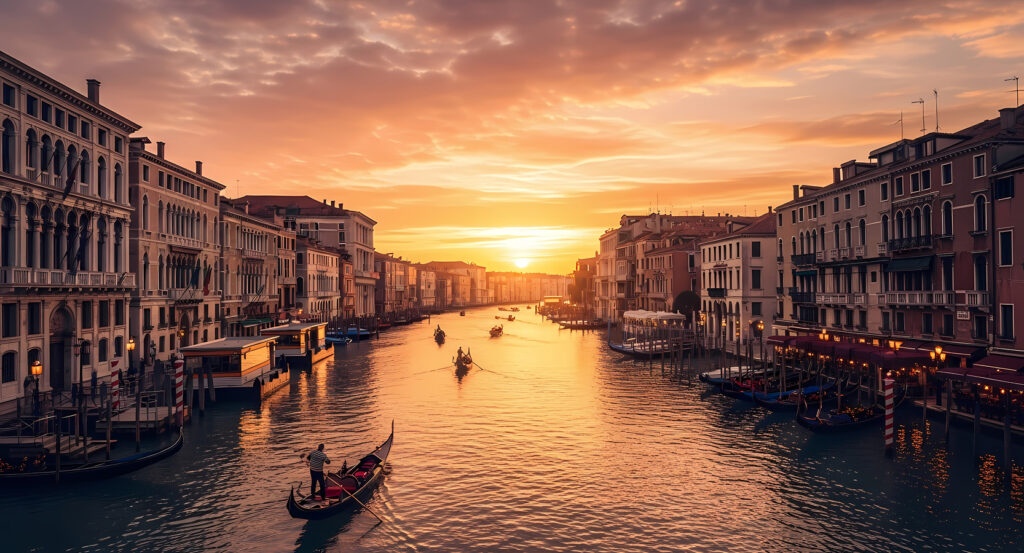
As the vaporetto glides down the Grand Canal, the palace reveals itself slowly, its low façade mirrored in the rippling current. From this angle, you can see how its simplicity sets it apart, the voids between its windows as deliberate as brushstrokes. Disembark at the nearby Accademia stop and follow the narrow calle to the entrance courtyard, where vines drape over stone and light spills across sculpture. Inside, the experience deepens: rooms unfold with quiet precision, each one holding its own discussion between the past and the present. The architecture remains Venetian, arched windows, terrazzo floors, the gentle hum of the canal beyond, but the spirit inside is rebelliously modern. Step into the garden and you'll find an oasis of calm: white marble paths winding through sculptures by Brancusi, Giacometti, and Moore. Sit for a moment at the balustrade overlooking the water, where Peggy herself once read, dreamed, and plotted the future of art. The city moves on without hurry around you, gondolas tracing the same curve that painters once tried to capture. Visit in the early evening, when the façade blushes gold and the water darkens to indigo, the hour when Venice and the palace seem to share a single heartbeat. To stand here is to understand what Venice teaches better than anywhere else: that beauty is not always about completion, but about devotion to what endures.
Where your story begins.
Foresyte Travel reveals places that feel extraordinary long before you arrive.
Enjoy editorial crafted for luxury travelers.
Foresyte may earn a commission when you book.