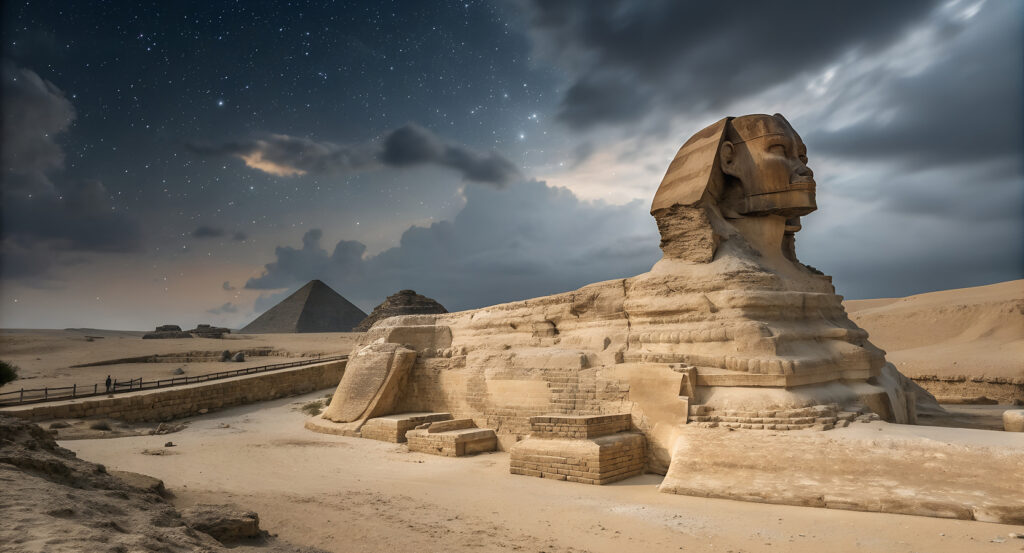
Why you should experience Sphinx Temple in Giza, Egypt.
Sphinx Temple lies at the very threshold between earth and eternity, an open-air sanctuary where the desert itself seems to hum with memory.
Resting just before the colossal paws of Great Sphinx, the ruins might appear humble at first glance, but step closer and their power becomes undeniable. Giant blocks of rose-hued limestone and Aswan granite rise in measured harmony, their surfaces smoothed with the same precision that shaped the pyramids. The structure feels both primal and mathematical, a place designed not to impress the eye, but to balance heaven and earth. As you stand among its weathered columns, the alignment of stone and sunlight begins to reveal itself: shafts of light striking ancient thresholds, corners perfectly oriented to the cardinal points. The wind moves through the gaps like a whisper of prayer, and every surface glows with the faint warmth of centuries. Here, Sphinx Temple isn't just a ruin, it's an instrument, one that once measured time by light and shadow, turning each sunrise into a sacred act of resurrection.
What you should know about Sphinx Temple.
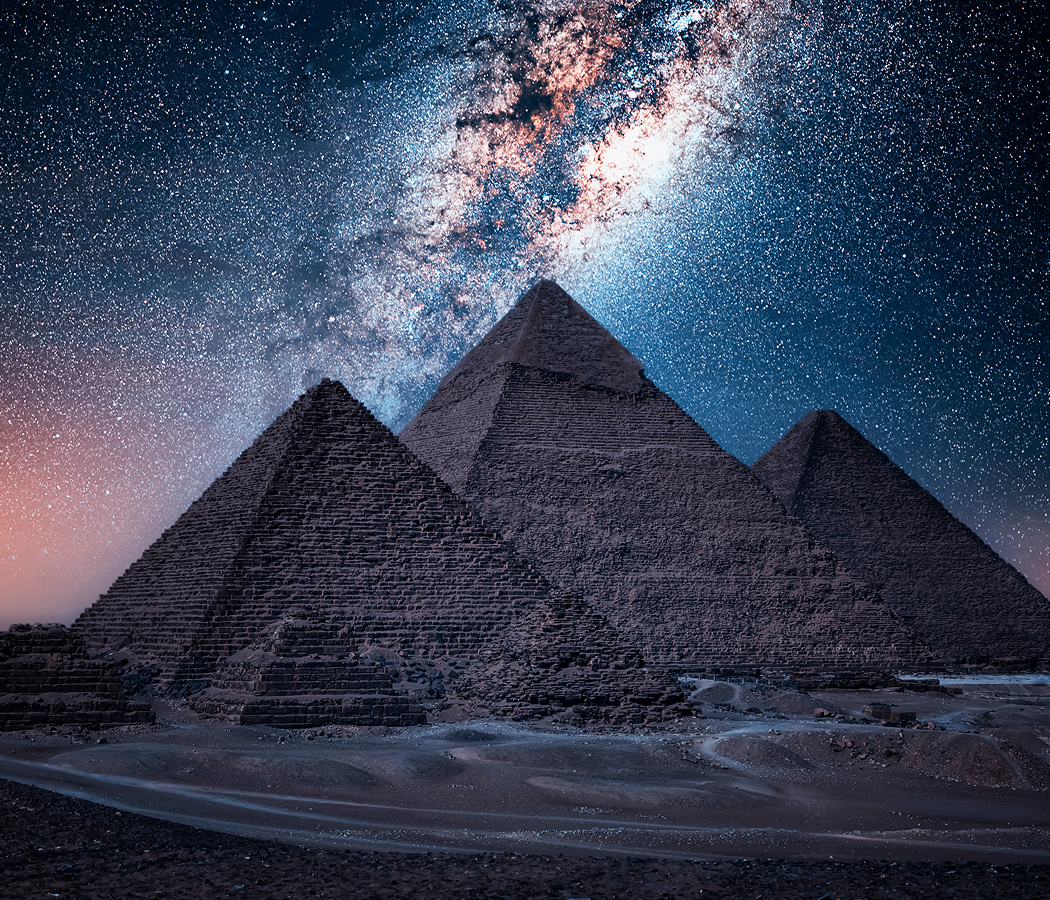
Sphinx Temple, dating to around 2500 BCE, is among the oldest and most architecturally mysterious structures on the Giza Plateau, built during the reign of Pharaoh Khafre, who also commissioned both the Great Pyramid's successor and Great Sphinx itself.
Archaeological evidence suggests that the temple was constructed from massive limestone blocks quarried directly from the bedrock surrounding Great Sphinx, some weighing more than 200 tons, making it among the earliest examples of megalithic precision in Egypt. Unlike later temples, it has no inscriptions, reliefs, or hieroglyphs; its purity of form is its message. The layout is a masterpiece of symmetry: twin entrances aligned east, west, leading into a central court once lined with twenty-four granite pillars that framed the rising and setting sun. Each pillar mirrored the cycle of hours in a day, a cosmic metaphor for eternal renewal. The temple's proximity to the Valley Temple of Khafre and Great Sphinx Enclosure suggests it played a dual role: both a solar shrine and a ceremonial station for the Pharaoh's resurrection rites. Excavations in the 19th and 20th centuries uncovered basalt flooring and traces of alabaster offering tables, hinting at rituals conducted here long before the concept of the afterlife was codified in hieroglyphic texts. Some archaeologists believe Great Sphinx and its temple were carved as a unified project, making this one of the earliest architectural compositions in history where monument and ritual space were designed as one. Despite erosion and time, Sphinx Temple continue to challenge assumptions, their silence and mathematical precision raising as many questions as they answer.
How to fold Sphinx Temple into your trip.
A visit to Sphinx Temple offers something rare in Giza, a chance to stand in a sacred space that still feels alive with purpose.
Access to the ruins is included with general entry to Great Sphinx area via the Valley Temple entrance off Al Haram Street. After exploring the Sphinx enclosure, walk a few meters west, the temple's massive stone walls emerge beside you, their geometry unmistakable even in decay. The best time to visit is in early morning or late afternoon, when the low light grazes the granite and reveals the subtle tool marks left by ancient craftsmen. Walk slowly through the central court, noting how the walls catch and frame the sun, an effect intentional, turning the temple into a calendar of light. Photography is permitted, but take a moment without the view to absorb the acoustics: even the faintest sound seems amplified, as if the space itself was designed to carry the voices of priests chanting in rhythm with the dawn. Spend about 30 to 45 minutes here before continuing to the nearby Khafre Valley Temple, whose interior preserves similar architectural principles in more complete form. For a panoramic perspective, climb to the viewing terrace near the Sound and Light Show seating area, from there, you can see Great Sphinx, its temple, and the Khafre Pyramid aligned in a single breathtaking axis. Sphinx Temple isn't grand in scale, but in feeling, a place where architecture dissolves into alignment, and the boundary between stone and spirit becomes im thin.
Where your story begins.
Foresyte Travel reveals places that feel extraordinary long before you arrive.
Experience premium editorial crafted for luxury travelers.