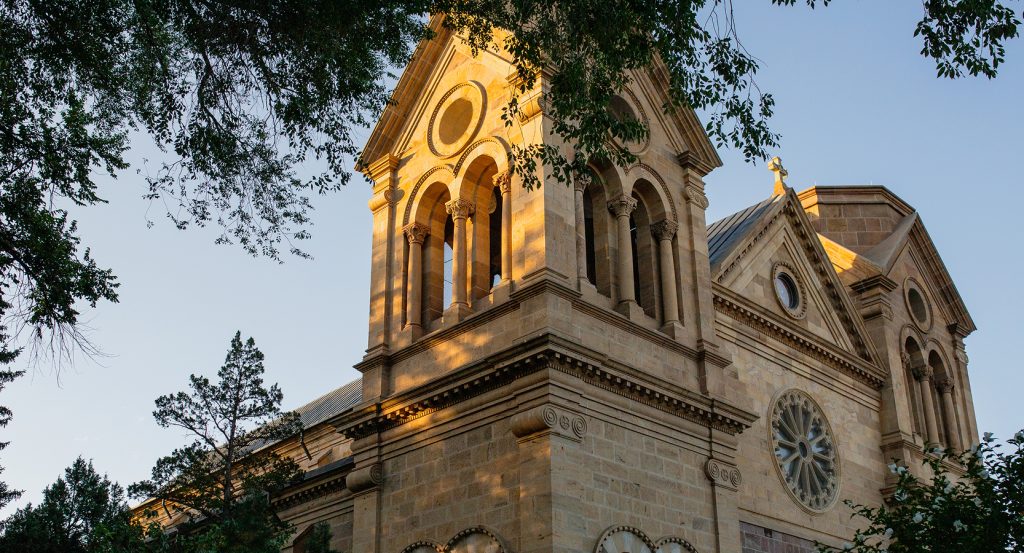
Why you should experience Inn of the Turquoise Bear in New Mexico.
Inn of the Turquoise Bear is a place governed by memory rather than momentum, where history, intimacy, and deliberate stillness create a stay that feels personal, contained, and emotionally weighted rather than performative or trend-aware.
Set along a quiet stretch of Canyon Road, the inn exists slightly outside Santa Fe's public performance. Arrival does not feel like entering a hotel; it feels like being admitted into a private household with a long past. The adobe exterior is understated and domestic, offering no performance and no announcement. That restraint is the signal. Inside, the environment immediately contracts in scale and tempo. Sound drops. Movement slows. The architecture encourages pause through narrow passages, layered rooms, and short sightlines that prevent visual sprawl. Fireplaces anchor the space, not decoratively. The inn's common rooms feel lived-in rather than curated, furnished with a sense of accumulation instead of design intent. You are not meant to pass through quickly. You are meant to settle. Guest rooms continue this inward-facing logic. Each room is distinct, shaped by the building's evolution. Beds are substantial and reassuring, designed to support deep, uninterrupted sleep. Furnishings favor warmth and permanence, wood that shows age, textiles with weight, lighting that softens. Fireplaces are central to the experience, changing the room's resonant temperature once evening arrives. Bathrooms are intimate and functional, supporting slow routines. Throughout the property, the experience feels private and deliberately insulated. Staying at Inn of the Turquoise Bear feels like being held within Santa Fe.
What you should know about Inn of the Turquoise Bear.
Inn of the Turquoise Bear is defined by continuity, of ownership, atmosphere, and intention, and that continuity is what gives the inn its uncommon resonant gravity.
Unlike properties that reinvent themselves every decade, the Turquoise Bear has preserved its character through accumulation. Rooms retain their individuality. Furnishings remain meaningful. The inn resists modern hospitality's impulse toward neutrality, choosing instead to honor personal history and idiosyncrasy. This choice creates an environment where time does not flatten. You feel the presence of past guests, conversations, and seasons, not as nostalgia, but as texture. Another underappreciated strength lies in how the inn manages exposure. Canyon Road is one of Santa Fe's most visited cultural corridors, yet the inn is oriented inward. Courtyards, walls, and room placement buffer sound and sight so effectively that the surrounding activity becomes abstract. This allows guests to engage with the city selectively. Service culture reinforces this sense of refuge. Interactions are warm, personal, and measured, shaped by long familiarity with the property and its rhythms. Guidance tends to be intuitive and situational, suggestions based on mood, light, or energy. There is an understanding that guests here are seeking something quieter and more inward than Santa Fe's public face. Over multiple nights, the inn's impact compounds. Sleep deepens. Attention narrows. The world outside begins to feel optional. The Turquoise Bear does not compete for relevance or novelty. It remains itself, and that steadiness becomes its luxury.
How to fold Inn of the Turquoise Bear into your trip.
Inn of the Turquoise Bear works best when you allow Santa Fe to unfold as a series of returns rather than a continuous outward push, using the inn as a place to withdraw to repeatedly rather than a base to abandon each morning.
Begin days quietly. Let breakfast happen slowly. From the inn, Canyon Road's galleries are immediately accessible, allowing you to engage briefly and return. This proximity changes behavior. You browse. You leave when curiosity wanes. Midday returns are essential. After navigating Santa Fe's light, altitude, and visual density, the inn absorbs stimulus quickly. Sit by the fire. Read. Do nothing. This rhythm, out, back, out again, keeps energy intact. Afternoons invite selectivity. Choose fewer destinations. Linger longer. Walk residential streets where Santa Fe feels lived-in. Because the inn does not impose activity, your time feels self-directed. Evenings are where the Turquoise Bear becomes most itself. Firelight replaces daylight. Silence deepens. The city recedes. Returning after dinner feels like crossing a threshold. Over several nights, Santa Fe begins to feel intimate. You stop scanning and start noticing. The trip becomes less about accumulation and more about presence. Inn of the Turquoise Bear does not attempt to frame Santa Fe or narrate it for you. It creates a condition, quiet, continuity, and containment, where meaning can surface on its own terms.
Where your story begins.
Foresyte Travel reveals places that feel extraordinary long before you arrive.
Experience premium editorial crafted for luxury travelers.