Why you should experience Jumeirah Mosque in Dubai, United Arab Emirates.
Jumeirah Mosque is Dubai’s bridge between worlds, an invitation to experience the soul of the city beyond its glittering skyline.
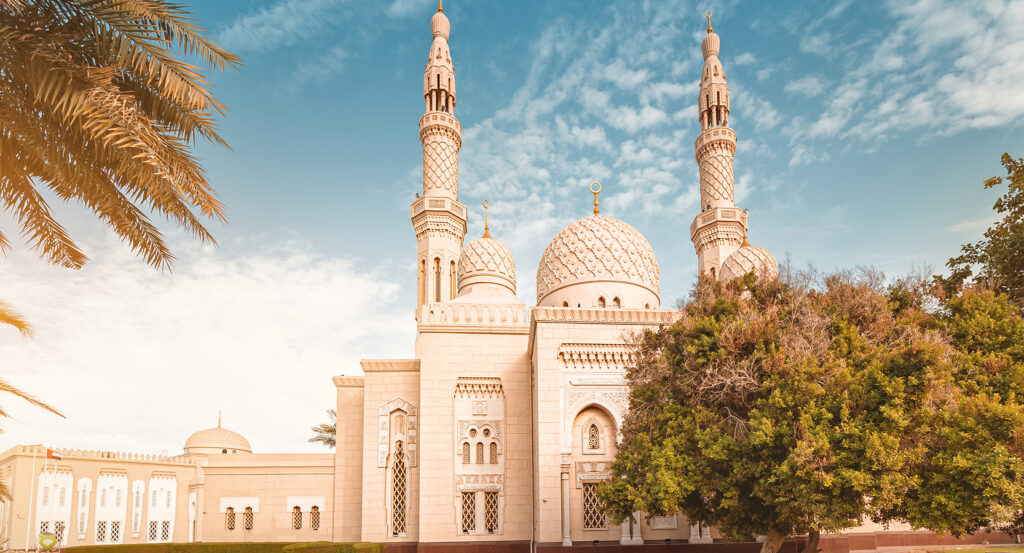
Set along the palm-lined streets of Jumeirah, this stunning white-stone mosque rises in elegant contrast to the modern towers that define Dubai today. Its two slender minarets and central dome gleam in the desert light, reflecting both simplicity and sophistication. Built entirely from white sandstone in the traditional Fatimid style, the mosque's design draws from medieval influences that trace back to Syria and Egypt, yet it carries a distinctly Emirati warmth. Commissioned by the late Sheikh Rashid bin Saeed Al Maktoum and completed in 1979, it stands not just as a place of worship but as a symbol of inclusivity, one of the few mosques in the UAE open to non-Muslim visitors. Step through its arched entrance and the air shifts: ornate calligraphy and geometric carvings bloom across the walls, soft carpets line the floor, and filtered light spills from stained glass into a space that feels calm and endless. When the muezzin's call to prayer rises through the air, it reverberates through the domes like a melody of devotion. In a city often defined by speed and spectacle, Jumeirah Mosque reminds you that its heart beats quietly in rhythm with faith, tradition, and hospitality.
What you didn’t know about Jumeirah Mosque.
Beneath its serene beauty lies a story of purpose, a conscious effort to connect cultures through understanding.
Jumeirah Mosque is one of the rare religious landmarks in the Middle East that explicitly invites visitors of all backgrounds to explore and learn about Islam firsthand. The Sheikh Mohammed Centre for Cultural Understanding (SMCCU) hosts daily “Open Doors, Open Minds” tours here, offering a candid, welcoming look into Emirati faith and life. Guides lead visitors through the rituals of prayer, explain the significance of architecture and symbolism, and answer any question with warmth and candor. This ethos of openness has made Jumeirah Mosque not just a landmark, but a living classroom of cultural dialogue. Architecturally, the mosque is modeled after the Fatimid mosques of Cairo, featuring intricate carvings, hand-painted floral details, and a central dome surrounded by semi-domes that draw the eye upward in graceful succession. Each element reflects unity and symmetry, key principles in Islamic art meant to echo divine order. At dusk, the mosque glows a soft gold as lights illuminate its carved façade, giving it an almost ethereal presence against the twilight sky. Few realize that the structure was one of the first in Dubai built entirely with local craftsmanship, combining traditional artistry with modern materials to withstand the desert's harsh climate. Inside, the mihrab, a semicircular niche indicating the direction of Mecca, is a masterpiece of marble and mosaic, while the chandelier overhead sparkles like captured starlight. During Ramadan, the mosque becomes a hub of generosity, hosting communal iftars that welcome both Muslims and non-Muslims to share in the breaking of the fast. It's this balance of reverence and inclusivity that gives the mosque its rare magic, a place where faith feels both timeless and inviting.
How to fold Jumeirah Mosque into your trip.
To truly experience Jumeirah Mosque, come with an open heart and curiosity, it's less about sightseeing and more about connection.
Plan to join one of the guided tours organized by the SMCCU, typically held mid-morning or early afternoon, when sunlight streams through the arches and fills the courtyard with warmth. The tours last about 75 minutes and begin with a traditional Emirati welcome: Arabic coffee and dates served as you sit cross-legged on the carpet, listening to stories about local culture, faith, and daily life. Visitors are encouraged to ask any question, about Islam, prayer, clothing, or customs, in an environment of total openness. Modest attire is required (shoulders and knees covered), though abayas and scarves are provided at the entrance if needed. After the orientation, step into the main prayer hall and look upward, the interplay of light and shadow across the dome's interior is mesmerizing, shifting from soft gold to cool ivory as the sun moves. Take time to observe the architectural details up close, the calligraphy, the arches, the latticework, each telling a story of devotion through design. After your visit, stroll along Jumeirah Beach Road, where the mosque's silhouette reflects beautifully in nearby glass façades, symbolizing Dubai's balance between heritage and modernity. Sunset is perhaps the most breathtaking time to return, as the sky deepens into amber and the mosque glows like a lantern against the horizon. Pair your visit with a walk along nearby La Mer Beach or a quiet meal at one of the Emirati restaurants near the coast to round out an afternoon that connects the spiritual and the sensory. Jumeirah Mosque isn't merely a monument, it's a mirror of Dubai's spirit: open, elegant, and profoundly human. Beneath its domes, cultures meet, questions find answers, and beauty transcends belief. To stand here as the call to prayer drifts into the sea breeze is to feel the city's truest rhythm, one that begins not in the skyline, but in the heart.
Hear it from the Foresyte community.
Just enough life around you not to be overwhelming. Right pace.
Where your story begins.
Start your planning journey with Foresyte Travel.
Experience immersive stories crafted for luxury travelers.