
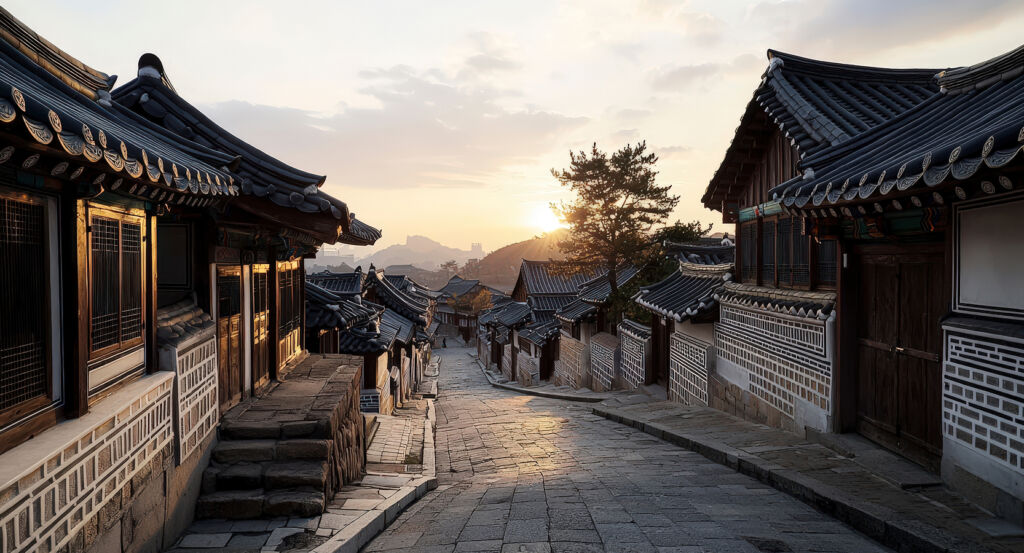
Why Jung-gu matters.
Jung-gu is the historic and civic heart of the South Korean capital, where royal heritage, national landmarks, and modern urban life converge within one of the most important districts in the nation.
Palaces, historic gates, government institutions, cultural landmarks, traditional markets, luxury hotels, and iconic commercial corridors create a district that has stood at the center of Korean history for centuries. As the historic core of Seoul, the area emerged as a political, administrative, and commercial center during the Joseon Dynasty, attracting monarchs, officials, merchants, scholars, and diplomats from across the Korean Peninsula and beyond. Successive generations enriched the district with royal architecture, civic monuments, cultural institutions, and commercial hubs that continue to define the character of modern Seoul. Today, visitors encounter a district where nearly every landmark reflects a different chapter of Korean history. The result is a neighborhood that feels monumental, influential, and unmistakably Korean. To the west, Mangwon-dong's celebrated neighborhood markets, riverside parks, and community spaces extend naturally from Jung-gu across one of Seoul's most diverse urban landscapes, reinforcing the district's role as the symbolic center of the capital. Every palace gate, boulevard, and public square reflects a district shaped by leadership, culture, and national significance.
What defines Jung-gu.
Jung-gu is best known for being home to Namdaemun, the oldest wooden gate in Seoul and the first National Treasure designated by the Republic of Korea.
Originally completed in 1398 during the early years of the Joseon Dynasty, Namdaemun served as the principal southern gate of Seoul's fortified city walls and became one of the most important symbols of the Korean capital. For centuries, merchants, diplomats, travelers, and residents passed through the structure as the city expanded around it. Its architectural significance, historical importance, and enduring role within Korea character led the government to designate it as National Treasure No. 1 upon the establishment of the modern national treasures system. Despite periods of damage and restoration, the gate remains one of the country's most revered landmarks. Today, it stands as a powerful symbol of continuity between Korea's past and present. Few districts possess a landmark so closely associated with the heritage of an entire nation.
How Jung-gu fits.
Jung-gu works as an exploration of the historic landmarks, cultural institutions, and civic destinations that define the center of the Korean capital.
Begin at Namdaemun, where the neighborhood's defining connection to Korean history and national character immediately comes into focus. Continue toward Myeongdong Cathedral, whose architectural significance and historic role reveal the cultural and social forces that shaped the district for generations. From there, make your way to N Seoul Tower, where panoramic views and iconic surroundings provide a broader perspective on the historical and civic significance that continues to define Jung-gu today. Along the route, you'll encounter historic gates, religious landmarks, commercial corridors, cultural institutions, public plazas, architectural icons, and celebrated urban destinations that reveal the district's extraordinary depth. The progression moves naturally from national landmark to cultural landmark to panoramic icon, revealing the forces that shaped the neighborhood. The experience showcases a side of Seoul defined by history, leadership, and some of the most important landmarks in South Korea.
Where your story begins.
Foresyte Travel reveals places that feel extraordinary long before you arrive.
Enjoy editorial crafted for luxury travelers.
Foresyte may earn a commission when you book.

















































































































