Why Les Amis matters.
Les Amis is a three-MICHELIN-starred French haute cuisine restaurant where Orchard Road's luxury dining culture meets Singapore's independent fine-dining heritage, classical French culinary craftsmanship and one of Asia's most accomplished traditions of wine service.
Set at Shaw Centre along Scotts Road near its junction with Orchard Road and a short walk from Orchard MRT station, the restaurant occupies the ground floor of a commercial complex between the district's principal luxury shopping avenues and adjoining hotel properties. Its entrance opens into a formal dining room arranged around generously spaced tables, upholstered seating and a restrained decorative palette. A mezzanine level accommodates private dining, extending the restaurant's capacity for discreet gatherings. The interior incorporates dedicated wine storage and a chef's table, establishing separate settings for dining, collection and culinary observation. The result is a carefully organized restaurant whose central commercial location and intimate interior support the measured service associated with French haute cuisine.
What defines Les Amis.
Les Amis is best known for Desmond Lim, Justin Quek, Ignatius Chan and Chong Yap Seng establishing Singapore's first independent fine-dining restaurant in 1994, challenging an industry in which elaborate European dining was concentrated inside luxury hotels. Lim's interest in French gastronomy had deepened during a 1984 journey through France, when he traveled between restaurants using the MICHELIN Guide as his reference. A decade later, the four founders combined financial backing, professional culinary expertise and specialist wine knowledge to create an establishment modeled on France's leading restaurants. Les Amis opened on March 15, 1994, with Quek directing the kitchen and Chan contributing the wine expertise that became central to the business. Its French name, meaning friends, acknowledged the personal relationships behind the partnership. The restaurant became a gathering place for Singapore's expanding community of serious diners during a period of rapid economic growth and increasing international culinary interest. Its commercial success provided the foundation for Les Amis Group, which subsequently developed restaurants across several cuisines and dining formats. A major expansion in 2007 incorporated adjoining second-floor premises, nearly doubling the original space through a S$2.5 million investment that introduced additional private dining facilities. The culinary leadership entered a new chapter in 2013 when Sébastien Lepinoy assumed responsibility for the kitchen following a career closely associated with Joël Robuchon. Lepinoy had spent seventeen years working within Robuchon's restaurant organization, including assignments in Hong Kong, where he developed extensive experience in the demanding preparation and presentation of classical French cuisine. His appointment strengthened the restaurant's commitment to specialist producers, formal kitchen discipline and the transmission of French culinary techniques to younger chefs. MICHELIN awarded Les Amis two stars in the inaugural Singapore guide in 2016, followed by a third star in 2019. The restaurant received the Art of Hospitality Award from Asia's 50 Best Restaurants in 2020, recognizing the service culture developed alongside its cooking. Its wine program also earned Wine Spectator's Grand Award, placing the establishment among an international group recognized for extensive collections and specialist wine service. The combination of three MICHELIN stars, five stars from Forbes Travel Guide and Wine Spectator's Grand Award gave Les Amis an unusual concentration of international distinctions across cuisine, hospitality and wine.
Sébastien Lepinoy's cooking begins with the selection of exceptional French ingredients and develops their natural qualities through the precise sauces, controlled temperatures and disciplined preparation of classical haute cuisine. The kitchen's commitment to French provenance makes the origin and seasonal condition of the principal ingredient decisive in determining the finished composition. Breton shellfish demonstrates that approach particularly clearly, as langoustines and crab possess delicate sweetness that becomes obscured under excessive heat or heavy seasoning. A preparation of Loctudy langoustine uses the shellfish's tender flesh as the foundation for a carefully balanced olive-oil emulsion, allowing richness to develop around its marine sweetness. Acidity then sharpens the finish, preserving the distinction between the seafood and the accompanying sauce. The same control becomes more demanding with substantial fish, where the kitchen must coordinate surface cooking, internal moisture and the concentration of a classical reduction. Wild turbot from Île d'Yeu has appeared with Printanière sauce, connecting the fish's firm, yielding flesh to the freshness of spring vegetables. Its preparation demonstrates how Lepinoy builds complexity through the relationship between a principal ingredient and a supporting sauce, keeping their textures individually recognizable. Meat courses deepen that approach through roasting and resting, allowing natural juices to concentrate before a carefully reduced jus completes the preparation. Aveyron lamb introduces a different balance of tenderness, roasted fat and savory intensity, with sweet peppers providing a contrasting vegetal note. The accompanying wine service develops in parallel, drawing upon a collection exceeding 1,800 selections and concentrating heavily on Burgundy and Bordeaux. Burgundy provides opportunities to explore the relationship between acidity, aromatic detail and delicate preparations, and Bordeaux introduces the structure suited to richer meat courses. Sommeliers coordinate vintages, serving temperatures and glassware with the changing character of the meal, making the movement between dishes and wines an essential component of its pacing. French cheese service extends that attention to regional production, maturation and the sequence of flavor before pastry concludes the meal. Cheryl Koh's desserts bring the same technical discipline to fruit, dairy and sugar, using carefully balanced sweetness and texture to complete the sequence. Les Amis develops French haute cuisine as a continuous relationship between ingredient selection, controlled cooking, classical sauce work and wine service, preserving the depth of the tradition through precise execution at the table.
How Les Amis fits.
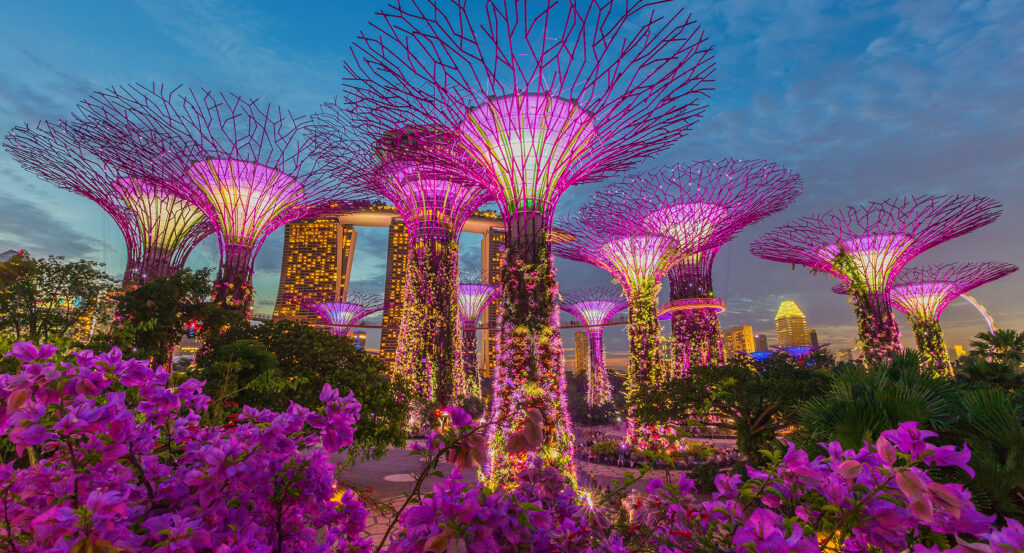
Les Amis works as the culinary centerpiece for a Singapore itinerary connecting the preservation of historic residential architecture, the scientific development of tropical horticulture and the institutional history of the modern city-state.
Begin at Emerald Hill, the residential enclave adjoining Orchard Road whose surviving shophouses preserve an important chapter in Singapore's nineteenth-century urban development. The district was developed on land associated with the former nutmeg plantations that preceded the commercial expansion of the surrounding area. Its residential buildings incorporate elements of Chinese Baroque architecture, including ornamental plasterwork, shuttered windows, decorative tiles and covered five-foot ways. Many houses feature narrow frontages extending into deeper interior spaces organized around courtyards. The preservation of these buildings provides a close architectural contrast to the adjoining shopping district, revealing an earlier pattern of residential development within Central Singapore. Continue to Singapore Botanic Gardens, established in 1859 and inscribed on the UNESCO World Heritage List in 2015. The gardens became an important center for tropical botanical research under directors including Henry Nicholas Ridley, whose work on rubber cultivation contributed to the expansion of plantation agriculture across Southeast Asia. Its landscaped grounds contain extensive collections of palms, tropical trees and flowering plants, alongside historic buildings associated with scientific research. The National Orchid Garden preserves an extensive collection of orchid species and hybrids, including cultivars named in honor of visiting international dignitaries. The gardens connect Singapore's horticultural heritage with the agricultural developments that shaped the wider region. Conclude at National Museum of Singapore, the country's oldest museum institution, whose origins lie in the nineteenth-century Raffles Library and Museum. Its principal building opened in 1887, incorporating a neoclassical façade, a central dome and architectural detailing associated with British colonial civic institutions. The museum's collections examine Singapore's political and social development through historical objects, photographs and installations. A major redevelopment completed in 2006 integrated contemporary exhibition spaces with the preserved historic structure. Its permanent galleries trace the development of the island through colonial administration, Japanese occupation, independence and subsequent national growth. The progression moves from preserved residential architecture through the scientific cultivation of tropical landscapes and culminates in the historical collections documenting Singapore's development into an independent city-state.
Where your story begins.
Foresyte Travel reveals places that feel extraordinary long before you arrive.
Enjoy editorial crafted for luxury travelers.
Foresyte may earn a commission when you book.