Why you should experience Mauvoisin Dam in Switzerland.
Mauvoisin Dam in Val de Bagnes, Switzerland, isn't just an engineering marvel, it's a cathedral of concrete and silence carved into the heart of the Alps.
Rising 250 meters above the turquoise waters of Lac de Mauvoisin, this sweeping arc of grey stone stands as one of the tallest arch dams in Europe, commanding a landscape so dramatic it feels almost lunar. Set deep in the upper reaches of the Bagnes Valley, above the last alpine villages and beneath a fortress of glacial peaks, Mauvoisin Dam feels like both a triumph of human will and a humble surrender to nature's scale. The first time you walk across its crest, the sensation is visceral, the wind whips off the lake, the drop vanishes into mist, and every sound seems to echo for miles. Behind the dam stretches a fjord-like reservoir of ice-blue water, fed by the Glacier de Giétro, whose meltwaters have shaped the valley for centuries. Below it lies a vast gorge, carved by centuries of roaring torrents. It's more than a dam, it's the intersection of raw geology, human ingenuity, and the timeless pulse of the mountains. In a region known for luxury chalets and ski lifts, Mauvoisin Dam reminds you of the other Verbier, the one that harnessed wild nature not to conquer it, but to coexist with it.
What you should know about Mauvoisin Dam.
Beneath its stillness, Mauvoisin Dam holds one of Switzerland's most fascinating, and turbulent, histories.
The story begins long before the concrete, in 1818, when a natural ice dam formed by the Giétro Glacier collapsed catastrophically, sending a torrent through the valley that destroyed villages and claimed over 30 lives. That tragedy became a turning point, prompting centuries of innovation in flood prevention and hydroelectric control. Construction of the current dam began in 1951, an audacious project that took seven years, thousands of workers, and grand effort at an altitude of nearly 2,000 meters. When completed in 1958, it stood as a symbol of postwar progress, a beacon of Swiss precision and perseverance. The dam forms part of a vast hydroelectric network that powers much of western Switzerland, storing nearly 200 million cubic meters of water drawn from glaciers and snowmelt. But beyond the numbers lies a deeper resonance, the dam stands at the meeting point of human survival and alpine beauty. Local artisans and historians often describe it as a “mountain within the mountain,” and when you step inside its interior tunnels, cool, echoing, and faintly damp, you understand why. Exhibits along the walkway detail the region's environmental evolution, from the Giétro disaster to the creation of modern hydro systems. Few visitors realize that the dam also helped preserve the valley's ecology, by regulating floods and supporting sustainable water flow to farms, it protected the fragile meadows that give Bagnes cheese its celebrated flavor. It's a place where power, both natural and manmade, feels sacred.
How to fold Mauvoisin Dam into your trip.
Visiting Mauvoisin Dam is an adventure that blends awe with quiet reflection, a must-see for anyone exploring Verbier or the broader Val de Bagnes.
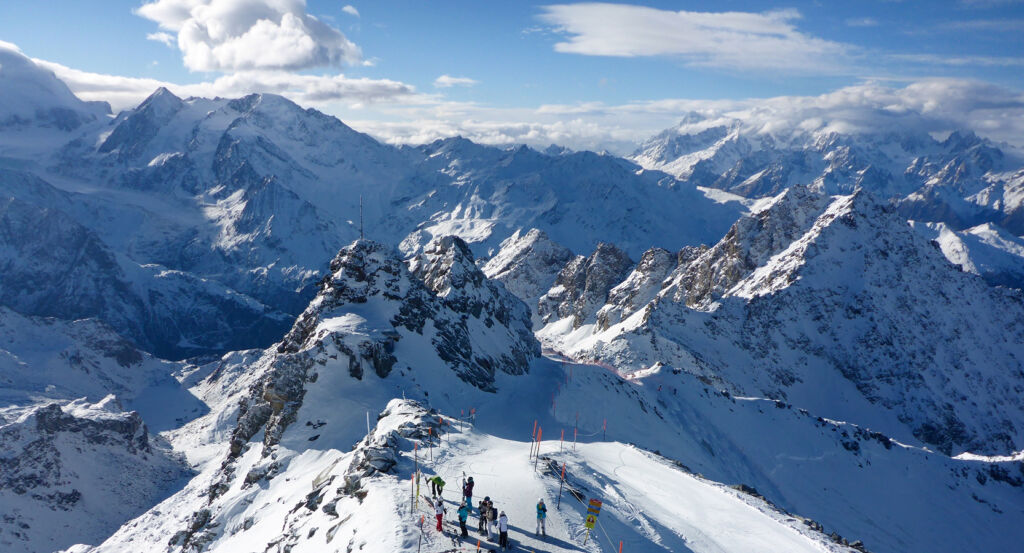
The journey begins with a breathtaking drive or bus ride from Le Châble through the valley's narrowing walls, where waterfalls spill from every ridge and the air grows thinner with every turn. The road ends at Fionnay, from which a short but dramatic hike leads you directly onto the dam's crest. Pause midway to look down the gorge, a dizzying 250 meters, before following the panoramic trail that winds along the reservoir's rim. In summer, the lake shimmers in impossible shades of turquoise, while the surrounding peaks, Mont Pleureur, Tournelon Blanc, and Grand Combin, loom like frozen sentinels. The trail continues beyond the dam into the high alpine wilderness, where suspension bridges, mountain huts, and even ibex sightings reward those who linger. For families, interpretive panels along the walkway tell the story of the Giétro disaster and the engineering feats that turned catastrophe into sustainability. In autumn, when the valley quiets and the larches turn gold, the reflection of the dam on the still water creates a surreal symmetry, as if nature and humankind finally found balance. If you visit in winter, the road closes partway, but the snowshoe route from Bonatchiesse turns the dam into a pilgrimage site, a vast, silent monolith under a frozen sky. Before leaving, step inside the small exhibition tunnel built into the structure's flank, where blue lights and historical photos trace the dam's creation. When you emerge back into daylight, the sound of the wind through the valley feels almost like applause, not for what we built, but for what we learned to build with.
Where your story begins.
Foresyte Travel reveals places that feel extraordinary long before you arrive.
Experience premium editorial crafted for luxury travelers.