
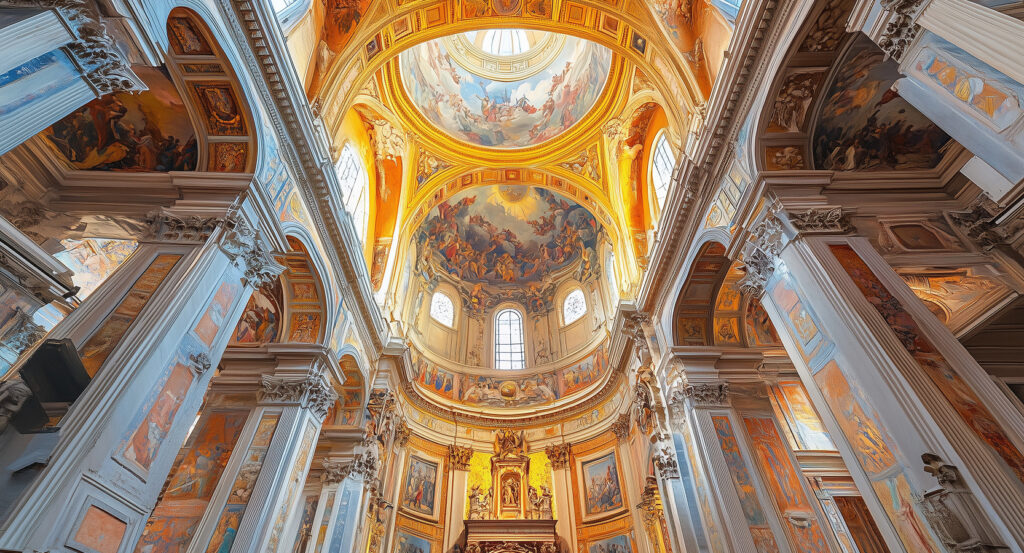
Why you should experience Cappelle Medicee in Florence, Italy.
Cappelle Medicee is a dynastic mausoleum where San Lorenzo's Medici legacy, Renaissance genius, sculptural mastery, and Florentine ambition converge within one of Italy's greatest artistic achievements.
Set along Piazza di Madonna degli Aldobrandini near Piazza di San Lorenzo and just steps from Basilica di San Lorenzo, this extraordinary funerary complex unfolds through soaring domes, richly inlaid marble, grand chapels, and some of Michelangelo's most celebrated sculptures that together immortalize the dynasty responsible for shaping Florence's political, artistic, and intellectual ascendancy. Every chamber reveals another expression of Medici patronage as architecture, sculpture, decorative stonework, and sacred symbolism unite beneath one of the city's most grand interior spaces. Monumental sarcophagi, luminous pietra dura, richly colored marbles, and harmonious Renaissance proportions continually reinforce the extraordinary wealth, influence, and artistic vision that transformed Florence into the cradle of the Renaissance. The experience ultimately combines artistic brilliance, dynastic history, and architectural innovation into one of Tuscany's most profound cultural destinations.
What you should know about Cappelle Medicee.
Cappelle Medicee is best known for preserving the burial place of the Medici dynasty through two of the Renaissance's greatest architectural achievements: Michelangelo's New Sacristy, commissioned in 1519 by Pope Leo X and Cardinal Giulio de' Medici, and the grand Chapel of the Princes, begun in 1604 under Grand Duke Ferdinando I de' Medici, together creating one of Europe's most ambitious dynastic mausoleums. Michelangelo designed the New Sacristy as a revolutionary synthesis of architecture and sculpture, creating the tombs of Lorenzo, Duke of Urbino, and Giuliano, Duke of Nemours beneath his celebrated allegorical figures Dawn, Dusk, Day, and Night, while the unfinished Madonna and Child with Saints Cosmas and Damian became one of the defining masterpieces of High Renaissance sculpture before the artist departed Florence permanently in 1534. The later Chapel of the Princes, designed principally by Matteo Nigetti following concepts developed by Don Giovanni de' Medici and Bernardo Buontalenti, rises beneath a dome approximately 59 meters high and showcases one of the world's most extraordinary displays of pietra dura, employing jasper, porphyry, lapis lazuli, mother-of-pearl, agate, chalcedony, coral, and numerous other precious stones painstakingly assembled by the Opificio delle Pietre Dure, the Medici grand-ducal workshop founded in 1588 that became Europe's foremost center for hardstone craftsmanship. Although conceived as the resting place for six Grand Dukes of Tuscany, only two grand sarcophagi contain human remains, while the remaining tombs serve primarily as symbolic monuments celebrating Medici authority and dynastic continuity. Integrated into the Basilica di San Lorenzo, itself begun by Filippo Brunelleschi in the early fifteenth century, the complex preserves centuries of Medici patronage that financed artists including Michelangelo, Donatello, Botticelli, Leonardo da Vinci, and Galileo Galilei, reflecting the extraordinary influence the family exerted over the political, scientific, religious, and artistic development of Renaissance Europe. Today the museum forms part of Italy's National Museums system, preserving one of the world's greatest collections of Renaissance funerary art, sculpture, architecture, and decorative stone craftsmanship.
Michelangelo fundamentally redefined Renaissance funerary architecture by dissolving the traditional boundary between sculpture and building, allowing grand figures to animate the surrounding architecture through dynamic poses, dramatic shadow, and profound psychological expression. The Chapel of the Princes extended that artistic ambition into the Baroque era through grand geometric harmony, sumptuous decorative programs, and technical achievements in stone inlay that required generations of craftsmen to complete. Every surface demonstrates exceptional precision as colored marbles, semiprecious stones, bronze ornament, sculpted allegories, and carefully proportioned architectural volumes celebrate both artistic excellence and Medici political authority. Every chapel, monument, and sculptural program reveals how dynastic ambition, artistic innovation, engineering mastery, and exceptional patronage transformed Cappelle Medicee into one of the most influential funerary complexes in Western art.
How to fold Cappelle Medicee into your trip.
Cappelle Medicee works as the centerpiece of an exploration through San Lorenzo's extraordinary Renaissance monuments and Medici heritage.
Begin at Basilica di San Lorenzo, where Brunelleschi's revolutionary architecture establishes the artistic significance of the Medici family's principal church before entering Cappelle Medicee to experience Michelangelo's sculptural masterpieces. Continue through Mercato Centrale Firenze, whose celebrated food hall and traditional market provide a spirited contrast to the solemn grandeur of the chapels while reflecting the neighborhood's enduring civic life. Conclude at Palazzo Medici Riccardi, where the Medici family's first great Renaissance palace completes the journey through the dynasty's extraordinary political, artistic, and architectural legacy. The progression moves naturally from sacred architecture to dynastic mausoleum before concluding at the family's original seat of power, revealing how Medici patronage permanently transformed Florence into the birthplace of the Renaissance.
Where your story begins.
Foresyte Travel reveals places that feel extraordinary long before you arrive.
Experience premium editorial crafted for luxury travelers.




















































































































