Why you should experience Mit Rahina Museum in Mit Rahina, Egypt.
The Mit Rahina Museum (Memphis Open Air Museum) in Cairo is a journey back to the cradle of Egyptian civilization, an open-air sanctuary where colossal statues and ancient relics whisper the stories of Egypt's first capital.
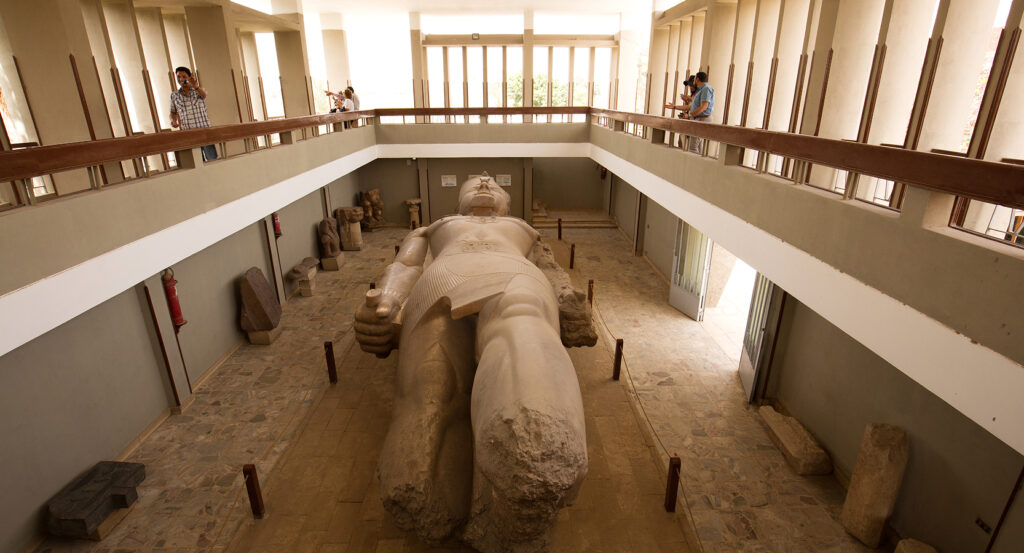
Located near the modern village of Mit Rahina, just south of Giza, this museum stands on the site of ancient Memphis, once the beating heart of the Old Kingdom and home to pharaohs who laid the foundation for one of history's greatest empires. Walking among the towering remnants of temples and deities, you can almost feel the pulse of a city that once rivaled the grandeur of Thebes and Alexandria. The museum's crown jewel, a massive, fallen statue of Ramses II carved from limestone, lies sheltered under a canopy, so perfectly detailed that even the folds of the king's kilt remain visible after more than 3,000 years. Surrounding it are sphinxes, altars, and fragments of grand columns, all displayed under open skies that have watched over Egypt since antiquity. It's less a museum in the conventional sense and more an ancient city breathing in slow motion, a timeless meeting of earth, stone, and memory.
What you should know about Mit Rahina Museum.
Beneath its tranquil exterior, the Mit Rahina Museum holds the key to understanding the dawn of Egyptian civilization.
Memphis, founded around 3100 BCE by King Menes (Narmer), was the first unified capital of Egypt, the political, cultural, and spiritual hub from which pharaohs ruled for centuries. The city was devoted to Ptah, the creator god and patron of craftsmen, whose temple once dominated the area. While most of ancient Memphis lies buried beneath the modern landscape, the open-air museum preserves what time and excavation have unearthed, fragments that still convey the city's grandeur. The highlight, Ramses II's immense statue, originally stood upright at the temple gate before sinking into Nile silt over the millennia. Nearby stands the Alabaster Sphinx of Memphis, a mysterious limestone sculpture thought to depict Queen Hatshepsut or Amenhotep II, a rare representation of royal power outside traditional pharaonic form. The site also reveals the remnants of workshops, shrines, and smaller sculptures that trace the evolution of Egyptian artistry across dynasties. Archaeologists continue to study the area, uncovering pottery shards, tools, and reliefs that paint a vivid picture of life in one of humanity's earliest metropolises. Unlike the grandeur of the pyramids, the Mit Rahina Museum feels intimate, almost meditative, a quiet conversation with the dawn of civilization itself.
How to fold Mit Rahina Museum into your trip.
Visiting the Mit Rahina Museum offers a chance to step beyond Cairo's bustle and into the serene silence of Egypt's ancient past.
Begin your journey in the morning, when the light casts golden hues across the statues and the surrounding palm groves sway in the breeze. The museum is about 20 miles (30 kilometers) south of Cairo and pairs naturally with a visit to nearby Saqqara, the site of the Step Pyramid of Djoser, and Dahshur, where the Bent and Red Pyramids rise from the desert horizon. At Mit Rahina, allow time to wander slowly among the artifacts; though compact, the site's open-air layout invites reflection. Stand beneath Ramses II's immense figure, admire the delicate polish of the Alabaster Sphinx, and trace the inscriptions carved by artisans thousands of years ago. The on-site guides are often local experts whose families have lived near these ruins for generations, adding a human thread to the story of a place older than recorded history. If you visit in the late afternoon, linger to watch the sunlight fade behind the palm-lined horizon, a fitting end to a day spent at Egypt's earliest capital. For travelers who want to feel the continuity of time, where the first kings of Egypt dreamed, built, and ruled, the Mit Rahina Museum is not just a site to see, but a sacred encounter with the origins of civilization itself.
Where your story begins.
Foresyte Travel reveals places that feel extraordinary long before you arrive.
Experience premium editorial crafted for luxury travelers.