Why you should experience Temple of Ptah at Mit Rahina Museum in Egypt.
The Temple of Ptah at Mit Rahina Museum, otherwise known as Memphis Open-Air Museum, is where the spirit of Egypt still stirs beneath the dust, the birthplace of gods, kings, and creation itself.
Set within the grounds of the Memphis Open-Air Museum, these scattered stones once formed the heart of ancient Memphis, Egypt's first capital and sacred center of the god Ptah, the divine craftsman who spoke the world into being. Standing among the remnants, you can almost feel the weight of millennia pressing through the ground: fragments of columns, crumbled walls, and foundation blocks that once supported one of the grandest temples of the Old Kingdom. The air hums with silence, broken only by the wind rustling through papyrus reeds. Though time has reduced the temple to ruins, its presence remains immense, an invisible architecture of memory and reverence. The ancients believed that Ptah's temple was where thought became form, and form became creation. To walk here, beneath the open Egyptian sky, is to walk across the blueprint of civilization itself.
What you didn't know about Temple of Ptah at Mit Rahina Museum.
The Temple of Ptah was the beating heart of Memphis, Egypt's legendary capital, founded around 3100 BCE by King Narmer, the unifier of Upper and Lower Egypt.
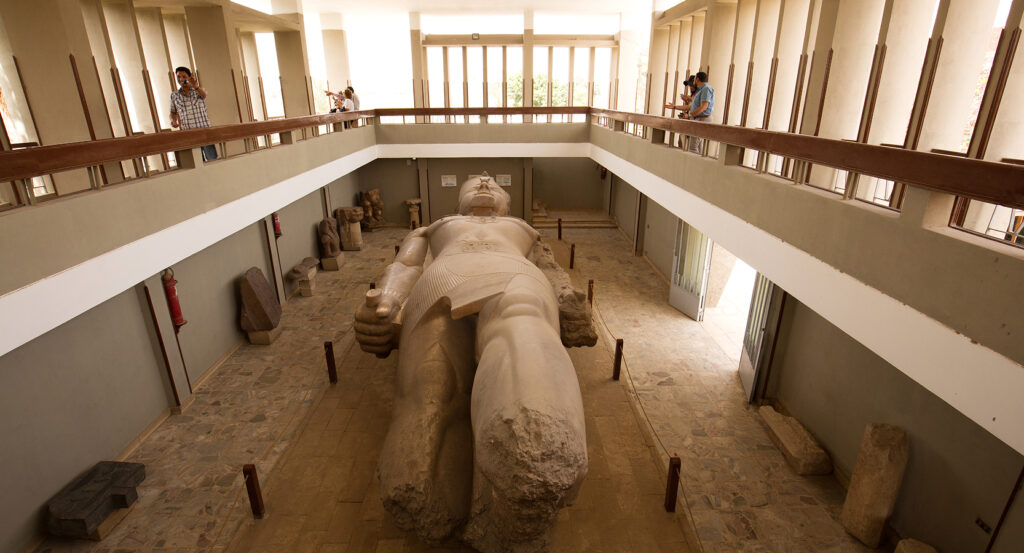
For more than 2,000 years, this temple stood as one of the most sacred sanctuaries in the country, dedicated to Ptah, the creator god and patron of artisans, builders, and sculptors, a divine embodiment of imagination made manifest. The temple's original name, “Hut-ka-Ptah” (“House of the Ka of Ptah”), would later echo through history, giving rise to the word Aigyptos, from which “Egypt” itself is derived. Built, rebuilt, and expanded across dynasties, the temple reached its zenith during the New Kingdom (1550, 1070 BCE), particularly under Ramesses II, whose colossal statues once flanked the temple gates. Archaeological evidence suggests the complex once spanned more than 50 hectares, rivaling Karnak in scale. Its sanctuaries, courtyards, and ceremonial avenues were adorned with alabaster sphinxes, granite obelisks, and reliefs of pharaohs presenting offerings to Ptah and his consort Sekhmet, goddess of fire and healing. Excavations led by Giovanni Caviglia (1820) and later Flinders Petrie (1908, 1912) uncovered massive foundation blocks, inscribed lintels, and fragments of colossal statues, including the now-famous Colossus of Ramesses II. Inscriptions found onsite describe temple ceremonies in which priests “awakened” the statues of Ptah each morning with hymns and incense, a ritual reaffirming the god's presence in the material world. Though centuries of Nile flooding buried much of the site, the remaining stones and architectural fragments reveal the temple's vast ground plan. They form not ruins, but a coded message, proof that Memphis was more than Egypt's capital; it was the cosmic workshop where creation itself was celebrated as divine craft.
How to fold Temple of Ptah at Mit Rahina Museum into your trip.
Exploring the Temple of Ptah ruins at the Memphis Open-Air Museum offers a quiet counterpoint to the majesty of the pyramids, a space where myth and archaeology merge into reflection.
Located about 25 kilometers south of Cairo, Memphis lies along the same route as Saqqara and Dahshur, making it an ideal inclusion in any full-day exploration of Egypt's early dynastic heritage. The ruins sit directly adjacent to the Colossus of Ramesses II and the Alabaster Sphinx, forming a natural progression through Memphis's layered history. Begin your visit at the Ramesses Pavilion, then step outside into the open gardens where the temple's remains are scattered. Simple stone markers identify key sections of the original foundation, the sanctuary base, colonnaded courts, and northern pylon, allowing you to trace the rough layout of a structure that once defined Egyptian theology. Visit in the early morning or late afternoon, when the low sunlight casts long shadows across the stones, revealing their subtle hieroglyphs and tool marks. Bring water and a hat; the site is unshaded, and the heat rises quickly from the limestone ground. Allocate 30, 45 minutes here, taking time to sit quietly near the surviving altar base, where priests once offered incense to Ptah. For context, nearby displays within the Memphis Museum exhibit fragments and statues recovered from the temple, including votive figures of Ptah and Sekhmet. End your visit by standing at the edge of the site, facing north toward Saqqara, where the Pyramid of Djoser still crowns the horizon. Between these two points, Ptah's temple and Djoser's pyramid, lies the span of Egypt's genius: the moment when thought became creation, and stone began to dream. The Temple of Ptah ruins are not a memory of what was lost; they are a reminder of what began.
Hear it from the Foresyte community.
Just enough life around you not to be overwhelming. Right pace.
Where your story begins.
Start your planning journey with Foresyte Travel.
Experience immersive stories crafted for luxury travelers.