
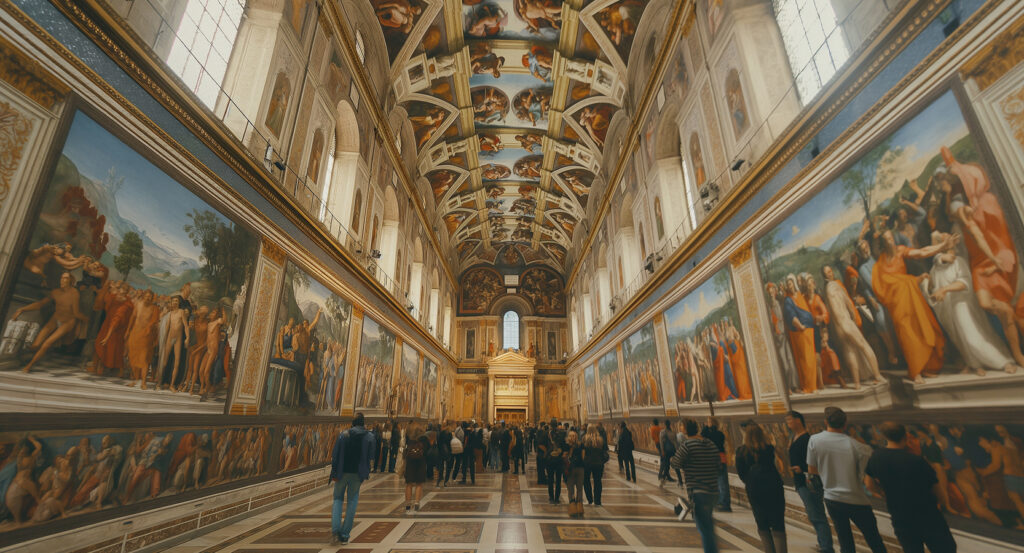
Why you should experience Sistine Chapel Ceiling in Vatican City.
Standing beneath Sistine Chapel Ceiling in Sistine Chapel at Vatican City feels like standing inside creation itself, not observing it, but witnessing it unfold in real time.
The frescoes surge above you in color and motion, a vast celestial storm painted by a man who never saw himself as a painter. Between 1508 and 1512, Michelangelo turned wet plaster into theology, his brush translating Genesis into a ballet of flesh and divinity. Figures twist, reach, and spiral across the vault like living sculpture, Adam's languid hand stretching toward the electric spark of God's, prophets caught in eternal thought, sibyls coiled in muscular poise. Every inch hums with the tension between heaven and earth, perfection and imperfection. You don't simply look up; you surrender upward. The ceiling swallows you whole, pulling your gaze through scenes of chaos, creation, and fall until you're left breathless, dizzy from both the art and the audacity.
What you should know about Sistine Chapel Ceiling.
What most visitors don't know is that Michelangelo's ceiling frescoes are as much an act of rebellion as of devotion.
Commissioned reluctantly by Pope Julius II, Michelangelo protested that he was a sculptor, not a painter, yet in defiance, he redefined both arts forever. He designed the entire iconographic program himself, compressing divine history into a sequence of human gestures so charged they verge on blasphemy. His God is not distant but fierce, almost corporeal, muscle and will incarnate. Even the architectural trompe-l'oeil he painted to frame each scene was revolutionary, creating an illusion of structure where none existed. Working on his back atop wooden scaffolding for four brutal years, Michelangelo painted more than 300 figures, alone, sleepless, often angry at the Church that demanded transcendence from mortal hands. The frescoes are not only an expression of faith, but a confession of struggle, proof that creation, divine or human, is born from tension.
How to fold Sistine Chapel Ceiling into your trip.
To fold Sistine Chapel Ceiling into your Roman experience, you must choreograph your approach like a pilgrimage, not a visit.
Enter the Vatican Museums early, resisting the urge to rush; let the anticipation build through the Raphael Rooms and gilded corridors. By the time you reach the Sistine Chapel, silence will come naturally, your body will understand before the mind does. Step inside and pause at the threshold; let your eyes adjust before lifting your gaze. Focus first on The Creation of Adam, but then allow yourself to wander, follow the sequence from Separation of Light from Darkness to The Drunkenness of Noah, tracing humanity's birth, triumph, and collapse. Visit again near closing time if you can; when the crowds thin, the chapel becomes intimate, its echoes soft and sacred. Outside, stand a moment in the sunlight of the Courtyard of the Pinecone, still half-dazed. It's there you'll realize that Michelangelo didn't just paint a ceiling, he redefined what it means for man to reach toward God.
Where your story begins.
Foresyte Travel reveals places that feel extraordinary long before you arrive.
Experience premium editorial crafted for luxury travelers.




















































































































