
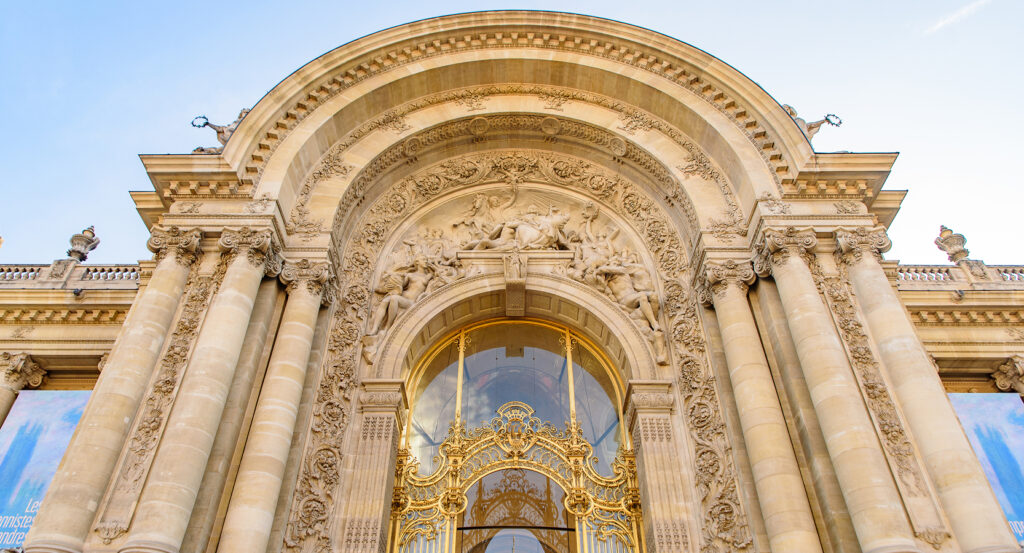
Why Musée des Beaux-Arts de la Ville de Paris matters.
Musée des Beaux-Arts de la Ville de Paris is an opulent civic museum where the Champs-Élysées quarter's ceremonial character meets Charles Girault's architecture for the 1900 Exposition Universelle, a garden-centered palace and municipal collections spanning antiquity through the opening decades of modern art.
Set along Avenue Winston Churchill near Avenue des Champs-Élysées and just steps from the Grand Palais, the museum occupies the eastern half of a ceremonial ensemble where two exhibition palaces face one another across a broad avenue descending directly toward Pont Alexandre III and the Seine. Girault's sweeping stone facade bends around a grand entrance framed by Ionic columns, sculpture and an iron-and-glass gate whose transparency offers an immediate glimpse into the building. Large galleries unfold behind this formal exterior around a semicircular interior garden, replacing the expectation of a sealed exhibition palace with colonnades, pools, mosaics and abundant natural light. The surrounding axis connects the Champs-Élysées with Hôtel des Invalides across the river, placing the building inside one of the most ambitious permanent urban compositions created for the 1900 fair. The result is a museum whose architecture operates at two scales at once, participating in a grand Parisian civic ensemble outside and turning inward toward an unexpectedly intimate garden at its center.
What defines Musée des Beaux-Arts de la Ville de Paris.
Musée des Beaux-Arts de la Ville de Paris is best known for occupying the Petit Palais, Charles Girault's purpose-built fine-arts palace for the Exposition Universelle of 1900 and the home of Paris's municipal art collection since 1902. Girault entered the 1896 architectural competition after studying under Honoré Daumet at the École des Beaux-Arts, winning the Prix de Rome in 1880 and establishing his reputation with Louis Pasteur's tomb in 1896. His Petit Palais proposal prevailed through its organization of exhibition spaces, historical architectural references and technical innovations, and Girault subsequently received responsibility for coordinating construction of the neighboring Grand Palais as well. The two buildings and Pont Alexandre III formed the permanent architectural core of a new exhibition district extending the Champs-Élysées toward Hôtel des Invalides. Girault conceived the Petit Palais with large exterior openings, extensive glazing and reinforced concrete, joining Beaux-Arts composition with construction technology suited to a modern exhibition building. The palace opened during the 1900 fair with a major retrospective devoted to French decorative arts from their origins through 1800. Paris assumed control in 1901, and the new Palais des Beaux-Arts de la Ville de Paris opened on December 11, 1902 with paintings and sculptures purchased or commissioned by the municipality since 1870. The same year brought the collection assembled by Auguste and Eugène Dutuit, whose bequest expanded the institution far beyond its initial concentration on recent French art by adding antiquities, paintings, drawings, prints and decorative arts. More than two decades of artistic work followed the building campaign, with painted and sculpted decoration continuing between 1903 and 1925 across spaces created to glorify Paris and the arts. Girault had designed not merely an exhibition shell for 1900 but the permanent civic museum that Paris occupied almost immediately after the fair.
The collection subsequently developed through a succession of gifts that turned the municipal holdings into a broad history of European art. The Dutuit bequest established the decisive early expansion, introducing ancient art and a celebrated group of Greek vases alongside works by artists including Rembrandt and extensive holdings of prints and drawings. Henry Lapauze strengthened the museum between 1904 and 1914 through acquisitions of Parisian artists' studio holdings, including Jean Carriès in 1904, Jules Dalou and Félix Ziem in 1905, Jean-Jacques Henner in 1906 and Alexandre Falguière in 1907. Juliette Courbet gave eight paintings by her brother Gustave in 1906, bringing Les Demoiselles des bords de Seine into the municipal collection. Edward Tuck and Julia Stell donated their eighteenth-century collection in 1921 under reserved usufruct, encompassing Chinese, Sèvres and Saxon porcelain, furniture, tapestries, watches, enamels, sculpture and painting; Edward later worked with dealer Sir Joseph Duveen and architect Guillaume Tronchet on the oak-paneled gallery inaugurated in 1930. Henri Matisse gave Cézanne's Les Trois Baigneuses in 1936, and Ambroise Vollard's 1945 bequest added paintings by Cézanne, Renoir and Bonnard. French nineteenth-century painting now extends through Géricault, Delacroix, Courbet, Monet, Sisley, Pissarro and Cézanne, joined by sculpture holdings centered on Carpeaux, Carriès and Dalou and decorative arts including Gallé glass, Lalique and Fouquet jewelry and Hector Guimard's dining room. These successive gifts transformed a municipal collection rooted in contemporary Parisian acquisitions into an institution extending from Greek and Roman antiquity through the artistic revolutions of the nineteenth and early twentieth centuries.
How Musée des Beaux-Arts de la Ville de Paris fits.
Musée des Beaux-Arts de la Ville de Paris works as the anchor for a daytime exploration of the grand territory between the Champs-Élysées and the Seine using three nearby sites that move from the collaborative exhibition palace opposite Girault's building through a bridge created for the same world's fair into an early reinforced-concrete theater that redirected Parisian architecture toward the twentieth century.
Begin at Grand Palais, conceived as the larger counterpart to the Petit Palais after the 1896 competition failed to produce a single winning scheme. Henri Deglane received responsibility for the principal facade and nave, Albert Louvet developed the intermediate section and grand staircase, Albert Thomas designed the rear portion and Charles Girault coordinated the entire undertaking. Construction began in 1897 with three years available before the Exposition Universelle, producing a vast synthesis of stone facades with an iron-and-glass nave and reinforced-concrete construction. The palace opened in 1900 and began hosting major annual art salons and equestrian competitions the following year; during the First World War, its exhibition spaces became a military hospital and rehabilitation center. Continue to Pont Alexandre III, whose foundation stone was laid on October 7, 1896 by Tsar Nicholas II with President Félix Faure as France and Russia translated their diplomatic alliance into the new exhibition district. The metal bridge established the principal crossing between the Grand and Petit Palais and the Esplanade des Invalides, with gilded Pegasus groups crowning four tall pylons and elaborate bronze and copper ornament extending across the span. Its inauguration accompanied the 1900 Exposition Universelle, completing the river crossing around which the permanent palaces had been planned. Conclude at Théâtre des Champs-Élysées, where impresario Gabriel Astruc and patron Gabriel Thomas pursued a new Parisian performance palace that opened in 1913. Henry Van de Velde entered the project as consulting architect before Auguste and Gustave Perret reworked its structural conception around reinforced concrete, making the completed building the first Parisian theater constructed entirely with that system. Antoine Bourdelle redesigned the facade through a vertical composition and supplied its grand frieze, five bas-reliefs and an extensive cycle of atrium frescoes, with Maurice Denis, Édouard Vuillard and other artists contributing to the wider decorative program. Stravinsky's Le Sacre du printemps with Nijinsky's choreography received its famous premiere there in 1913, joining dramatic performance to an architectural project already breaking decisively with nineteenth-century theater construction. The progression moves from Girault, Deglane, Louvet and Thomas's collaborative exhibition architecture through the Franco-Russian bridge that completed its ceremonial axis into Perret and Bourdelle's reinforced-concrete theater, carrying the surrounding district from the architectural ambitions of 1900 into the experimental culture of prewar Paris.
Where your story begins.
Foresyte Travel reveals places that feel extraordinary long before you arrive.
Enjoy editorial crafted for luxury travelers.
Foresyte may earn a commission when you book.














































































































