Why National Palace matters.
National Palace, or Palacio Nacional, is the beating heart of the nation's history, a living mural of its triumphs, revolutions, and dreams.
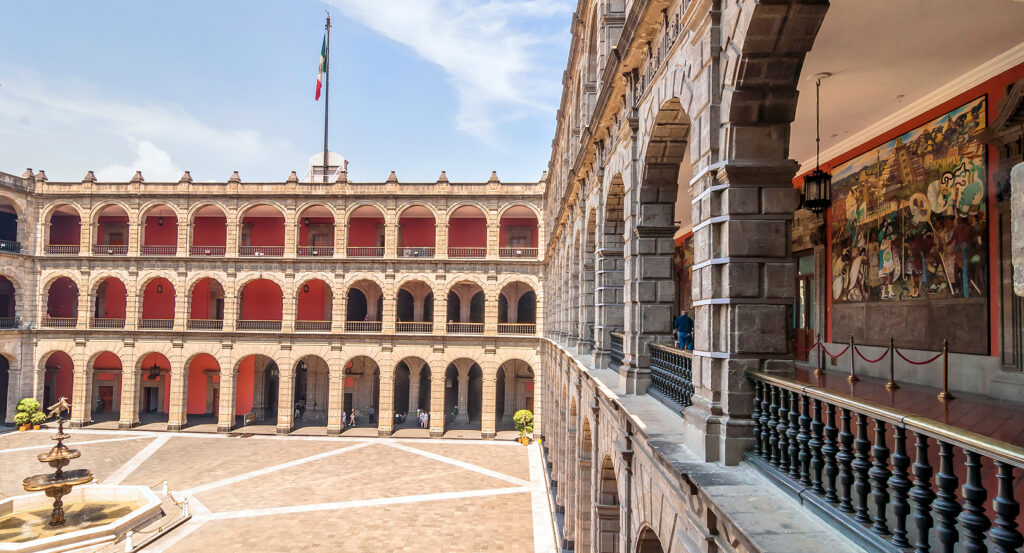
Stretching along the eastern edge of the Zócalo, this expansive structure has witnessed the evolution of Mexico for more than seven centuries. Built upon the ruins of Moctezuma II's palace, the site captures the fusion of pre-Hispanic roots and colonial legacy, its walls steeped in the echoes of empires past. The façade, a commanding expanse of volcanic tezontle stone, dates largely to the 17th century, yet its grandeur transcends time. The building's sheer scale, spanning 200 meters, anchors the city's historic core, while its baroque symmetry and arched colonnades exude quiet authority. Above the central balcony flies the national flag, and it is from this spot that the President delivers the annual Grito de Dolores, reenacting the cry that sparked Mexico's independence. To stand before the palace is to feel the gravity of centuries layered into stone, the Aztec capital, the Spanish viceroyalty, the birth of a republic, all converging in one living landmark. Inside, courtyards bloom with bougainvillea, corridors glow with soft afternoon light, and Diego Rivera's murals transform the walls into a sweeping visual epic of Mexico's past. Few places in the world encapsulate a nation's soul with such visceral force, both solemn and thriving, grand yet deeply human.
What defines National Palace.
Behind its stately façade, National Palace holds stories as dramatic and colorful as the nation it governs.
The palace's lineage stretches back to the 16th century, when Hernán Cortés claimed the site of Moctezuma's original palace and built his own residence atop it, a symbolic act that intertwined the destinies of indigenous Mexico and colonial Spain. Over the following centuries, the building evolved from a fortress-like viceroyal residence into the elegant government seat that defines it today. Each addition and restoration has mirrored the shifting tides of Mexican identity. Yet, what truly sets the palace apart is the art that breathes within its walls, most famously, Diego Rivera's expansive mural series The History of Mexico, painted between 1929 and 1951. Stretching across the grand staircase and surrounding galleries, these murals capture the entire Mexican saga, from Aztec civilization and Spanish conquest to revolution and modern reform. Rivera's vivid scenes swirl with motion and emotion: laborers, soldiers, priests, and farmers converge in a powerful mosaic that demands contemplation. The murals are not decoration; they are declaration, Rivera's ode to the resilience and spirit of his people. Beyond the art, the palace itself is a museum of architecture and memory. Its courtyards reveal layers of colonial and neoclassical design, each wing telling a different chapter of history. One can still find remnants of the original Aztec foundations and ancient basalt stones woven into the walls. National Palace also houses the Treasury offices and the National Archives, which guard centuries-old documents, including the original plans of Cortés and decrees from the earliest Mexican presidents. During the 19th century, Emperor Maximilian briefly claimed it as his seat of power, only for it to return to the people after his fall. The palace has endured earthquakes, fires, and revolutions, yet its spirit remains unbroken, a structure that has adapted. Even the ceremonial bell above the central balcony is steeped in symbolism: it is the same bell Father Hidalgo rang in 1810 to spark Mexico's independence, now rung each year to renew that eternal cry for liberty.
How National Palace fits.
Visiting National Palace is like stepping into a living chronicle, an experience that demands both reverence and curiosity.
Begin your journey at the Zócalo, the vast plaza that opens before the palace, where street vendors, mariachi bands, and fluttering flags infuse the air with energy. The palace's long façade stretches along the entire east side, its deep red stone glowing warmly against the afternoon sun. Entry is free but requires an ID for security; once inside, you'll find yourself in a sanctuary of art and history shielded from the bustle outside. Start at the grand stairway, the central heart of the palace, where Rivera's mural unfurls like a cinematic masterpiece across three walls. Spend time tracing the figures, from indigenous warriors and conquistadors to revolutionary icons like Emiliano Zapata and Frida Kahlo. Then wander through the adjoining corridors, where smaller panels continue Rivera's story of Mexico's transformation. The courtyards offer a peaceful contrast: fountains shimmer under jacaranda trees, and cloistered archways open into sunlit galleries. The Palace's Chapel of the Assumption and old Treasury rooms retain exquisite colonial details, gilded ceilings, carved wood, and talavera tilework that reveal centuries of craftsmanship. Don't miss the ceremonial balcony overlooking the Zócalo; though not open to the public, its view defines Mexico's political theater. Plan the visit early in the day to avoid crowds, or time it for late afternoon when the light softens and the plaza glows with golden hues. For a deeper connection, visit on September 15th, Independence Day, when the President's Grito de Dolores transforms the palace into the nation's stage, as fireworks illuminate the night sky and the crowd below chants in unison: ¡Viva México! Nearby, the Metropolitan Cathedral and Templo Mayor create a triad of history that perfectly complements your visit, pre-Hispanic, colonial, and republican Mexico in discussion within a single city block. National Palace isn't merely a building, it is the living heart of Mexico, where art, politics, and character merge into one indomitable story. To walk its halls is to feel the pulse of a nation that has reinvented itself countless times, yet never lost sight of its soul.
Where your story begins.
Foresyte Travel reveals places that feel extraordinary long before you arrive.
Enjoy editorial crafted for luxury travelers.
Foresyte may earn a commission when you book.