Why Nusara matters.
Nusara is a contemporary Thai fine-dining restaurant where Tha Tien's riverfront heritage meets Thitid Tassanakajohn's reinterpretation of family recipes, the aromatic foundations of traditional Thai cooking and an intimate dining experience overlooking the city's historic royal district.
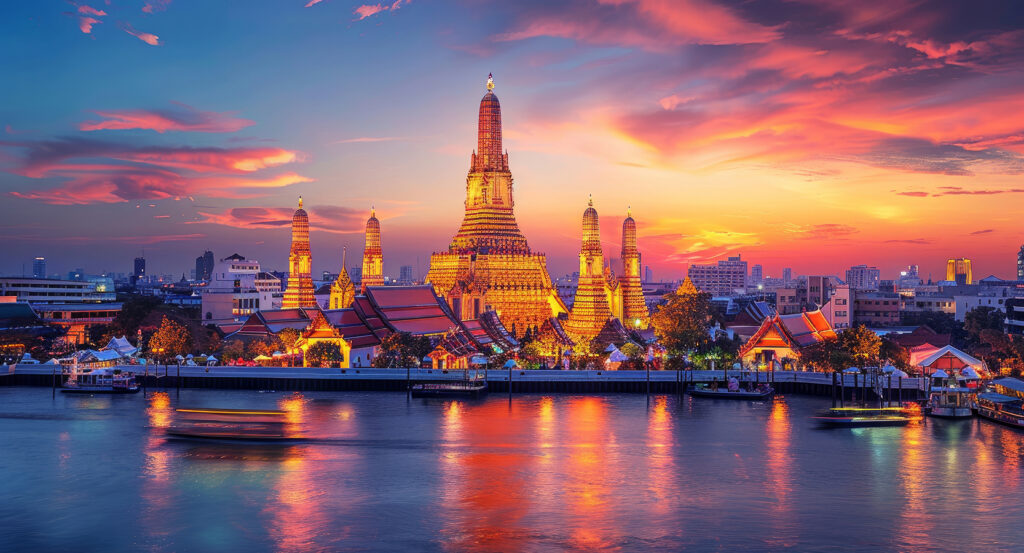
Set along Maha Rat Road near Tha Tien Market and a short walk from Sanam Chai MRT station, the restaurant occupies a restored commercial building within the historic riverside neighborhood, surrounded by traditional shophouses, narrow lanes and the eastern bank of the Chao Phraya River. Its upper-floor dining room opens toward a remarkable view of Wat Pho's temple complex, with illuminated stupas rising above the surrounding rooftops. Warm timber finishes, subdued lighting and carefully arranged tables establish an intimate setting within the older commercial streetscape. The restaurant's vertical arrangement separates the arrival area from the principal dining space, creating a gradual transition from the street into the meal. The result is a restaurant whose historic surroundings, elevated temple views and restrained interiors provide a setting closely connected to Bangkok's cultural and culinary inheritance.
What defines Nusara.
Nusara is best known for chef Thitid Tassanakajohn's transformation of his grandmother's culinary inheritance into a contemporary Thai tasting-menu restaurant, developed alongside his younger brother, Chaisiri Tassanakajohn. Known professionally as Ton, Thitid grew up in Bangkok within a family whose domestic cooking traditions became central to his later work. His grandmother Nusara occupied a particularly important place in that upbringing, preparing traditional Thai dishes whose flavors and methods he subsequently sought to preserve through professional cooking. Tassanakajohn pursued formal culinary training at the Culinary Institute of America in New York, developing a technical foundation in European and American restaurant kitchens. His professional experience included work at Eleven Madison Park, where he encountered the disciplined organization and precise execution associated with contemporary fine dining. Returning to Thailand, he established Le Du in Bangkok in 2013, developing a restaurant that combined Thai ingredients with modern culinary techniques and international wine knowledge. Le Du's subsequent recognition through MICHELIN and Asia's 50 Best Restaurants strengthened his standing within the region's contemporary dining industry. Tassanakajohn later developed Nusara as a separate project devoted more directly to traditional Thai recipes and the personal culinary inheritance of his family. The restaurant opened in 2020, taking its name from his grandmother and establishing a tasting-menu format built around familiar Thai dishes presented through contemporary techniques. His brother Chaisiri, known professionally as Tam, contributed to the hospitality and operational development of the project, extending the family's involvement beyond the kitchen. Nusara initially operated in Bangkok's historic riverside district before relocating to a larger property overlooking Wat Pho, creating a more developed setting for its culinary program. The restaurant's progression coincided with increasing international interest in contemporary interpretations of traditional Thai cuisine, particularly among establishments combining family recipes with formal tasting-menu service. Nusara entered Asia's 50 Best Restaurants rankings and reached third place in 2023, establishing it among the region's most highly ranked restaurants. Its recognition continued through subsequent appearances on the list, strengthening the international standing of Tassanakajohn's work. The restaurant's development established a personal counterpart to Le Du, concentrating on the preservation and reinterpretation of Thai domestic cooking through the memories, ingredients and recipes associated with the chef's family.
Thitid Tassanakajohn's cooking at Nusara begins with the concentrated aromatic foundations of traditional Thai cuisine, developing familiar family preparations through carefully balanced acidity, sweetness, salinity and heat. The kitchen builds its flavors through fresh herbs, roots and spices, using ingredients such as lemongrass, galangal, kaffir lime and chilli to establish the character of individual dishes. These components are prepared through pounding, slicing and controlled cooking, releasing aromatic oils that form the foundation of curries, relishes and seasoned sauces. The restaurant's interpretation of traditional Thai recipes preserves their recognizable flavor structures while adjusting texture, presentation and the sequence in which ingredients reach the palate. Seafood preparations demonstrate this approach through carefully selected fish and shellfish whose natural sweetness provides a counterpoint to concentrated seasoning. The kitchen's treatment of crab has included preparations combining delicate meat with aromatic accompaniments, allowing the seafood's texture to remain distinct beneath the surrounding flavors. Richer courses introduce the depth of slow-cooked meat and carefully reduced sauces, drawing upon the long preparation times associated with traditional household cooking. The resulting dishes establish contrasts between tender proteins, crisp garnishes and intensely flavored condiments, creating several textures within individual servings. Rice provides an essential structural component of the meal, absorbing sauces and connecting the tasting sequence with the communal dining practices of Thai households. Fermented ingredients contribute savory depth, while fresh citrus and herbs introduce sharper aromatic elements that maintain balance across richer preparations. The kitchen's use of coconut milk develops additional richness in selected dishes, requiring careful control of sweetness and spice intensity. Nusara's tasting-menu structure organizes these preparations into successive courses, allowing individual recipes to receive concentrated attention while preserving the flavor relationships associated with traditional Thai meals. Staff explain the culinary origins of dishes and the family connections behind their development, giving the meal a personal dimension beyond its technical preparation. The beverage program incorporates wine and other pairings selected to complement the pronounced acidity, aromatic intensity and spice of the cuisine. Desserts draw upon Thai sweets and tropical ingredients, extending the emphasis on familiar flavors into carefully composed final courses. Nusara's distinctive culinary character develops through this sustained relationship between inherited recipes and contemporary technique, preserving the resonant and cultural significance of Thai home cooking within a refined tasting-menu format.
How Nusara fits.
Nusara works as the culinary centerpiece for a Bangkok itinerary connecting the royal architecture of Rattanakosin Island, the religious traditions of the Chao Phraya riverfront and the commercial heritage of the city's historic trading neighborhoods.
Begin at Wat Pho, the royal temple complex formally known as Wat Phra Chetuphon Wimon Mangkhalaram. Established on the site of an earlier monastery, the temple underwent extensive reconstruction under King Rama I following the founding of Bangkok as the Siamese capital in 1782. Its grounds contain the Reclining Buddha, a gilded figure measuring 46 meters in length, housed within a richly decorated pavilion. King Rama III expanded the complex during the nineteenth century, incorporating inscriptions and illustrations devoted to medicine, literature and traditional knowledge. The temple became an important center for the preservation and teaching of traditional Thai massage, maintaining a connection between religious architecture and practical scholarship. Continue to Museum Siam, housed within the former Ministry of Commerce building near Sanam Chai. The neoclassical structure was completed in 1922, incorporating architectural features associated with the administrative modernization of Siam during the early twentieth century. The museum opened in 2007, establishing an institution devoted to the historical development of Thai society and national culture. Its exhibitions examine the changing meanings of Thai cultural practices through interactive installations, historical objects and contemporary interpretation. The surrounding streets preserve the relationship between government buildings, commercial activity and residential neighborhoods within the historic capital. Conclude at Pak Khlong Talat, Bangkok's principal flower market near the southern edge of Rattanakosin Island. The district developed through river-based commerce, with agricultural produce arriving by boat along the Chao Phraya and adjoining canals. Its wholesale trade expanded into flowers, creating a market associated with orchids, roses, jasmine and marigolds used in domestic decoration, religious offerings and ceremonial arrangements. Vendors prepare garlands and floral compositions throughout the market, maintaining practices closely connected with Buddhist and Hindu ritual traditions. The adjoining streets contain traditional commercial buildings whose ground floors accommodate wholesale stalls and specialist merchants. The progression moves from royal religious architecture through the institutional preservation of Thai cultural history and culminates in the commercial traditions sustaining Bangkok's everyday ceremonial life.
Where your story begins.
Foresyte Travel reveals places that feel extraordinary long before you arrive.
Enjoy editorial crafted for luxury travelers.
Foresyte may earn a commission when you book.