Why Wat Pho matters.
Wat Pho is a royal Buddhist temple where Phra Borom Maha Ratchawang's sacred heritage meets the architectural patronage of the Chakri dynasty and Thailand's centuries-old traditions of Buddhist scholarship, healing and religious art.
Set along Sanam Chai Road near Thai Wang Road and just steps from Museum Siam, the temple occupies an extensive walled compound south of the Grand Palace between the historic Rattanakosin ceremonial precinct, the eastern bank of the Chao Phraya River and the traditional commercial streets extending toward Pak Khlong Talat. Its courtyards contain richly ornamented ordination halls, tiered roofs, gilded Buddha images and towering stupas decorated with intricate ceramic mosaics. Covered galleries surround ceremonial buildings and sculpture gardens, creating an interconnected arrangement of sacred spaces framed by stone figures, flowering trees and traditional Thai architectural detailing. The immense Reclining Buddha occupies a dedicated chapel, its gilded form extending almost the entire length of the interior beneath an elaborately decorated ceiling. The result is a religious complex whose royal architecture, extraordinary Buddhist sculpture and enduring educational traditions establish one of Bangkok's most significant cultural institutions.
What defines Wat Pho.
Wat Pho is best known for its grand Reclining Buddha and its historical importance as a royal center of Buddhist learning, traditional Thai medicine and architectural patronage during the early Chakri dynasty. The temple's formal name, Wat Phra Chetuphon Wimon Mangkhalaram Rajwaramahawihan, identifies its status among Thailand's principal royal Buddhist monasteries. Its origins precede the establishment of Bangkok as the capital, with an earlier temple occupying the site during the Ayutthaya period. Following the founding of Rattanakosin in 1782, King Rama I undertook an extensive reconstruction of the existing religious compound as part of the new capital's ceremonial development. The rebuilding campaign began in 1788 and continued for several years, introducing substantial new religious structures and expanding the monastery's architectural organization. Rama I commissioned the collection of Buddha images from abandoned temples in former Siamese capitals, transferring important sculptures into the new royal religious precinct. This program preserved significant works of Buddhist art during a period of political reconstruction following the destruction of Ayutthaya in 1767. The temple's galleries became repositories for these sacred images, establishing an exceptional concentration of religious sculpture associated with different periods of Thai history. King Rama III initiated another major reconstruction campaign in 1832, substantially enlarging the compound and developing its educational functions. His patronage introduced new architectural structures, extensive decorative programs and an ambitious project to preserve practical knowledge through inscriptions displayed throughout the monastery. Scholars, physicians, artists and religious specialists contributed material concerning traditional medicine, massage, literature, geography and Buddhist teachings. The inscriptions transformed the temple into an important center for the public transmission of knowledge, establishing an educational role that extended beyond conventional monastic instruction. The celebrated Reclining Buddha was constructed during Rama III's reign, becoming the principal sculptural achievement of the expanded religious complex. The temple subsequently developed a particularly strong association with traditional Thai massage and medicine, maintaining educational programs connected with therapeutic practice. In 1955, the Wat Pho Traditional Medical School was established, formalizing instruction in disciplines associated with the monastery's historical medical traditions. UNESCO recognized the temple's epigraphic archives through the Memory of the World Register in 2011, acknowledging the cultural importance of its extensive collection of historical inscriptions. Wat Pho's institutional development established a distinctive relationship between royal Buddhist patronage, artistic preservation and the transmission of practical knowledge within Thailand's religious culture.
The Reclining Buddha represents the historical Buddha's passage into final nirvana, a central subject within Buddhist religious art associated with the completion of the enlightened teacher's earthly existence. The sculpture measures 46 meters in length and 15 meters in height, creating an immense gilded figure whose proportions define the surrounding chapel. Its reclining posture places the head upon a supporting hand, with the body extending across the interior in a carefully composed arrangement of curved surfaces and ornamental details. The soles of the figure's feet contain 108 auspicious symbols executed in mother-of-pearl inlay, incorporating imagery associated with Buddhist cosmology and traditional representations of enlightened perfection. A sequence of bronze bowls lines the surrounding passage, supporting a devotional practice in which worshippers place coins as offerings associated with merit-making. The chapel's interior contains elaborate painted surfaces, decorative columns and traditional architectural elements that reinforce the ceremonial significance of the sculpture. Elsewhere within the compound, Phra Ubosot serves as the principal ordination hall, containing a revered seated Buddha image associated with the religious patronage of the early Bangkok monarchy. The hall's surrounding galleries contain hundreds of Buddha images arranged in ordered sequences, creating an extensive collection of Thai religious sculpture. Four grand royal chedis commemorate the first four monarchs of the Chakri dynasty, their surfaces covered with elaborate floral patterns formed from colored ceramic fragments. The chedis establish a striking architectural ensemble, with their contrasting colors and vertical profiles contributing to the temple's distinctive skyline. Smaller stupas, ceremonial pavilions and decorative structures occupy the surrounding courtyards, creating a densely organized sacred landscape. Stone guardian figures and sculptures imported from China contribute another decorative tradition, connecting the temple's architectural program with the commercial and artistic exchanges between Siam and Qing China. The monastery's historical medical inscriptions contain demonstrated material concerning anatomy, therapeutic techniques and traditional healing practices. Stone plaques and carved figures preserve knowledge associated with massage pressure points, stretching exercises and the treatment of physical ailments. The temple's medical school developed these traditions through structured instruction, contributing to the international recognition of Thai massage as an important component of the country's cultural heritage. The combination of grand Buddhist sculpture, royal memorial architecture and historical medical knowledge establishes Wat Pho as a religious institution whose significance extends across artistic, educational and therapeutic traditions.
How Wat Pho fits.
Wat Pho works as the religious centerpiece for a Rattanakosin itinerary connecting Bangkok's royal ceremonial architecture, the sacred monuments of the Chao Phraya and the cultural institutions devoted to Thailand's historical development.
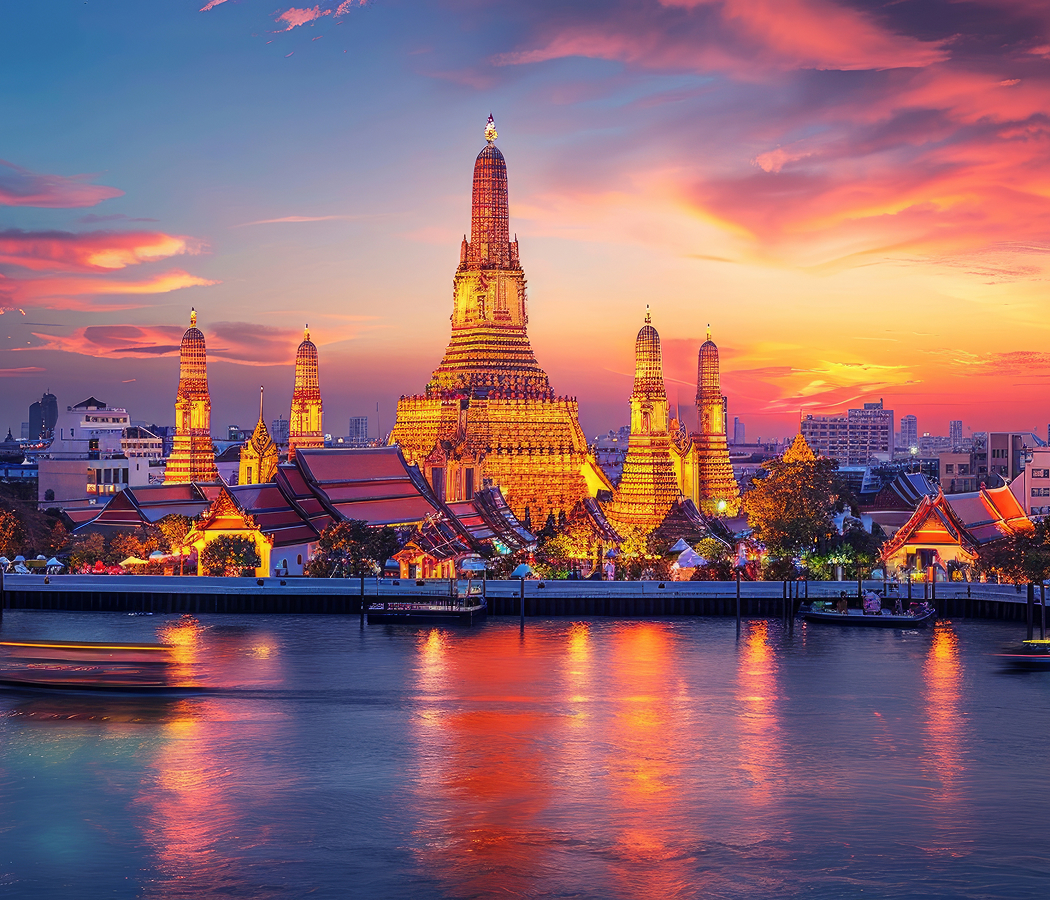
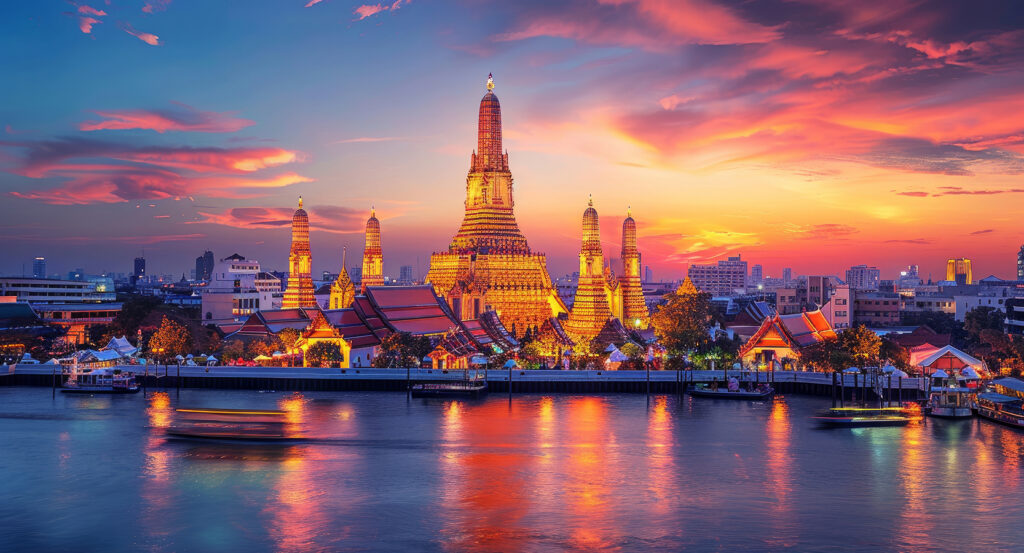
Begin at The Grand Palace, the royal architectural complex established following King Rama I's founding of Bangkok as the capital of Siam in 1782. Its extensive walled precinct contains ceremonial halls, former royal residences and religious buildings developed through successive Chakri reigns. The palace's architectural composition combines traditional Thai roof forms, gilded ornament and European-influenced structures associated with nineteenth-century royal modernization. Wat Phra Kaew occupies the principal sacred precinct, housing the revered Emerald Buddha within an elaborately decorated ordination hall. The surrounding galleries contain extensive mural paintings depicting episodes from the Ramakien, connecting the palace with Thailand's literary and theatrical traditions. Continue to Wat Arun, the celebrated riverside temple rising above the western bank of the Chao Phraya. Its principal prang reaches 70 meters in height, creating one of Bangkok's most recognizable religious silhouettes. The tower's surface incorporates intricate floral patterns and decorative elements formed from fragments of Chinese porcelain, establishing a distinctive example of Thai religious craftsmanship. The temple's architectural development accelerated during the early Chakri period, with substantial construction undertaken during the reigns of Rama II and Rama III. Its riverfront position preserves an important connection with the former capital at Thonburi and the historical movement of royal institutions across the Chao Phraya. Conclude at Museum Siam, the cultural institution housed within the former Ministry of Commerce building near Sanam Chai. The museum examines the development of Thai society, cultural traditions and national history through exhibitions exploring the changing meanings of Thai identity. Its principal building incorporates European-influenced architectural detailing associated with the administrative modernization of Siam during the early twentieth century. The museum's exhibitions connect historical objects, multimedia installations and interactive displays with broader questions concerning cultural heritage and social transformation. Its position within the historic Rattanakosin district establishes a direct relationship between the former royal administrative precinct and contemporary interpretations of Thailand's historical development. The progression moves from the ceremonial architecture of the Chakri monarchy through the grand religious heritage of the Chao Phraya and culminates in a museum devoted to the cultural transformations shaping modern Thailand.
Where your story begins.
Foresyte Travel reveals places that feel extraordinary long before you arrive.
Enjoy editorial crafted for luxury travelers.
Foresyte may earn a commission when you book.