
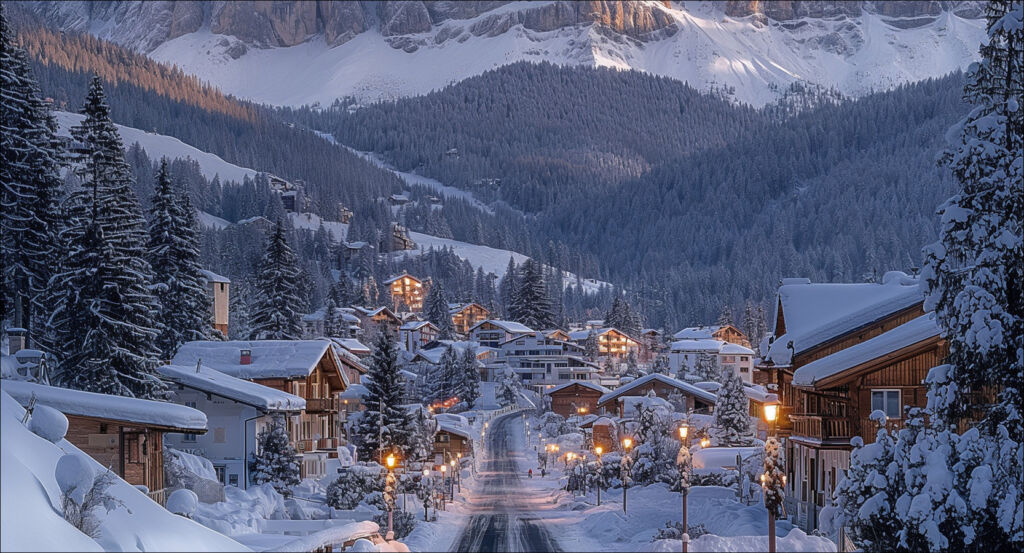
Why you should experience Olympia delle Tofane in Italy.
Olympia delle Tofane in Cortina d'Ampezzo, Italy is where skiing meets legacy, a mountain stage carved by decades of champions, framed by the jagged light of the Dolomites.
Set on the steep slopes of Mount Tofana, this world-class downhill course isn't just a run; it's a ribbon of ice and glory. Originally built for the 1956 Winter Olympics, Olympia delle Tofane has since hosted generations of World Cup races, earning a reputation as one of the most technical and spectacular courses in alpine skiing. Every meter of the descent carries the pulse of history, the echo of cheering crowds, the hiss of skis on corduroy snow, and the daring rhythm of athletes dropping into curves that test the limits of balance and nerve. But even when the grandstands are empty, there's something transcendent about standing at its starting gate. The view spills over the Ampezzo valley like a dream, jagged limestone peaks, endless forests, and the soft hum of the town below. Here, the thrill isn't just in racing; it's in feeling connected to every skier who's ever chased perfection down these slopes.
What you should know about Olympia delle Tofane.
The Olympia delle Tofane isn't merely a historic slope, it's a living monument to precision, courage, and reinvention.
Designed for the 1956 Winter Olympics, it was among the first downhill courses ever to receive international acclaim for both technical layout and natural beauty. Since then, it's been a constant presence on the FIS Women's World Cup calendar, hosting downhill, super-G, and combined events that attract the sport's elite. The course itself begins near the top of Rumerlo and plunges nearly 2.8 kilometers, with a vertical drop of around 800 meters, twisting through tight chutes, forested stretches, and sweeping curves with names that have entered skiing legend, Schuss, Tretapassi, Scarpadon. In 2021, it was fully upgraded for the FIS World Championships, blending its heritage with state-of-the-art snowmaking and safety systems. But the magic lies in its dual personality: one part ferocious competition, one part serene alpine escape. In summer, the same slopes turn to wildflower meadows and hiking trails, and the old race gates give way to climbers and bikers who come to trace the contours of history in their own way.
How to fold Olympia delle Tofane into your trip.
To visit Olympia delle Tofane is to stand where ski history was written, and to feel it under your boots.
Start the day at the Freccia nel Cielo gondola from the town center, which carries you up toward Pié Tofana and the heart of the course. Even if you're not racing, you can ski large sections of Olympia on open days, gliding through the same gates once tackled by Olympic legends. For intermediate skiers, the upper runs near Pomedes offer gentler access to panoramic views, while experts can test themselves on the full descent. Pause for lunch at Rifugio Duca d'Aosta or Rifugio Pomedes, both set along the race route, where wooden terraces overlook the valley in a sweep of pure Dolomite drama. If you're visiting outside ski season, the Tofane area still captivates: the lifts run year-round for hikers, and the old race signage guides you along alpine trails that double as open-air museums of sport. As the sun dips behind Croda Rosa, linger for one last look down the mountain, you'll see the track glinting like silver, as though still alive with the ghosts of speed and glory.
Where your story begins.
Foresyte Travel reveals places that feel extraordinary long before you arrive.
Experience premium editorial crafted for luxury travelers.




















































































































