
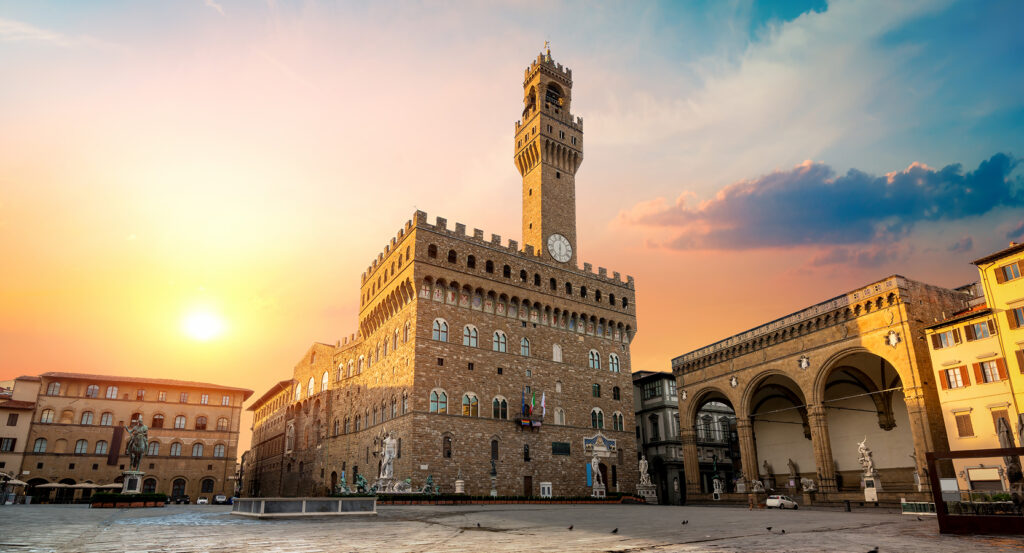
Why you should experience Sala dei Gigli in Florence, Italy.
Sala dei Gigli at Palazzo Vecchio in Florence is a jewel of Renaissance civic grandeur, a chamber where artistry, politics and symbolism merge into a mosaic of power and beauty.
Stepping into the room, you're greeted by a dazzling coffer-ceiling carved and gilded with lilies, fluttering like petals on a field of blue. The walls shimmer with the same motif, the fleur-de-lys that symbolised Florence's alliance with the French crown, a subtle sign of diplomatic ambition wrapped into the language of decoration. One end of the hall is dominated by frescoes executed by Domenico Ghirlandaio in the early 1480s: The Apotheosis of Saint Zenobius with Saints Lawrence and Stephen, flanked by stern and heroic figures of Roman antiquity, Brutus, Scaevola and Camillus on one side; Decius, Scipio and Cicero on the other. In that combination you feel the pulse of Florence's identity: Christian devotion, classical virtue, and civic pride all standing before you. Sala dei Gigli doesn't simply display art, it captures Florence's ambition, its alliances, and the vision of itself as both moral and majestic.
What you should know about Sala dei Gigli.
This hall is among the very few spaces inside Palazzo Vecchio to survive the Medici-era transformations intact, meaning it still reflects the 15th-century aesthetics of Florentine republican power.
The name “Hall of Lilies” comes not from the familiar Florentine red lily but from the golden fleur-de-lys on a blue field, a tribute to the French Anjou dynasty, which at the time acted as protector of the Guelf-aligned Florence. The ceiling and wall decor were crafted by the brothers Benedetto da Maiano and Giuliano da Maiano (and their workshop) and completed in the late 1470s. Meanwhile Ghirlandaio was commissioned in 1482 to create the cycle of frescoes, a task initially shared with other leading artists but ultimately completed by him alone. The classical figures painted into the side panels demonstrate how Florence linked itself to the Roman ideal of civic virtue, a deliberate compliment to the Christian saints at the centre. Less well-known is that a version of Donatello's Judith and Holofernes was later placed in the hall, aligning political imagery of liberation with artistic grandeur. The fact that this room retains so many original elements makes it crucial for understanding how Florence viewed itself in that era, not just as a city of art, but as a state of principle.
How to fold Sala dei Gigli into your trip.
Visiting Sala dei Gigli is a moment of quiet intensity in the Palazzo Vecchio, plan to pause.
Enter through the ground floor and ascend to the first floor where the “grand apartments” begin. The hall sits near the Sala dell'Udienza, take a moment to admire the carved portal that links the two rooms, also by the Maiano brothers. In Sala dei Gigli, stand with your back to the entrance and let your eyes adjust: the coffered ceiling arches above you, the lilies glinting softly in the ambient light. Then walk toward the wall of Ghirlandaio's frescoes, spend time on the central panel of Saint Zenobius, and then shift sideways to take in the classical trio-portraits. Note how Ghirlandaio frames the saints within illusionistic architecture, a bold early move toward perspective that was ahead of its time. Visit either early morning or as the afternoon light turns the ceiling's blue to deep lapis. Afterward, exit the hall and look back: the harmony of ceiling, wall and floor will stay with you. Sala dei Gigli at Palazzo Vecchio in Florence is not just another room in a palace, it's Florence's statement of ambition in wood, paint and gilding.
Where your story begins.
Foresyte Travel reveals places that feel extraordinary long before you arrive.
Experience premium editorial crafted for luxury travelers.




















































































































