
Why Park City Mountain matters.
Park City Mountain is an expansive alpine ski resort where Old Town's silver-mining heritage meets the recreational transformation of the Wasatch Range, the competitive legacy of the Winter Olympic Games and the engineering achievements that established one of North America's largest interconnected mountain destinations.
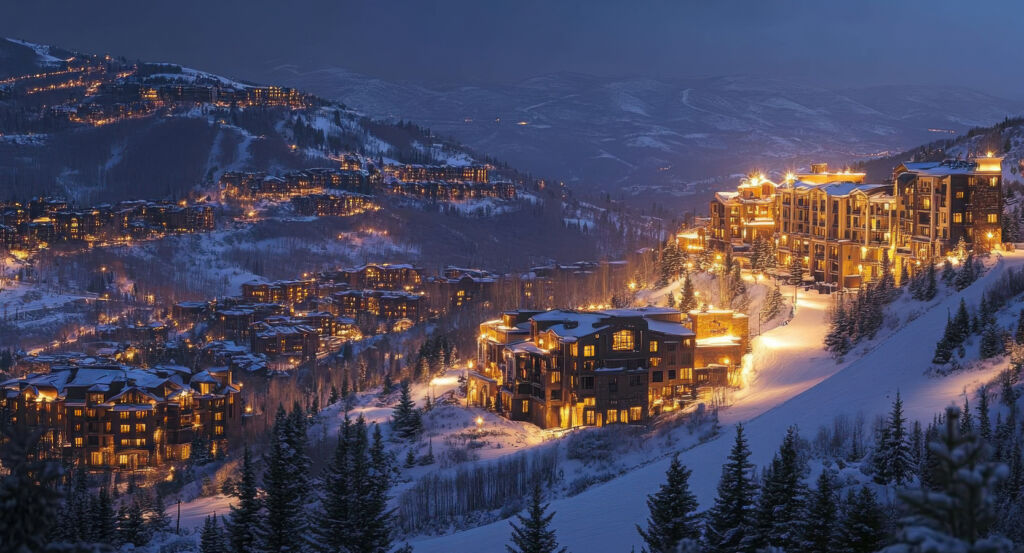
Rising above the western edge of Park City from the Lowell Avenue base area, near the junction of Empire Avenue and Silver King Drive, the resort extends across the eastern Wasatch Mountains toward Canyons Village, with wooded ridgelines overlooking Snyderville Basin and the Uinta Mountains. Its lower slopes incorporate broad ski runs, densely wooded hillsides and substantial lift terminals arranged around a compact mountain village. Higher elevations introduce steep bowls, exposed ridges and extensive stands of aspen and evergreen trees, creating a varied alpine landscape across successive mountain faces. The interconnected terrain descends through multiple drainage basins, with chairlifts and gondolas crossing forested slopes and connecting elevated recreational areas to developed mountain bases. Timber-clad lodges, pedestrian plazas and substantial outdoor terraces establish the architectural character of the principal arrival areas, connecting mountain transportation infrastructure to the surrounding hospitality facilities. The result is a vast alpine resort whose interconnected ridgelines, extensive lift network and contrasting mountain villages establish a distinctive relationship between historic mining terrain and contemporary winter recreation.
What defines Park City Mountain.
Park City Mountain is best known for transforming the industrial landscape of Utah's silver-mining economy into the largest ski resort in the United States, establishing a continuous recreational enterprise whose development connects federal economic assistance, pioneering aerial transportation, Olympic competition and substantial investment in mountain infrastructure. The resort's origins emerged during the decline of Park City's mining industry, when falling mineral prices and increasingly expensive underground operations threatened the economic foundation of the surrounding community. United Park City Mines began exploring recreational development in 1958, seeking a commercial alternative capable of supporting employment and attracting investment to the former mining settlement. The company controlled substantial mountain property and mineral rights, providing the geographical foundation for a ski area developed across land previously devoted to industrial extraction. Its directors advanced the proposal during the early 1960s, combining private investment with assistance from the federal Area Redevelopment Administration. A federal loan of $1.25 million supported the undertaking, contributing to a development program whose total initial investment reached $2 million. Construction employed former miners whose knowledge of the terrain and established industrial infrastructure provided practical advantages during the installation of mountain transportation systems. Treasure Mountains opened on December 21, 1963, introducing a substantial new recreational enterprise during a period of economic uncertainty for the town. The original installation included a gondola, the Prospector double chairlift and two J-bar surface lifts, establishing access to terrain previously associated with mineral production. Its principal gondola was the longest in North America, extending two and a half miles across the mountainside through a series of intermediate stations. Four-passenger cabins carried skiers from the lower mountain to the upper recreational areas, climbing 2,300 vertical feet. The opening season attracted close to 50,000 skier visits, demonstrating the commercial potential of winter recreation in the former mining community. A distinctive transportation experiment followed through the adaptation of the Spiro Tunnel, an underground passage originally developed to drain water from mining operations. The Skier Subway carried passengers two and a half miles into the mountain aboard a former mine train before transferring them to a hoist ascending 1,750 feet toward the ski terrain. The underground journey required forty-five minutes, and the discomfort associated with cold, wet conditions limited its popularity. The system nevertheless represented an unusual engineering connection between the community's industrial past and its emerging recreational economy. The ski area adopted the Park City Ski Area name for the 1966-1967 season, establishing a closer commercial association with the developing mountain destination. Sports Illustrated recognized the Payday run among the country's finest ski trails in 1966, strengthening the resort's national reputation during its early development. The surrounding recreational industry expanded in 1968 with the opening of Park City West, a separate ski area that subsequently underwent several ownership and naming changes. The United States Ski Team established training operations in Park City during the 1970s, connecting the resort's growing facilities to the development of elite American winter sports. The installation of a triple chairlift in 1973 expanded uphill transportation capacity, supporting the increasing popularity of recreational skiing. Ownership passed from Edgar Stern to Nick Badami in 1975, initiating another period of investment in the resort's facilities and competitive skiing programs. The mountain subsequently developed additional lifts and specialized terrain, strengthening its position within the expanding American ski industry. Powdr Corporation acquired the operation during the 1990s, introducing a new ownership period associated with further modernization and the Park City Mountain Resort name. The original gondola was retired during the late 1990s, concluding more than three decades of operation and making way for faster aerial transportation systems. The 2002 Winter Olympic Games established a major international milestone when the resort hosted alpine giant slalom, snowboard giant slalom and halfpipe competitions. Olympic preparations accelerated investment in competition terrain, transportation facilities and mountain operations, connecting the resort to the international standards required for elite winter sports. American snowboarders Ross Powers, Danny Kass and Jarret Thomas completed a sweep of the men's halfpipe medals, establishing one of the memorable achievements associated with the venue. Kelly Clark won the women's halfpipe competition, contributing another American gold medal to the resort's Olympic history. A substantial corporate transition followed a dispute concerning the lease of land controlled by Talisker Land Holdings, which affected the continued operation of the mountain. Vail Resorts acquired Park City Mountain Resort from Powdr Corporation in September 2014 for $182.5 million, establishing the foundation for its integration with the neighboring Canyons operation. The company announced a $50 million improvement program, incorporating a major transportation connection between the previously separate mountain areas. The Quicksilver Gondola opened in December 2015, connecting the Park City and Canyons sides through an eight-passenger aerial system crossing Pine Cone Ridge. Its installation created the largest interconnected ski resort in the United States, fundamentally changing the scale and organization of the destination. The improvement program also incorporated expanded restaurant facilities, upgraded lifts and additional mountain infrastructure, supporting the operation of the combined resort. Further investment continued through the modernization of uphill transportation and the development of the two principal base villages. The Sunrise Gondola entered service for the 2025-2026 winter season, introducing ten-passenger cabins and additional transportation capacity at the western base. Park City Mountain's historical significance rests on its continuous evolution from an industrial diversification project into a major international winter-sports destination, preserving the relationship between Utah's mining economy and the recreational development of the Central Wasatch Range.
The Wasatch Range establishes the resort's defining recreational character through a substantial concentration of interconnected ski terrain distributed across seventeen mountain peaks and thirteen bowls. The combined ski area encompasses 7,300 acres, establishing the largest lift-served resort in the United States through a mountain network that connects extensive intermediate terrain with technically demanding advanced slopes. Its highest summit reaches 10,026 feet above sea level, and the principal base elevation stands at 6,800 feet, producing substantial vertical differences across the recreational landscape. The mountain incorporates more than 330 designated trails served by forty-one lifts, creating a comprehensive transportation system across its two principal sectors. Approximately eight percent of the terrain carries a beginner designation, forty-two percent is classified as intermediate and fifty percent accommodates advanced skiing and snowboarding. These proportions establish an extensive concentration of challenging terrain supported by substantial areas of groomed intermediate runs and dedicated learning slopes. The mountain's recreational geography develops through distinct combinations of elevation, exposure and forest cover, creating significant differences between individual skiing areas. Jupiter Bowl introduces steep upper-mountain terrain through open alpine slopes, substantial snow accumulation and demanding descents beneath the surrounding ridgelines. Its challenging runs connect to extensive tree skiing and technically demanding natural terrain, establishing a specialized area for accomplished skiers. McConkey's Bowl contributes another high-elevation environment through broad mountain faces and exposed slopes whose terrain follows the contours of the Upper Wasatch landscape. The surrounding runs incorporate substantial changes in gradient, connecting steep sections to more moderate approaches through wooded mountain corridors. King Con develops a contrasting recreational environment through extensive groomed terrain and broad intermediate slopes suited to sustained downhill skiing. The Silverlode area introduces another important transportation junction, connecting several mountain sectors through substantial lift infrastructure and a concentration of established recreational trails. The Motherlode terrain preserves a direct association with the resort's mining heritage through the names and geographical relationships of its surrounding slopes. Thaynes Canyon contributes another historically significant mountain sector, connecting elevated forest terrain to the physical geography of the former mining district. The Canyons side extends the resort westward through substantial terrain surrounding the Tombstone, DreamCatcher and Super Condor lifts. Tombstone provides access to extensive intermediate slopes, connecting broad groomed runs with wooded sections and more challenging terrain along the surrounding ridges. DreamCatcher incorporates forested trails and natural glades, establishing a distinct relationship between recreational skiing and the mountain's established vegetation. Super Condor develops another advanced skiing area through substantial vertical descents, challenging runs and terrain associated with the resort's western mountain geography. The Ninety-Nine 90 Express serves steep expert terrain, including substantial natural slopes and demanding descents that contribute to the resort's advanced recreational character. The interconnected lift system supports movement between these mountain sectors through a combination of detachable chairlifts, gondolas and specialized surface transportation. The mountain's average annual snowfall reaches 355 inches, supporting a substantial winter season through the interaction of Pacific weather systems and the high-elevation geography of northern Utah. The 2022-2023 season produced 636 inches of snowfall, establishing a record winter for the resort and demonstrating the substantial seasonal variation associated with the Wasatch climate. Snowmaking infrastructure contributes additional operational capacity across selected lower-elevation slopes, supporting early-season preparation and the maintenance of important transportation corridors. Grooming equipment maintains broad recreational trails through systematic snow redistribution, compaction and surface preparation, establishing consistent conditions across substantial portions of the mountain. Seven terrain parks introduce specialized snowboarding and freestyle skiing facilities through engineered jumps, rails, boxes and other features designed for progressive technical development. The resort's established halfpipe tradition contributes another competitive dimension through the relationship between shaped snow surfaces, aerial maneuvers and the athletic requirements of freestyle winter sports. Mountain Village provides the principal eastern arrival area through a concentration of ski-school facilities, equipment rentals, dining establishments and recreational attractions. Its pedestrian environment connects substantial lift terminals to restaurants and gathering spaces, establishing a functional center for the organization of mountain activities. Canyons Village develops a complementary western arrival area through contemporary resort architecture, hotels, restaurants and substantial pedestrian plazas. Its Red Pine Gondola provides access to an elevated mountain hub, connecting the village to the recreational terrain and dining facilities above. The resort's mountain dining program incorporates established lodges including Summit House, Mid-Mountain Lodge and Miner's Camp, supporting extended recreational days through substantial indoor seating and outdoor terraces. Summer operations introduce a complementary recreational season through scenic lift rides, mountain biking, hiking and specialized attractions associated with the developed mountain bases. The Alpine Slide incorporates a gravity-powered recreational course descending the mountainside through a system of controlled sleds and engineered tracks. The Mountain Coaster introduces another gravity-based attraction through individual cars traveling along an elevated steel track, connecting substantial changes in elevation to a controlled recreational ride. Mountain biking extends across the surrounding trail network, incorporating forested singletrack, substantial climbing routes and downhill terrain adapted to the mountain's summer landscape. The resort's distinctive recreational character derives from the coordination of extensive natural terrain, substantial aerial transportation infrastructure, established mountain villages and year-round outdoor activities across one of the American West's most substantial alpine destinations.
How Park City Mountain fits.
Park City Mountain works as the starting point for an exploration connecting the municipal institutions of Utah's silver-mining communities, the performing-arts traditions of the historic mountain town and the international sporting facilities developed for the Winter Olympic Games.
Begin at Park City Museum, the historical institution housed within the former municipal building that served as the center of local government during the town's industrial development. The original City Hall was completed in 1885 at a cost of $6,400, accommodating municipal offices, the police department, the fire department and the territorial jail. A devastating fire in 1898 destroyed substantial portions of the structure, leaving the principal façade, sections of the side walls and the jail standing. The Park City Historical Society formed in 1981, and a temporary exhibition celebrating the town's centennial in 1984 established the foundation for a permanent museum. An expansion completed in 2009 introduced more than 6,000 square feet of additional exhibition space, supporting substantial presentations devoted to mining, transportation and the community's historical development. Continue to Egyptian Theatre, the historic performance venue whose architectural character reflects the international fascination with ancient Egypt following the discovery of Tutankhamun's tomb. The site previously accommodated the Dewey Theatre, which opened in 1899 before its roof collapsed beneath an exceptional snow load in 1916. Construction of a replacement began in 1922, introducing decorative influences associated with the Egyptian Revival movement. The new theatre opened on Christmas Day in 1926, incorporating lotus-leaf ornament, scarabs, hieroglyphic decoration and architectural details inspired by ancient Egyptian religious art. Its subsequent programming incorporated theatrical performances, film screenings and cultural events, preserving an important performing-arts institution within the historic commercial district. Conclude at Utah Olympic Park, the international winter-sports complex developed through Utah's preparations for the 2002 Winter Olympic Games. Construction began in 1991, and the principal ski-jumping facilities opened in 1993, establishing specialized training infrastructure for Nordic and freestyle disciplines. The bobsled, skeleton and luge track became operational in 1997, introducing a 1,335-meter competition course designed for the demanding requirements of international sliding sports. The venue hosted fourteen Olympic events across sixteen days of competition, attracting more than 300,000 spectators and establishing an important chapter in Utah's sporting history. Its Joe Quinney Winter Sports Center accommodates the Alf Engen Ski Museum and Eccles Olympic Museum, preserving substantial collections associated with regional skiing and the achievements of the Olympic movement. The progression moves from Park City Museum's municipal and industrial heritage through Egyptian Theatre's performing-arts traditions and culminates in Utah Olympic Park's international competition facilities, connecting the civic, cultural and sporting institutions that shaped Park City's transformation.
Where your story begins.
Foresyte Travel reveals places that feel extraordinary long before you arrive.
Enjoy editorial crafted for luxury travelers.
Foresyte may earn a commission when you book.


























































































































