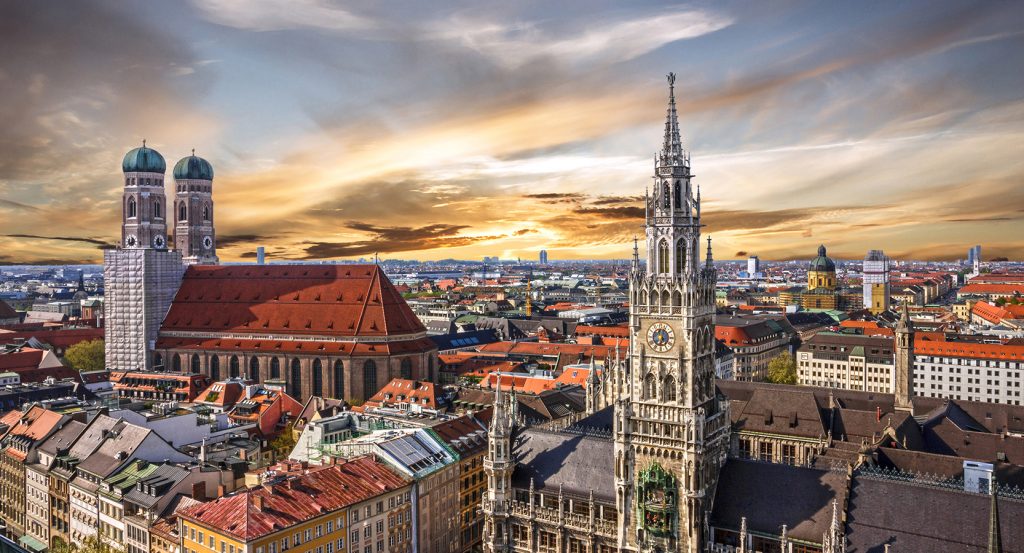
Why you should experience Perlach in Munich, Germany.
Perlach is among the city's most fascinating contrasts, where centuries-old village heritage, ambitious postwar development, and expansive green spaces converge within a district that reveals Munich's evolution across multiple eras.
Historic churches, residential communities, business centers, neighborhood parks, shopping destinations, traditional Bavarian landmarks, and modern housing developments create a district that balances deep-rooted history with contemporary urban living. Originally an independent village southeast of Munich, Perlach maintained its rural character for centuries before becoming part of the growing city. During the twentieth century, large-scale developments transformed portions of the district into modern residential communities while preserving traces of its historic core. Today, visitors encounter a neighborhood that feels diverse, spacious, and unexpectedly layered. To the north, Ramersdorf's pilgrimage heritage and village character continue the historical story that shaped much of southeastern Munich before urban expansion redefined the landscape. Every church square, residential avenue, and public space reflects a district shaped by continuity, growth, and reinvention.
What you should know about Perlach.
Perlach is best known for being home to Neuperlach, among Germany's largest postwar planned urban developments, created to address Munich's housing needs through an ambitious vision of modern city design.
Conceived during the 1960s and developed over subsequent decades, Neuperlach represented one of the most significant urban planning projects in postwar Germany. The development introduced large-scale residential communities, integrated transportation infrastructure, commercial centers, schools, and public amenities designed to function as a self-contained urban district. Its creation fundamentally reshaped the southeastern edge of Munich while providing housing for tens of thousands of residents. The project remains an important case study in European urban planning and continues to influence discussions around large-scale residential development. Few neighborhoods in Munich possess such a direct connection to one of Germany's most ambitious postwar planning initiatives.
How to fold Perlach into your trip.
Perlach works as an exploration of historic village roots, modern urban planning, and the community spaces that define everyday life in southeastern Munich.
Begin at the historic center of Altperlach, where the district's defining relationship with local history, village identity, and community life immediately comes into focus. Continue toward Neuperlach Zentrum, whose modern architecture, commercial activity, and transportation connections reveal the ambitious planning vision that transformed the district during the twentieth century. From there, make your way to Ostpark, where expansive green spaces, walking paths, and recreational facilities provide a broader perspective on the balance of nature and urban living that continues to attract residents today. Along the route, you'll encounter historic churches, residential neighborhoods, shopping districts, public plazas, community facilities, local cafés, and green spaces that showcase Perlach's remarkable diversity. Together, these destinations reveal how Perlach evolved from a rural village into one of the city's most significant residential districts.
Where your story begins.
Foresyte Travel reveals places that feel extraordinary long before you arrive.
Experience premium editorial crafted for luxury travelers.