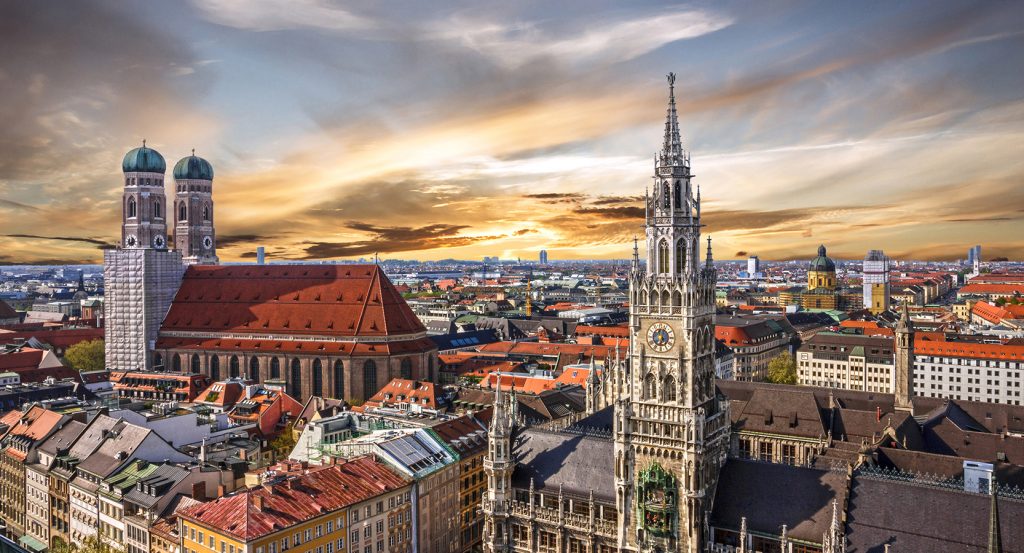
Why you should experience Ramersdorf in Munich, Germany.
Ramersdorf is among the city's oldest continuously inhabited districts, where centuries of religious heritage, residential charm, and urban growth converge within a neighborhood that bridges Munich's historic traditions and modern expansion.
Historic churches, quiet residential streets, local cafés, community parks, traditional Bavarian establishments, neighborhood squares, and convenient transit connections create a district that balances historical significance with everyday livability. Originally a rural village located along important trade and pilgrimage routes southeast of Munich, Ramersdorf gradually became integrated into the growing city while preserving much of its distinct identity. Over generations, farmers, merchants, craftsmen, and residents helped shape a community known for its strong local character and deep historical roots. Today, visitors encounter a neighborhood that feels authentic, approachable, and deeply connected to Munich's past. To the north, Schwabing-Freimann's modern business centers and internationally recognized landmarks provide a striking contrast to the historic village atmosphere that continues to define much of Ramersdorf. Every church tower, neighborhood square, and residential street reflects a district shaped by faith, continuity, and community.
What you should know about Ramersdorf.
Ramersdorf is best known for being home to one of Munich's oldest pilgrimage churches, a religious landmark that has attracted worshippers and travelers for centuries and helped establish the district as an important spiritual destination within Bavaria.
The Church of St. Mary in Ramersdorf became a significant pilgrimage site during the Middle Ages, drawing visitors from across the region who traveled to venerate sacred relics and participate in religious traditions. Its presence helped shape the character of the surrounding village, influencing local development and establishing Ramersdorf as an important stop along regional pilgrimage routes. Over the centuries, the church remained a focal point of community life while surviving political, social, and urban changes that transformed the surrounding landscape. Today, it stands as one of Munich's most historically significant religious sites and a visible reminder of the district's deep historical roots. Few neighborhoods in Munich possess such a direct connection to the city's medieval spiritual heritage.
How to fold Ramersdorf into your trip.
Ramersdorf works as an exploration of historic landmarks, neighborhood culture, and the places that reveal a quieter side of the city.
Begin at the Church of St. Mary in Ramersdorf, where the district's defining relationship with pilgrimage, faith, and local history immediately comes into focus. Continue toward Ramersdorfer Platz, whose surrounding streets, local businesses, and community atmosphere reveal the village character that has shaped the neighborhood for generations. From there, make your way to Ostpark, where landscaped green spaces, walking paths, and recreational facilities provide a broader perspective on the quality of life that continues to attract residents to the district today. Along the route, you'll encounter historic churches, neighborhood cafés, residential avenues, community landmarks, local parks, traditional Bavarian establishments, and public gathering spaces that showcase Ramersdorf's distinctive character. Together, these destinations reveal how Ramersdorf evolved from a medieval pilgrimage village into one of the city's most historically rich residential districts.
Where your story begins.
Foresyte Travel reveals places that feel extraordinary long before you arrive.
Experience premium editorial crafted for luxury travelers.