
Why you should experience Equestrian Monument of Cosimo I in Florence, Italy.
Equestrian Monument of Cosimo I in Florence stands like a bronze heartbeat at the center of Piazza della Signoria, a portrait not just of a man, but of a dynasty in motion.
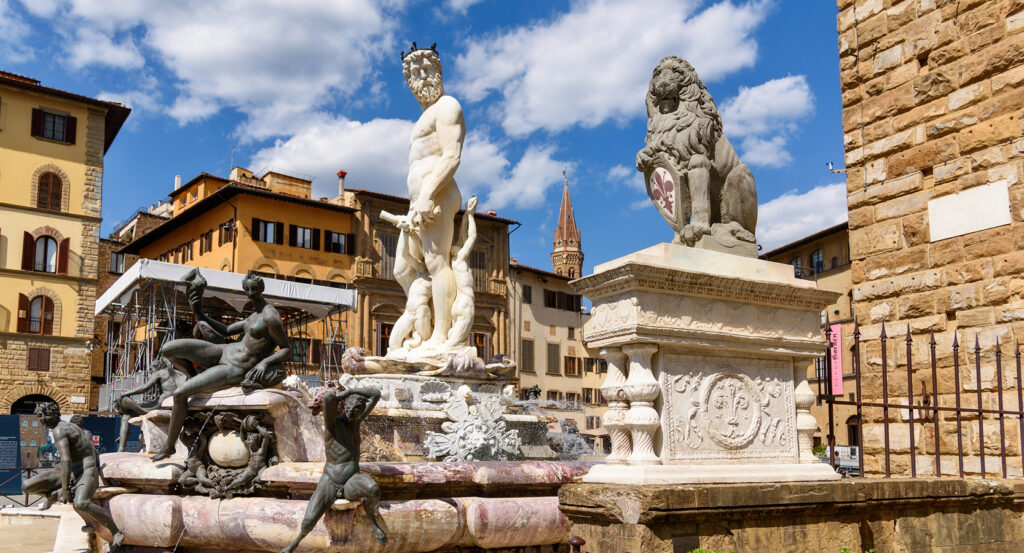
Cast by Giambologna in 1594, the statue captures Florence's first Grand Duke with the calm assurance of someone who believed his rule was destiny. Cosimo sits astride his horse with measured poise, not in battle armor but in the composed elegance of command, the perfect example of Medici authority. The horse itself is a masterpiece of balance: veins visible beneath its taut bronze skin, one hoof lifted as if caught between breath and stride. Sunlight traces the smooth metal curves, making the duke appear perpetually alive, surveying his city. Around him, the square hums with energy, the Fountain of Neptune glistening nearby, Palazzo Vecchio looming above, yet this single figure commands quiet. Giambologna's artistry achieves what few monuments ever do: power rendered with grace, motion captured in eternity.
What you should know about Equestrian Monument of Cosimo I.
Equestrian Monument of Cosimo I was more than a tribute, it was a statement of legacy cast in bronze.
Commissioned by Cosimo's son, Francesco I, after the duke's death, the statue was intended to immortalize not just a ruler but the idea of Florentine stability under Medici rule. Giambologna, a Flemish sculptor who had made Florence his home, studied ancient Roman equestrian statues like that of Marcus Aurelius before creating his own interpretation, one that merged classical restraint with Renaissance precision. Every line was deliberate: the calm gaze of Cosimo signifying rational governance, the horse's raised hoof symbolizing progress and controlled strength. Even the pedestal tells a story, adorned with bas-reliefs depicting Cosimo's triumphs, from the conquest of Siena to the founding of the Florentine naval order. The casting process itself was a triumph of engineering; the statue, over four meters tall, was poured in a single piece of molten bronze, a feat that astonished contemporaries and solidified Giambologna's reputation as the Medici's master sculptor. For Florence, it was a declaration in metal: the republic's age of turbulence had ended, replaced by order under one serene hand.
How to fold Equestrian Monument of Cosimo I into your trip.
Equestrian Monument of Cosimo I rewards slow observation, a sculpture meant to be walked around, not just glanced at.
Visit Piazza della Signoria in the morning, when the bronze glows amber and long shadows carve the details of horse and rider into high relief. Begin from the front, where Cosimo's gaze meets the horizon, he's facing the Uffizi, as if watching over Florence's intellect as much as its politics. Move clockwise to admire Giambologna's anatomical precision: the musculature of the horse, the drape of the duke's cloak, the quiet equilibrium that defines the composition. Step close to the pedestal to study the bas-reliefs; each one reads like a miniature chronicle of Medici triumph. As dusk approaches, the fading light transforms the bronze into something almost living, the horse's flank catching fire in gold, the duke's profile etched against the evening sky. Take a final look from the edge of the piazza, with Palazzo Vecchio rising behind him; Equestrian Monument of Cosimo I isn't merely a monument, it's the example of Florence's passage from republic to Renaissance empire, frozen mid-stride.
Where your story begins.
Foresyte Travel reveals places that feel extraordinary long before you arrive.
Experience premium editorial crafted for luxury travelers.




















































































































