
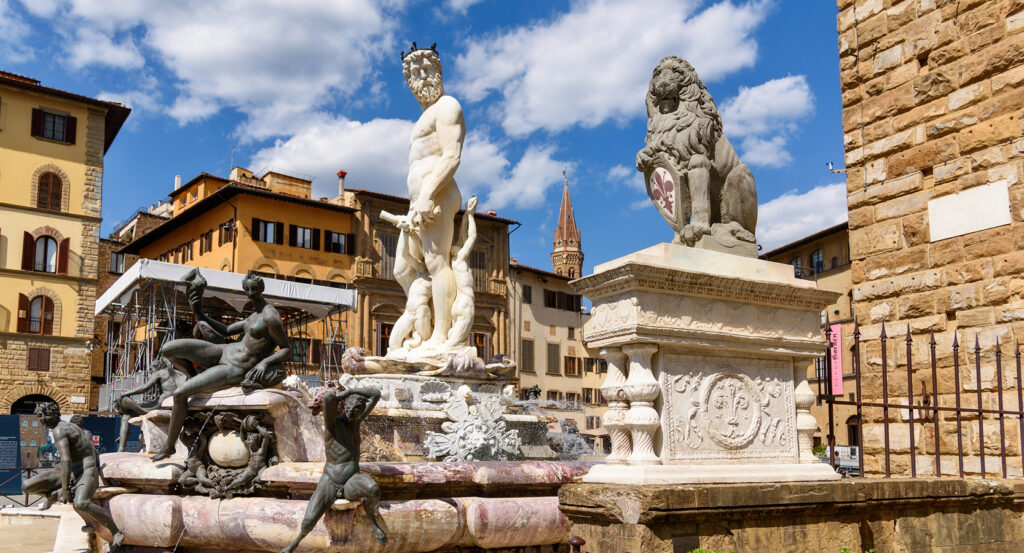
Why you should experience Hercules and Cacus in Florence, Italy.
Hercules and Cacus in Florence stands as a tribute to brute strength and civic pride, a muscular example of Florence's will to prevail.
Guarding the entrance to Palazzo Vecchio alongside the David, this colossal marble by Baccio Bandinelli commands attention with its sheer physical tension. Hercules towers above the defeated giant Cacus, his sinews taut, his gaze fixed in triumph. Every detail, the twisting torso, the strained veins, the powerful grip, speaks of struggle, conquest, and authority. Unlike the poised idealism of Michelangelo's David, Bandinelli's Hercules captures the Medici vision of control and domination. Bathed in sunlight, the statue's polished surface glows with an almost living vitality, while the shadows cast beneath Hercules's stance dramatize the eternal clash between intellect and force. Together, David and Hercules and Cacus form a discussion at the Palazzo's threshold, freedom and power, citizen and ruler, forever locked in marble conversation.
What you should know about Hercules and Cacus.
Hercules and Cacus was conceived as political art, a statement carved in stone during Florence's most turbulent years.
Commissioned by Duke Cosimo I de' Medici in 1525, the statue was intended as a counterbalance to Michelangelo's David, which symbolized the free republic that the Medici had overthrown. Where David represented rebellious independence, Bandinelli's Hercules asserted the restored strength and order of Medici rule. The choice of myth was deliberate: Hercules, the hero of civilization, subdues Cacus, the chaotic cave-dweller, a metaphor for Florence's triumph over rebellion. Bandinelli's style, often criticized in his lifetime, departed from Michelangelo's idealism, favoring an almost theatrical realism, bulging muscles, twisting forms, and high resonant drama. Yet within that exaggeration lies a powerful narrative of Florence's evolving identity: from republic to principality, from idealism to authority. The statue also marks one of the last great works of the High Renaissance, when humanist proportion began giving way to the expressive distortion of Mannerism. Every inch of marble is both art and ideology, a proclamation of who ruled Florence, and how.
How to fold Hercules and Cacus into your trip.
To appreciate Hercules and Cacus fully, view it as part of the grand sculptural ensemble in Piazza della Signoria, a discussion among eras and ideals.
Visit in the morning when sunlight floods the square and shadows sharpen the marble's forms. Stand between David and Hercules to sense the tension, Michelangelo's calm defiance against Bandinelli's controlled fury. Walk around the statue; from the left, Hercules's face softens in victory, while from the right, Cacus's contorted features emerge from the stone in almost cinematic relief. Step closer to observe the masterful chiseling of hair, sinew, and skin, Bandinelli's precision reveals both obsession and ego. In the late afternoon, when golden light reflects off Palazzo Vecchio's façade, the scene feels almost alive, the marble glowing as if still warm from the sculptor's hand. End your visit by looking upward toward the tower of the Palazzo, the statue's natural axis, to see how perfectly its energy feeds into the architecture above. Hercules and Cacus in Florence is more than myth brought to life; it's a city's declaration in stone, that power, like art, demands to be seen.
Where your story begins.
Foresyte Travel reveals places that feel extraordinary long before you arrive.
Experience premium editorial crafted for luxury travelers.




















































































































