Why Pikes Peak matters.
Pikes Peak is a towering Rocky Mountain summit where the Colorado's dramatic alpine geography meets centuries of Indigenous cultural significance, the exploration of the American West and the transportation innovations that transformed a fourteen-thousand-foot mountain into a national symbol.
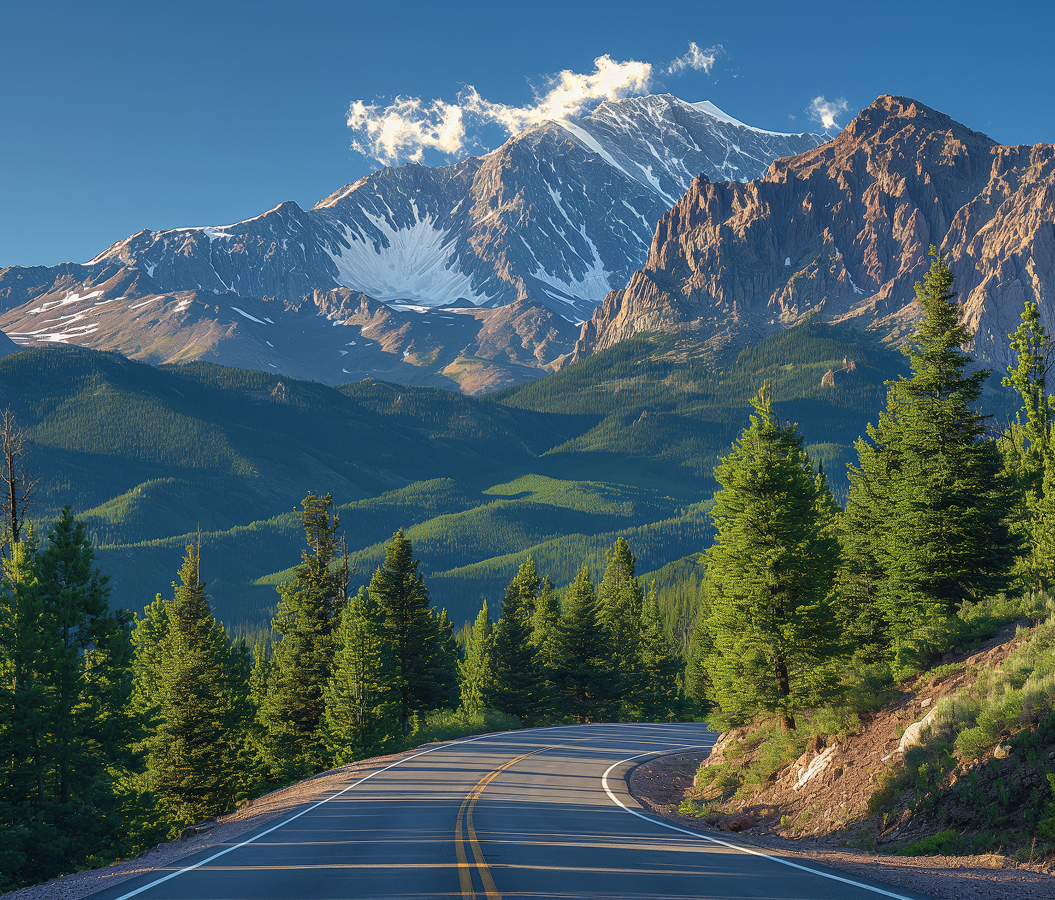
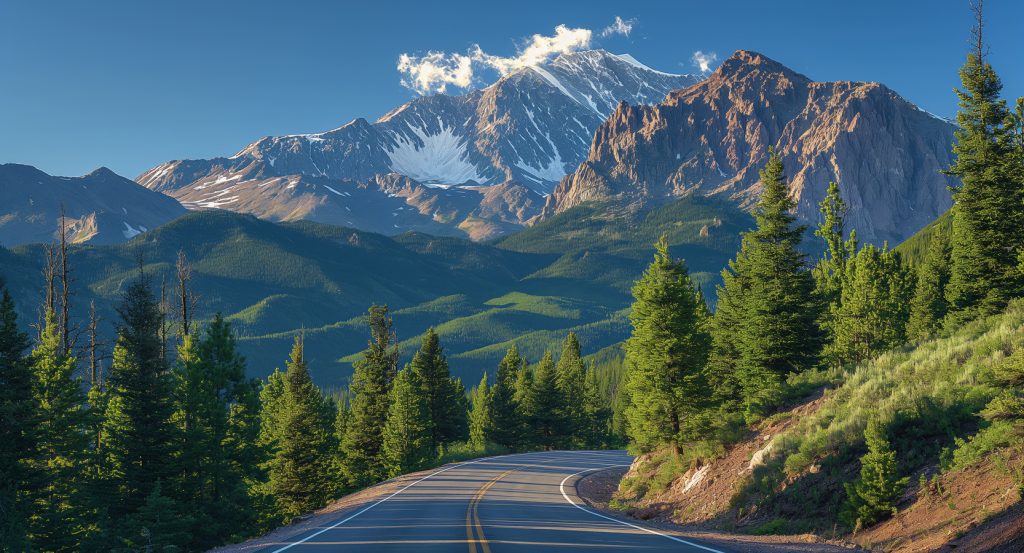
Rising west of Colorado Springs above Manitou Springs and Cascade, the mountain dominates the southern Front Range between the broad plains of eastern El Paso County and the forested highlands extending toward South Park, with its summit forming the highest point in the immediate Colorado Springs landscape. Massive granite slopes ascend through dense conifer forests, exposed rocky ridges and broad expanses of alpine tundra, culminating at an elevation of 14,115 feet above sea level. Above timberline, fractured boulder fields and weathered rock surfaces extend across an exposed summit plateau, where sparse alpine vegetation survives amid extreme temperature changes and powerful winds. The mountain's eastern face descends through steep valleys and glacially influenced terrain, creating a dramatic contrast between the summit's barren granite and the wooded foothills below. The result is a commanding alpine environment whose geological scale, immense vertical relief and panoramic relationship with the Great Plains have made Pikes Peak one of America's most recognizable mountains.
What defines Pikes Peak.
Pikes Peak is best known for its association with American westward expansion, the inspiration for America the Beautiful and its development into one of the world's most accessible high-altitude summits. The mountain's geological foundation consists principally of Pikes Peak Granite, an ancient igneous formation created 1.08 billion years ago through the cooling and crystallization of molten rock deep within Earth's crust. Subsequent tectonic uplift and prolonged erosion exposed the granite massif, establishing the mountain's substantial elevation above the surrounding plains. Indigenous peoples maintained connections with the region for thousands of years, with the Ute recognizing the mountain as an important feature of their ancestral homeland and spiritual geography. The Ute name Tava, meaning sun, expresses the mountain's longstanding cultural importance within the southern Rocky Mountains. Spanish expeditions encountered the broader region during the eighteenth century, incorporating the prominent summit into European geographic knowledge of the interior West. Lieutenant Zebulon Montgomery Pike approached the mountain in November 1806 during an expedition commissioned by President Thomas Jefferson to investigate the southern Louisiana Purchase. Pike attempted an ascent with several members of his party, but severe winter conditions prevented them from reaching the summit. Botanist Edwin James completed the first recorded ascent in July 1820 during Major Stephen Harriman Long's expedition, collecting scientific observations and plant specimens along the route. The mountain briefly carried the name James Peak before Pikes Peak became established through military maps and geographic usage. Julia Archibald Holmes reached the summit in August 1858, becoming the first European American woman known to have completed the ascent. The Colorado Gold Rush subsequently transformed the mountain into a powerful symbol of western opportunity, with prospectors adopting the slogan Pikes Peak or Bust during the migrations of 1859. Colorado Springs founder William Jackson Palmer recognized the mountain's importance to the city's development, incorporating its dramatic setting into the region's emerging reputation as a health resort and scenic destination. Katharine Lee Bates visited the summit in 1893, drawing inspiration from the expansive landscape for the poem that became America the Beautiful. The mountain's national significance developed through the convergence of Indigenous heritage, scientific exploration, western migration and American cultural expression.
Zalmon Gilbert Simmons financed the Manitou and Pikes Peak Railway, which began operating in 1891 and introduced a mechanically sophisticated route to the summit through steep mountain terrain. The railway employed a rack-and-pinion system, allowing specially designed locomotives to climb gradients that conventional adhesion railroads could not negotiate. Its original steam-powered equipment eventually gave way to diesel-electric railcars, improving operational efficiency and accommodating increasing passenger demand. Spencer Penrose subsequently transformed the mountain's automobile accessibility by financing construction of the Pikes Peak Highway, completed in 1915. The winding road established a direct connection between the lower mountain and the summit, introducing a new era of motorized alpine travel. Penrose also founded the Pikes Peak International Hill Climb in 1916, creating an automobile competition that became one of the world's most demanding motorsport events. The race's course incorporated steep grades, tight switchbacks and substantial elevation changes, challenging drivers and engineers to adapt their vehicles to extreme mountain conditions. Early competitors raced across unpaved surfaces, and successive improvements eventually produced a fully paved route. The event attracted internationally recognized manufacturers and drivers, establishing the mountain as an important testing ground for automotive performance and engineering. The railway underwent a major modernization beginning in 2017, culminating in its reopening in 2021 with new trains, upgraded infrastructure and renovated facilities. A new Pikes Peak Summit Visitor Center also opened in June 2021, replacing earlier summit facilities with a contemporary building designed to accommodate the severe alpine climate. The project incorporated extensive environmental planning, improved accessibility and interpretive exhibitions addressing the mountain's history and natural environment. The summit's high-altitude conditions continue to support scientific investigations involving atmospheric physics, human physiology and environmental processes. Its surrounding habitats support bighorn sheep, yellow-bellied marmots and alpine plant communities adapted to short growing seasons and severe weather. Pikes Peak's enduring importance rests in the relationship between its formidable natural geography and the technological achievements that brought successive generations of Americans into direct contact with the high Rocky Mountains.
How Pikes Peak fits.
Pikes Peak works as the geographical anchor for an outing connecting Manitou Springs' nineteenth-century resort culture, the distinctive architecture of Colorado's Victorian settlement era and the limestone caverns that established the region's early reputation for natural discovery.
Begin at Manitou Springs Heritage Museum, the historical institution devoted to preserving the cultural development of the community established along the mineral springs at the mountain's eastern base. Operated by Historic Manitou Springs, Inc., the museum occupies a historic commercial building along Manitou Avenue and maintains collections of photographs, artifacts and archival materials associated with the town's development. Exhibitions examine the area's mineral-water traditions, transportation history and decorative arts, including the work of Van Briggle Art Pottery. The institution also preserves material concerning Indigenous connections to the region and the transformation of Manitou Springs into a nineteenth-century resort community. Continue to Miramont Castle Museum, the elaborate historic residence constructed for French Catholic priest Jean Baptiste Francolon beginning in 1895. The building incorporates an eclectic combination of architectural influences, including English Tudor, medieval European and Victorian forms, assembled through irregular rooflines, projecting bays and crenellated towers. Local contractors Angus and Archie Gillis contributed to its construction, using substantial quantities of quarried greenstone to create the castle's distinctive exterior. Interior rooms preserve architectural details and furnishings associated with the Victorian period, and historical exhibitions examine the property's changing institutional uses. Conclude at Cave of the Winds Mountain Park, the historic cavern attraction situated above Williams Canyon near Manitou Springs. Brothers George and John Pickett explored the cave entrance in 1880, drawing the attention of George Washington Snider, who subsequently excavated passages and developed the property for public exploration. Guided tours began in February 1881, establishing the attraction during Colorado's early period of organized mountain tourism. The limestone cave system contains chambers, narrow passages and mineral formations created through the movement of groundwater over immense geological periods. Electric lighting introduced in 1907 transformed the presentation of its underground chambers, expanding access to formations previously explored by candlelight. The progression moves from Manitou Springs Heritage Museum's regional collections through Miramont Castle Museum's Victorian architecture and culminates at Cave of the Winds Mountain Park's historic underground passages, connecting Pikes Peak with the resort development, architectural ambitions and natural discoveries of its surrounding communities.
Where your story begins.
Foresyte Travel reveals places that feel extraordinary long before you arrive.
Enjoy editorial crafted for luxury travelers.
Foresyte may earn a commission when you book.