
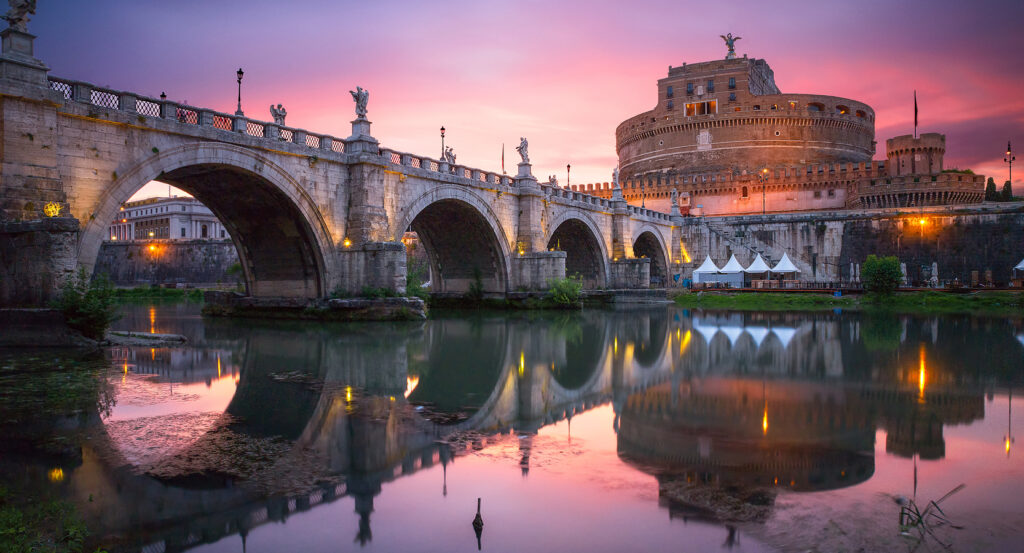
Why you should experience St. Angelo Bridge in Rome, Italy.
Ponte Sant'Angelo stretches across the Tiber like a hymn in stone, a bridge where heaven and history meet midair.
Built in 134 CE by Emperor Hadrian to lead directly to his mausoleum (now Castel Sant'Angelo), it was once the sacred artery of imperial Rome, a pathway from life to immortality. Today, its arches still rise from the river with serene confidence, their reflections shimmering like doubled halos. But what transforms this bridge into poetry are the angels, ten marble messengers conceived by Gian Lorenzo Bernini in the 17th century, each bearing an instrument of Christ's Passion. As you walk its length, the figures seem to move with you: wings trembling, drapery alive in the breeze, expressions carved between sorrow and serenity. The sound of the Tiber murmurs below, echoing centuries of pilgrim footsteps. To cross this bridge is not to move through space, but through emotion, a slow, luminous passage from the mortal to the divine.
What you should know about St. Angelo Bridge.
What most visitors don't realize is that Ponte Sant'Angelo has witnessed every contradiction Rome has ever contained, triumph, tragedy, faith, and performance.
Hadrian's original statues of Peter and Paul once flanked the entrance, guardians of the emperor's eternal rest. In the Middle Ages, the bridge became a route for pilgrims heading to St. Peter's Basilica, yet it also served as a stage for executions, where heads of the condemned were displayed upon pikes as grim warnings to the devout. When Bernini reimagined it under Pope Clement IX, he turned cruelty into grace. His angels, sculpted with impossible delicacy, replaced terror with transcendence, their downward gazes and flowing robes inviting contemplation. Each angel tells a story: the one with the Crown of Thorns, serene despite its burden; the one with the Cross, stoic as marble faith. Though centuries of floods and battles have passed, the bridge endures as Rome's most elegant paradox, sacred yet sensual, eternal yet ephemeral.
How to fold St. Angelo Bridge into your trip.
To fold Ponte Sant'Angelo into your Roman journey, approach it not as a shortcut, but as a ceremony.
Arrive near sunset when the light gilds the statues, and their shadows stretch long across the cobblestones like silent pilgrims of their own. Walk slowly from the city side toward the Castel, letting each angel meet your gaze, they are arranged as verses in a psalm, meant to be read in motion. Pause midway and lean against the parapet; watch the river turn bronze beneath you as the dome of St. Peter's ignites in the distance. If you visit after rain, you'll find the marble glistening, every wing alive with reflection. At night, the bridge becomes intimate, lanterns flicker, the city quiets, and Bernini's angels seem to breathe. Cross once more in reverse, and you'll feel it, the rarest sensation in Rome: tranquility. Ponte Sant'Angelo doesn't just connect banks of a river; it connects eras, faiths, and hearts that have never stopped crossing.
Where your story begins.
Foresyte Travel reveals places that feel extraordinary long before you arrive.
Experience premium editorial crafted for luxury travelers.




















































































































