
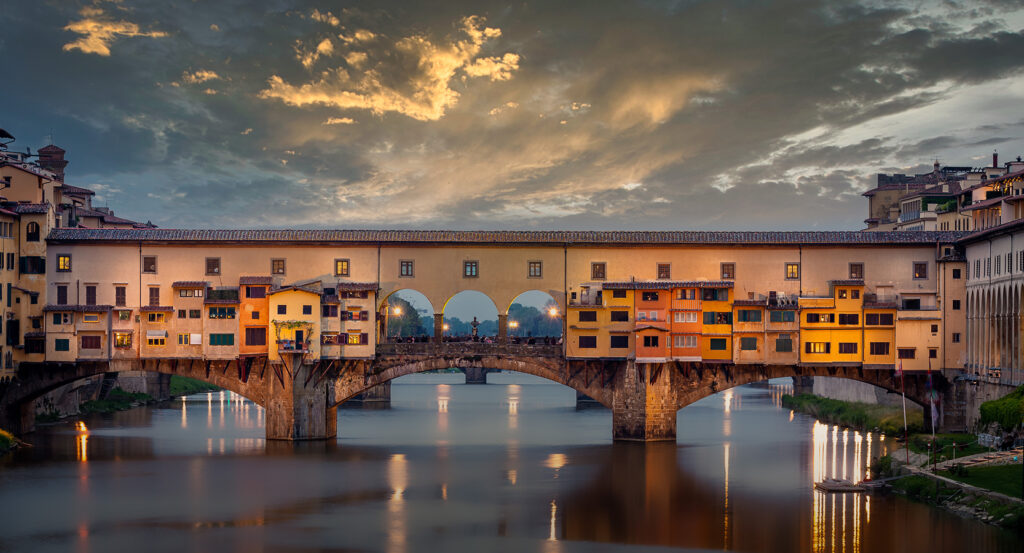
Why you should experience Corridoio Vasariano in Florence, Italy.
Corridoio Vasariano at Ponte Vecchio in Florence is among the city's most fascinating architectural secrets, a quiet thread of power and art that weaves through the heart of the Renaissance.
From the outside, it might seem like a simple elevated walkway curving gracefully over the bridge's rooftops, but it represents centuries of intrigue, privilege, and genius. Designed by Giorgio Vasari in 1565 for Duke Cosimo I de' Medici, the corridor allowed the Medici family to travel safely and unseen between their seat of government at the Palazzo Vecchio and their residence at the Pitti Palace across the river. Passing through the Uffizi, over the Ponte Vecchio, and along the rooftops of the Oltrarno, the corridor offered a commanding view of the city below, a literal elevation above the people. Standing beneath its stone archway, you can feel the duality it represents: the artistry that built Florence and the authority that ruled it. The passage looms elegantly over the shops and tourists of the bridge, a silent reminder that even in a city devoted to beauty, power always had the best view.
What you should know about Corridoio Vasariano.
Corridoio Vasariano was an architectural marvel of its time, and the archway above the Ponte Vecchio remains its most iconic stretch.
Constructed in just five months to celebrate the marriage of Francesco I de' Medici and Joanna of Austria, the corridor was a triumph of Vasari's ingenuity. Its path crosses the Arno by passing directly over the jewelry shops of the Ponte Vecchio, continuing along private buildings, and entering the Boboli Gardens behind the Pitti Palace. The portion above the bridge features the famous archway windows, which were redesigned in the 20th century to open outward and reveal Florence's skyline. Originally, these windows were sealed, the Medici preferred privacy and discretion, but their later addition gave the public a glimpse into the corridor's rarefied world. During World War II, when all other bridges were destroyed, Corridoio Vasariano survived intact, preserving its Renaissance structure. Inside, it once held hundreds of self-portraits by artists from the 16th to the 20th century, forming one of the most unusual and personal collections in the world. Though the corridor has been periodically closed for restoration, the archway remains visible to all, an enduring emblem of Florence's marriage of art, politics, and vision.
How to fold Corridoio Vasariano into your trip.
Corridoio Vasariano is best appreciated as part of a slow, deliberate walk through Florence's historic core, where every corner reveals the legacy of the Medici.
Begin at the Uffizi Gallery, whose upper halls align with the start of the corridor, and trace its exterior path with your eyes as it stretches over the Lungarno toward the Ponte Vecchio. Once on the bridge, look up, the archway curves directly overhead, its pale stone glowing in contrast to the warm colors of the surrounding shops. Stand at the midpoint of the bridge and peer through the windows: one frames the Uffizi and the Arno's calm expanse, the other looks west toward the golden light of sunset over the water. The view encapsulates the entire essence of Florence, beauty, secrecy, and power intertwined. Visit in the early morning for quiet reflection or late evening when the lights shimmer on the river below. Corridoio Vasariano at Ponte Vecchio in Florence is not just an architectural passage, it's a bridge above a bridge, a suspended whisper of history that still binds the city's soul together.
Where your story begins.
Foresyte Travel reveals places that feel extraordinary long before you arrive.
Experience premium editorial crafted for luxury travelers.




















































































































