Why Raya Restaurant matters.
Raya Restaurant is a historic Phuketian restaurant where Old Phuket Town's Sino-European architectural heritage meets the culinary traditions of southern Thailand, Kularb Jesadawal's celebrated family recipes and the preservation of Phuket's multicultural food culture within a century-old merchant residence.
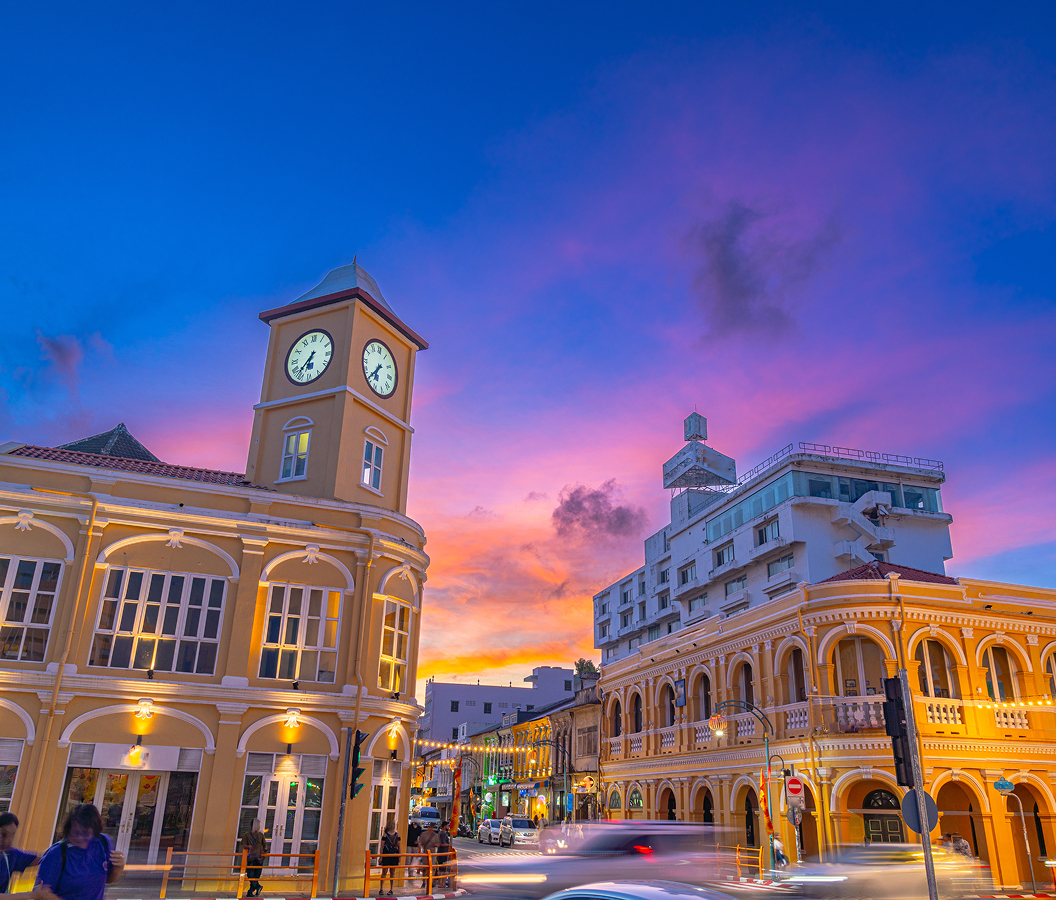
Occupying a prominent corner near the intersection of Dibuk Road and its adjoining cross street in Phuket's Talat Yai district, Raya Restaurant stands east of Yaowarat Road and north of Thalang Road, within walking distance of the historic shophouses, Chinese shrines and commercial streets surrounding Soi Romanee. The restaurant occupies a two-story Sino-European residence whose pale yellow exterior incorporates arched ground-floor openings, green timber shutters and decorative plasterwork associated with Phuket's historic merchant architecture. Original patterned floor tiles extend through the interior, introducing geometric designs and contrasting colors beneath traditional wooden furnishings. Stained-glass windows, framed historical photographs and vintage decorative objects contribute to the domestic character of the dining rooms. The ground floor contains several connected dining spaces, and an upper level provides additional seating within the former residential structure. Mature plants and ornamental greenery soften the building's exterior, creating a garden-like transition between the surrounding commercial streets and its historic interior. The result is an atmospheric heritage restaurant whose preserved domestic architecture and intimate dining rooms establish a direct connection with the merchant households that shaped Phuket's historic center.
What defines Raya Restaurant.
Raya Restaurant is best known for the culinary legacy of Kularb Jesadawal, affectionately called Pa Kularb, whose family cooking transformed a historic Phuket residence into one of southern Thailand's most recognized regional restaurants. Before entering the restaurant industry, Jesadawal worked in banking and developed a reputation among relatives and friends for preparing traditional Phuket dishes at home. Her cooking drew upon recipes inherited through her family, preserving preparations associated with the island's Chinese-Thai households and the distinctive ingredients of southern Thailand. Friends repeatedly encouraged her to establish a restaurant, recognizing the quality of the food and the significance of the family traditions she maintained. In 1994, Jesadawal opened Raya, adapting a historic residence into a dining establishment devoted to Phuket's regional cuisine. The restaurant's development coincided with a period when the island's international tourism industry concentrated heavily on coastal resorts, leaving the architectural and culinary heritage of Phuket Town less prominent within the visitor economy. Jesadawal established the restaurant around a relatively focused collection of family preparations, emphasizing consistency, carefully selected ingredients and direct oversight of the kitchen. Her mother's crab curry became the defining preparation, connecting the restaurant's commercial success to a recipe developed within the family household. Jesadawal personally selected ingredients, including large fresh prawns, southern stink beans and the tender shoots of local edible plants, establishing ingredient quality as a central part of the restaurant's reputation. She also supervised the cooking process, maintaining the distinctive flavors of preparations that had been served within her family for generations. Raya gradually attracted a substantial following among Phuket residents, Thai travelers and visitors seeking the island's regional specialties. Its reputation extended to members of royal families, international dignitaries and prominent culinary figures who visited the restaurant during their travels through southern Thailand. The restaurant became particularly associated with Phuket's emerging heritage conservation movement as renewed interest in the historic town brought attention to its surviving Sino-European buildings and traditional food establishments. Phuket's designation as a UNESCO Creative City of Gastronomy in 2015 strengthened international recognition of the island's multicultural culinary traditions, providing a broader cultural setting for Raya's established cooking. The MICHELIN Guide expanded its Thailand coverage to Phuket in 2019, bringing the island's regional restaurants into an internationally recognized system of culinary evaluation. Raya received a Bib Gourmand distinction in the inaugural Phuket selection, recognizing its regional cooking and value within the guide's restaurant classification. The restaurant retained Bib Gourmand recognition through the 2024 selection, establishing a sustained period of MICHELIN distinction for its traditional Phuket preparations. Its classification changed to MICHELIN Selected in 2025, and the restaurant was absent from the 2026 Phuket guide. These developments followed three decades during which Jesadawal's cooking had become closely associated with Phuket's regional culinary heritage. The restaurant's continued operation preserves the original family-centered concept, maintaining the relationship between inherited recipes, ingredient selection and the historic building that established its reputation. Raya's significance rests on this sustained preservation of Phuket's domestic cooking traditions, demonstrating how a family kitchen developed into an internationally recognized institution within the island's historic commercial center.
Kularb Jesadawal's culinary program centers on the distinctive combination of southern Thai spices, Chinese-Phuket cooking techniques and ingredients associated with the island's coastal and agricultural environments. The kitchen's signature crab curry, gaeng pu bai cha plu, develops its character through fresh crab meat simmered in a coconut-based curry enriched with aromatic herbs and spices. The preparation incorporates wild betel leaves, whose peppery fragrance contributes a distinctive herbal dimension to the rich coconut sauce. Substantial pieces of crab provide natural sweetness and delicate texture, creating a balance with the curry's concentrated heat and aromatic intensity. Thin rice noodles accompany the preparation, absorbing the sauce and connecting the seafood curry to a longstanding tradition of serving southern Thai curries with fermented or plain rice noodles. The restaurant's moo hong develops another expression of Phuket's culinary heritage through the slow braising of pork with garlic, pepper and savory seasonings. The meat cooks for more than three hours, allowing its connective tissue to soften and the surrounding liquid to develop a concentrated, glossy sauce. This preparation derives from Chinese-Phuket household cooking, incorporating techniques associated with Hokkien culinary traditions and the island's historic Chinese merchant communities. The balance of pepper, garlic and rich pork creates a deeply savory preparation whose tenderness depends on extended cooking and careful control of heat. Jesadawal's tamarind prawns develop a contrasting flavor profile through the combination of fresh shellfish and a sauce shaped by the fruit's characteristic acidity. Large prawns are selected for their firm texture and natural sweetness, allowing the tamarind's tartness to provide a clear counterpoint to the richness of the seafood. Southern stink beans, known as sator, contribute a distinctive pungency associated with regional cooking throughout the Malay Peninsula and southern Thailand. Their preparation emphasizes the beans' pronounced flavor, frequently combining them with aromatic seasonings and savory ingredients that complement their intensity. Pak miang, a leafy vegetable widely used in southern Thai kitchens, introduces another regional ingredient through its tender young shoots. Stir-frying the leaves with egg or dried shrimp creates a preparation whose gentle bitterness and vegetal sweetness balance the more concentrated flavors of the surrounding dishes. Raya's repertoire also includes sour fish curries incorporating coconut shoots and local vegetables, extending the kitchen's treatment of seafood through the sharp acidity and chili heat characteristic of southern Thai cooking. Dried shrimp chili relish, known as nam phrik kung siap, develops another connection to Phuket's coastal food traditions through preserved seafood, chilies and aromatic ingredients. Its concentrated flavor complements fresh vegetables and rice, demonstrating the importance of condiments within the structure of a traditional Thai meal. The restaurant's dishes are intended for communal dining, with several preparations placed at the center of the table and combined according to individual preferences. Rice provides the foundation for the meal, allowing rich braises, spicy curries, seafood and vegetables to develop complementary relationships. The kitchen's culinary distinction emerges through this interconnected collection of family preparations, preserving the balance of heat, acidity, sweetness and savory depth that characterizes Phuket's regional food culture.
How Raya Restaurant fits.
Raya Restaurant works as the centerpiece of an exploration connecting Phuket's Chinese religious heritage, the commercial architecture of its historic trading streets and the educational institutions established by the island's prosperous merchant families.
Begin at Shrine of the Serene Light, the historic Chinese religious sanctuary concealed behind the commercial frontage of Phang Nga Road. Established in 1889, the shrine is associated with the Tan Luan Jae community and preserves architectural elements characteristic of southern Chinese religious buildings. Its decorative program incorporates elaborate roof ornaments, carved details and painted panels depicting figures from Chinese religious traditions. The shrine occupies a compact courtyard reached through a narrow passage from the adjoining street, preserving a distinctive relationship between commercial buildings and community worship. Incense offerings and devotional ceremonies maintain its connection to the religious traditions of Phuket's Chinese families, whose settlement contributed substantially to the development of the historic town. Continue to Thalang Road, the principal historic commercial street running through the center of Old Phuket Town. Its continuous rows of Sino-European shophouses preserve the architectural character of the island's nineteenth- and early twentieth-century merchant economy, with narrow commercial frontages, decorative plasterwork and covered pedestrian arcades. The street developed through Phuket's tin-mining prosperity, when Chinese merchants established trading houses and commercial enterprises connected to regional maritime networks. In 2010, a major streetscape improvement project relocated overhead electrical cables underground, restoring clearer views of the historic façades. The Lard Yai Sunday Walking Street Market began in late 2013, transforming the corridor into a weekly gathering devoted to local food, crafts and cultural activity. Conclude at Phuket Thai Hua Museum, the former Chinese-language school occupying a substantial historic building on Krabi Road. Constructed in 1934 through contributions from Phuket's Hokkien Chinese community, the building incorporates a symmetrical façade, arched openings and an internal courtyard associated with Sino-European institutional architecture. King Prajadhipok, Rama VII, visited the school grounds in 1928, an event commemorated within the museum's historical exhibitions. The building was registered as a heritage property in 2002, and its subsequent restoration transformed the former educational institution into a museum that opened in 2010. Thirteen exhibition rooms examine Chinese migration, tin mining, family customs, educational development and the cultural traditions that shaped Phuket's urban history. The progression moves from Shrine of the Serene Light's religious heritage through Thalang Road's merchant architecture and culminates in Phuket Thai Hua Museum's educational and migration history, connecting the institutions that shaped Old Phuket Town's multicultural development.
Where your story begins.
Foresyte Travel reveals places that feel extraordinary long before you arrive.
Enjoy editorial crafted for luxury travelers.
Foresyte may earn a commission when you book.