Why Red Rocks Park and Amphitheatre matters.
Red Rocks Park and Amphitheatre is a geologic performance complex where Morrison's Front Range threshold meets towering Fountain Formation monoliths, Burnham Hoyt's site-responsive architecture and one of the Civilian Conservation Corps' most ambitious public works projects.
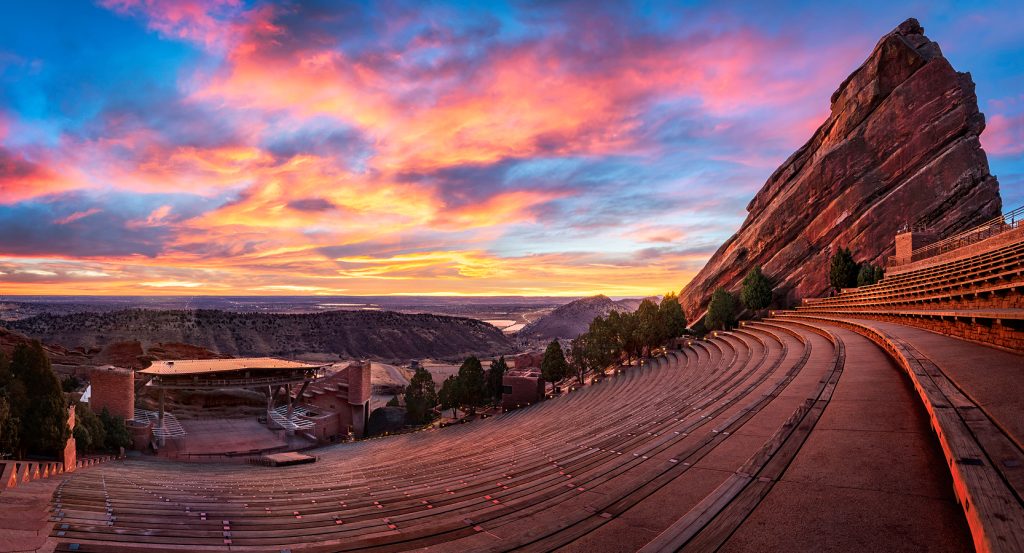
Set along West Alameda Parkway near Trading Post Road and just steps from Ship Rock, the amphitheatre occupies a 738-acre mountain park where the Great Plains rise into the Rocky Mountain foothills, with Creation Rock enclosing the north side and Mount Morrison climbing immediately west. Rows of benches descend through a natural sandstone opening toward Stage Rock, using the land's 100-foot drop to preserve broad sightlines across the auditorium. Ship Rock rises along the southern edge as Creation Rock forms the opposing wall, placing grand stone directly inside the performance environment. Sandstone stairs, retaining walls, planters and colored concrete extend built elements through the terrain with forms and hues tied closely to the surrounding formations. The result is an open-air auditorium in which architecture occupies the narrow space between immense rock formations, preserving mountain terrain as the dominant physical force.
What defines Red Rocks Park and Amphitheatre.
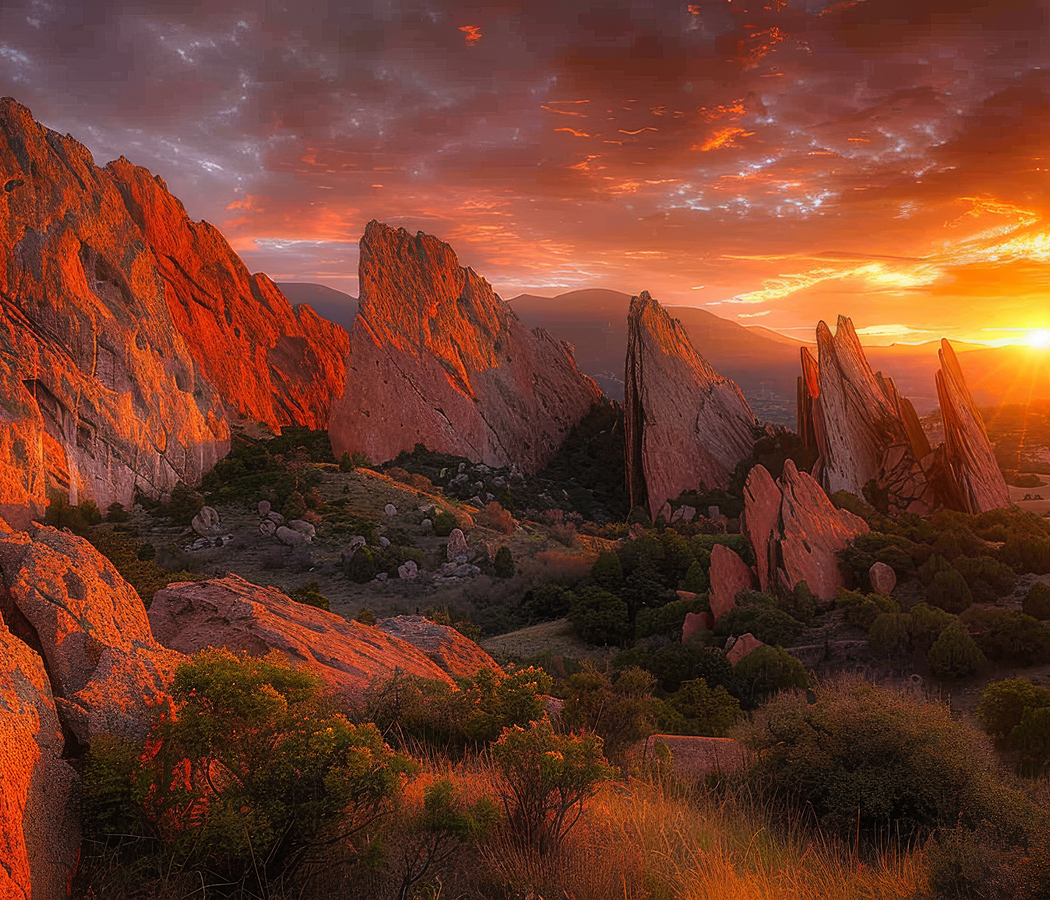
Red Rocks Park and Amphitheatre is best known for the union of ancient Front Range geology, Burnham Hoyt's amphitheatre design and Depression-era construction undertaken by Civilian Conservation Corps workers between 1936 and 1941. The Fountain Formation began accumulating 300 million years ago from sediment eroded off the ancestral Rocky Mountains, with later uplift tilting enormous slabs along the Front Range and differential erosion carving the formations visible across the park. Iron oxidation supplied their red coloration, and Ship Rock and Creation Rock became the immense opposing walls surrounding the natural auditorium. John Brisben Walker purchased property here after selling Cosmopolitan to William Randolph Hearst and developed the Garden of the Titans as an attraction, constructing a temporary performance stage and tourist railway during the early twentieth century. Scottish soprano Mary Garden sang at the natural auditorium in 1911 and praised its acoustic properties years before a permanent theatre occupied the site. Denver acquired 675 acres in 1927 for $50,000, then developed a five-mile scenic roadway through the formations before Parks and Improvements Manager George Cranmer advanced plans for a permanent outdoor theatre. Secretary of the Interior Harold Ickes approved Civilian Conservation Corps participation on May 9, 1936, clearing the way for Company 1848 and later Company 1860 to undertake one of the Corps' largest construction projects. Architect Burnham Hoyt sought minimal architectural intervention, positioning the seating between Ship Rock and Creation Rock and preserving an unobstructed eastern view toward Denver and the plains. Stanley Morse produced much of the detailed design work under Hoyt, resolving grading, sightlines, stage facilities, redwood benches, handrails, drainage and plantings as construction advanced. Workers removed 25,000 cubic yards of rock and earth and installed 90,000 square feet of flagstone, 800 tons of quarried stone and 30,000 pounds of reinforced steel during the project. The official opening on June 15, 1941 featured Metropolitan Opera soprano Helen Jepson, the Denver Municipal Chorus and civic ceremonies carried nationally by CBS. Red Rocks later hosted the Beatles in 1964, Bruce Springsteen's first outdoor concert in 1978 and U2's 1983 Under a Blood Red Sky concert film, performances that expanded the theatre's international musical stature across successive generations. Red Rocks Park and the surviving Mount Morrison CCC camp received National Historic Landmark designation in 2015, recognizing the combined significance of the landscape, park planning, architecture and New Deal construction.
Geology controls sound inside the auditorium by placing the performance area between immense rock masses whose position, height and orientation already formed an acoustic enclosure before permanent construction began. Ship Rock rises 200 feet along the south side and Creation Rock 300 feet along the north, restricting lateral sound dispersion across the seating bowl. Hoyt preserved that natural enclosure as the fundamental acoustic structure, concentrating architectural work on the graded audience area, stage and supporting facilities. The seating descends 100 vertical feet toward Stage Rock, creating direct lines between performers and successive rows as the audience rises away from the stage. Continental seating removes a central aisle from the principal bench field, preserving long uninterrupted rows across the slope. Sandstone retaining walls and built surfaces follow the surrounding geology closely, limiting large architectural barriers between the audience and the formations. The open eastern end releases the auditorium toward the plains and Denver skyline, giving the enclosed sides a broad outward termination beyond the stage. Amplified concerts add modern sound reinforcement to this geologic shell, yet the room's fundamental proportions still derive from the relationship among Ship Rock, Creation Rock, Stage Rock and the descending terrain. A 9,525-person capacity places a substantial audience inside that natural geometry without enclosing the auditorium beneath a roof. Red Rocks Park and Amphitheatre derives its performance character from this union of tilted sandstone, descending topography and restrained architectural intervention, turning the preexisting landform into the organizing structure for sight and sound.
How Red Rocks Park and Amphitheatre fits.
Red Rocks Park and Amphitheatre works as the centerpiece of a park route connecting its Pueblo Revival trading post, preserved New Deal work camp and fossil-bearing hogback where discoveries helped launch the scientific study of Colorado dinosaurs.
Begin at Red Rocks Trading Post, opened by Denver in 1931 as development of the mountain park accelerated before amphitheatre construction. Architect W.R. Rosche designed the two-story Pueblo Revival building from local stone and concrete, placing it beneath the formations as a visitor facility surrounded by native vegetation and trails. Its early combination of dining, retail and museum functions made the building an interpretive gateway to a park still years from receiving its permanent performance venue. The structure later housed the Colorado Music Hall of Fame museum from 2015 through 2024, adding a music-history role to a building created during Red Rocks' earliest municipal development. Continue to Mount Morrison Civilian Conservation Corps Camp, where Company 1848 arrived on June 30, 1935 to undertake park improvements before federal approval shifted almost the entire workforce toward amphitheatre construction the following May. Ninety-five percent of Company 1848 came from Colorado, and the men built roads, bridges, trails, parking areas, erosion controls and park facilities as planning advanced. Veterans of Company 1860 arrived in 1937 and devoted their work to the theatre. Surviving camp buildings preserve an unusually complete physical connection to the labor force responsible for one of the New Deal's most difficult recreational construction projects. Conclude at Dinosaur Ridge, where Colorado School of Mines professor Arthur Lakes excavated dinosaur fossils in 1877 along the hogback immediately east of Red Rocks. Lakes and his crew uncovered enormous Jurassic bones during the scientific rivalry later known as the Bone Wars, with specimens from the Morrison Formation helping define some of North America's best-known dinosaurs. Later discoveries exposed Cretaceous tracks along the opposite side of the ridge, giving the site evidence from substantially different prehistoric periods within one compact geological corridor. The progression moves from Denver's early visitor infrastructure through the preserved camp of the workers who physically built Red Rocks and culminates on the fossil-bearing ridge where exposed strata connect the surrounding landscape to deep geological time.
Where your story begins.
Foresyte Travel reveals places that feel extraordinary long before you arrive.
Enjoy editorial crafted for luxury travelers.
Foresyte may earn a commission when you book.