Why Restaurant Constance matters.
Restaurant Constance is an intimate American restaurant where Wesley Heights' industrial heritage meets chef Sam Diminich's remarkable journey through recovery, his commitment to Carolina agriculture and a deeply personal approach to hospitality that has earned national culinary recognition.
Set along Thrift Road near Berryhill Road and a short distance from West Morehead Street, the restaurant occupies a former industrial corridor where repurposed commercial buildings, creative businesses and established residential neighborhoods mark West Charlotte's continuing evolution. Its modest storefront opens into a ten-table dining room with warm wood finishes, custom banquettes and coastal-inspired wainscoting. Framed records, photographs and personal memorabilia introduce elements of the chef's life, creating an atmosphere that feels closely connected to the people behind the restaurant. A chef's table overlooks the kitchen, and projected footage of regional farmers brings the agricultural origins of the meal into the dining room. The result is an unusually personal setting where intimate scale, understated design and visible connections to local producers establish the character of the restaurant.
What defines Restaurant Constance.
Restaurant Constance is best known for chef Sam Diminich's transformation of a difficult personal journey into a nationally recognized culinary enterprise built around local agriculture, recovery advocacy and community service. Born into a restaurant family in Myrtle Beach, Diminich learned the business alongside his father and grandfather, whose Italian immigrant roots shaped three generations of hospitality. He graduated from the Culinary Institute of America and trained under Georges Perrier at Philadelphia's celebrated Le Bec-Fin, developing the classical foundation that would inform his subsequent cooking. His career brought him to Charlotte as sous chef at BLT Steak inside The Ritz-Carlton before further leadership positions at The Hampton's Restaurant in South Carolina and Upstream in SouthPark. Addiction interrupted that professional ascent, eventually leaving him homeless in Charlotte before he began his recovery in 2014. Sobriety redirected his career toward service, and Diminich subsequently became a co-leader of Charlotte's Ben's Friends chapter, supporting hospitality professionals confronting addiction. A national breakthrough arrived in 2020 when he defeated Bobby Flay on Food Network's Beat Bobby Flay with lobster risotto, bringing wider attention to his cooking. During the pandemic, he established Your Farms Your Table, a meal delivery enterprise connecting regional farmers with Charlotte households through chef-prepared seasonal food. The business expanded into a Community Supported Meal Program in 2022, providing meals to patients receiving addiction recovery and psychiatric treatment. Diminich then invested $300,000 to establish his first full-service restaurant, opening Restaurant Constance on January 27, 2023, in the former Counter- space adjoining The City Kitch. He named the restaurant after his daughter, Constance, honoring the steadfast support she provided during his recovery and his promise to dedicate his first restaurant to her. His agricultural commitments subsequently extended into a partnership with HopeWay, the Charlotte mental health treatment organization, where Your Farms Your Table assumed responsibility for preparing meals and supporting therapeutic kitchen activities. By January 2025, the community meal initiative had prepared more than 36,000 meals for patients receiving treatment across Charlotte. That same month, the James Beard Foundation named Diminich a semifinalist for Best Chef: Southeast, recognizing a career that had evolved from classical fine dining into a distinctive combination of culinary excellence and community responsibility. MICHELIN subsequently included Restaurant Constance in its inaugural American South restaurant selection, extending the recognition of Diminich's farm-centered approach. His achievement rests on the connection between personal recovery, professional reinvention and an agricultural network that supports both his restaurant and the communities surrounding it.
Sam Diminich's cooking begins with the seasonal decisions of Carolina farmers, allowing available produce to determine the structure of a dish before classical technique and international influences establish its finished character. This approach gives vegetables a central role, with ripe fruit, leafy greens, cultivated mushrooms and regional grains contributing flavor, texture and acidity to preparations that change throughout the growing season. His classical training provides the technical foundation through controlled roasting, carefully developed sauces and precise treatment of seafood and meat. The kitchen's jalapeño cornbread waffles demonstrate how familiar Southern ingredients become something distinctive through the relationship between roasted peppers, white cheddar, cornmeal and pepper jelly. Sweetness and heat emerge from the same preparation, allowing the natural flavor of corn to connect the savory and aromatic components. More elaborate dishes extend that balance through international techniques, including the use of fermentation, aromatic herbs and Asian-inspired sauces to develop regional seafood and vegetables. North Carolina blue crab dumplings demonstrate the approach through a combination of delicate shellfish, lemongrass, Thai basil and the citrus-forward character of tom yum. The same attention to contrasting flavors informs the kitchen's treatment of braised meats, where concentrated cooking liquids and vegetable purées create richness grounded in the agricultural character of the ingredients. Diminich's relationship with local producers also shapes the beverage program, which places unusual emphasis on sophisticated nonalcoholic cocktails. Seasonal fruits and vegetables are puréed and preserved for later use, allowing ingredients harvested during warmer months to contribute to drinks throughout the year. Rosemary ice, kombucha, ginger and carefully balanced fruit acidity create layered preparations that receive the same attention as the restaurant's wine selections. The intimate dining room reinforces that connection between preparation and hospitality, with the kitchen's work and the farmers responsible for its ingredients remaining central to the meal. Restaurant Constance expresses Diminich's culinary character through the relationship between seasonal agriculture, classical technique and a deeply considered approach to shared dining.
How Restaurant Constance fits.
Restaurant Constance works as the anchor for an outing connecting West Charlotte's African American educational heritage, the preservation of historic university architecture and the public art celebrating the communities that shaped the city's westward expansion.
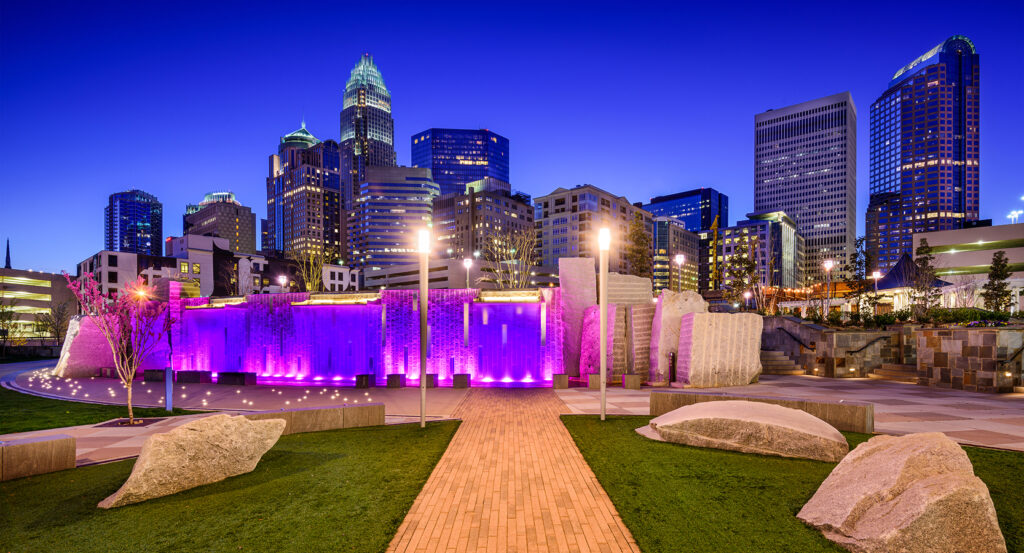
Begin at Five Points Plaza, the public gathering space developed at the intersection of Beatties Ford Road, West Trade Street and Rozzelles Ferry Road in Charlotte's historic West End. The intersection became an important commercial and social center for the surrounding African American neighborhoods, connecting local businesses with the nearby university community. A major public-space redevelopment introduced landscaped seating, performance areas and an environment designed for neighborhood gatherings. Public artist David Wilson created Excelsior, an expansive installation celebrating the West End's cultural inheritance through references to historic community landmarks and figures. The plaza's renewed public role reflects the continuing importance of Beatties Ford Road as a center of Black cultural and commercial life in Charlotte. Continue to Biddle Memorial Hall, the oldest surviving building on the campus of Johnson C. Smith University and a landmark of nineteenth-century African American higher education. Completed in 1884, the substantial Victorian building was constructed partly through the labor of students who manufactured bricks for the project. Its prominent clock tower became a defining feature of the campus, with a carillon added in 1925 through contributions from alumni, students and supporters. The building originally accommodated classrooms, administrative offices, a library and an auditorium, concentrating the institution's educational activities within a single structure. Its preservation connects the university's contemporary campus with the Reconstruction-era movement to establish educational opportunities for formerly enslaved Americans. Conclude at Johnson C. Smith University Stone Entry Gates, the expansive entrance developed through the philanthropy of Jane Berry Smith during the university's early twentieth-century expansion. Smith's financial support followed the destruction of several campus buildings in a 1921 fire, helping the institution rebuild and strengthen its educational facilities. Architect A. G. Lamont designed the stone entrance as part of a broader construction program that included academic buildings and residential facilities. Dedicated in 1923, the gateway commemorates Johnson C. Smith and the philanthropic commitment that helped secure the university's future. Its architectural presence along Beatties Ford Road preserves a visible connection between the university and the historic neighborhoods that developed around it. The progression moves from the West End's contemporary gathering place through the university's nineteenth-century educational landmark and concludes at the memorial gateway that commemorates its survival and expansion, revealing the institutional and community history surrounding Restaurant Constance.
Where your story begins.
Foresyte Travel reveals places that feel extraordinary long before you arrive.
Enjoy editorial crafted for luxury travelers.
Foresyte may earn a commission when you book.