
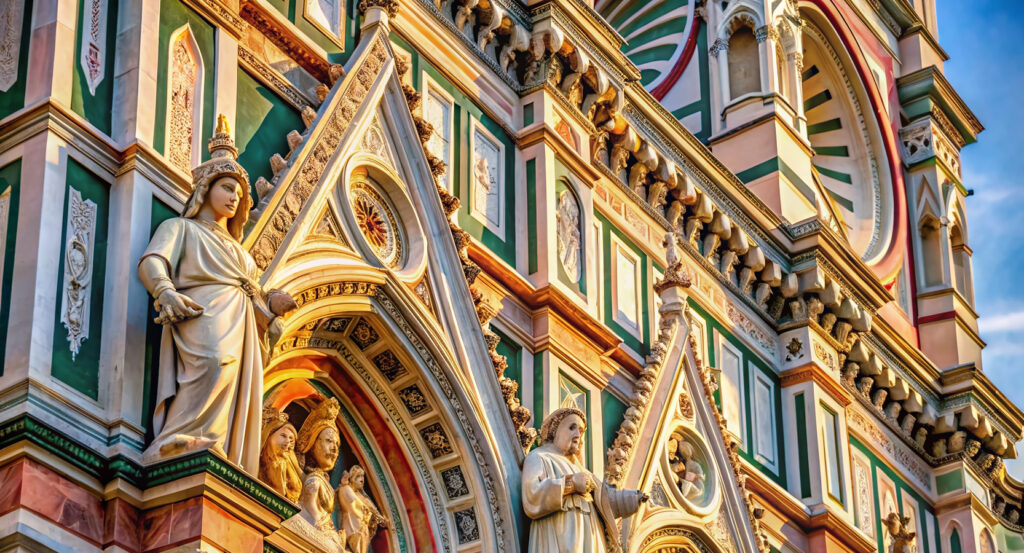
Why you should experience Statue of Dante Alighieri in Florence, Italy.
Statue of Dante Alighieri at Basilica of Santa Croce in Florence stands as a solemn tribute to Italy's greatest poet, the man who gave language to eternity.
Set in the broad piazza before the basilica, the marble monument rises with quiet grandeur, its figure of Dante draped in classical robes and crowned with a laurel wreath. He gazes outward, his expression stern yet contemplative, as if still judging the world he once immortalized in The Divine Comedy. The sculpture, created in 1865 by Enrico Pazzi to mark the 600th anniversary of Dante's birth, captures Florence's enduring reverence for the writer it once exiled. Around him, allegorical lions, the guardians of Florence, rest on their haunches, their presence both protective and repentant. The monument stands not as mere decoration but as Florence's act of contrition and pride, uniting poetry, politics, and faith beneath the open Tuscan sky.
What you should know about Statue of Dante Alighieri.
The story behind Statue of Dante Alighieri is one of exile, redemption, and cultural reconciliation.
Though Dante was born in Florence in 1265, political turmoil forced him into exile in 1302, a punishment that lasted until his death in Ravenna nearly two decades later. The city that cast him out later spent centuries longing to bring him home. His body still lies in Ravenna, but in 1829, Florence built an empty tomb for him inside Santa Croce, a symbolic gesture of apology. The monument we see today outside the basilica came more than thirty years later, commissioned to celebrate national unity and Florence's role in Italy's intellectual rebirth. Sculptor Enrico Pazzi carved Dante as both poet and prophet: his robe modeled after Roman statuary, his laurel crown a symbol of literary immortality, and his gaze turned toward the heart of Florence, both watchful and forgiving. Ironically, during the brief period when Florence served as the capital of a newly unified Italy (1865-1871), the monument became a patriotic emblem, embodying not just Florence's pride but Italy's character as a nation founded on art and language.
How to fold Statue of Dante Alighieri into your trip.
Visiting Statue of Dante Alighieri offers a poetic pause amid Florence's architectural majesty.
After exploring the interior of Santa Croce and the tombs of Michelangelo, Galileo, and Machiavelli, step outside into the wide piazza where the monument commands the view. Approach from the center of the square to take in its full symmetry, Dante elevated against the basilica's marble façade, framed by Gothic spires and the Tuscan sky. Visit in the early morning or late afternoon, when the light sharpens the folds of his robes and casts long shadows from the lions below. Bring a copy of The Divine Comedy or simply recall a few lines; standing there, with the sounds of Florence drifting around you, the connection between the poet's imagined heavens and this earthly city feels tangible. During festivals and national holidays, the monument becomes a gathering point for readings and processions, linking Dante's words to the living rhythm of the city. Before leaving, circle to the monument's back to glimpse the basilica from a quieter angle, it's a moment that captures Florence at its most contemplative. Statue of Dante Alighieri at the Basilica of Santa Croce in Florence is not just a statue, it's an apology carved in marble, a city's promise to never again turn its back on genius.
Where your story begins.
Foresyte Travel reveals places that feel extraordinary long before you arrive.
Experience premium editorial crafted for luxury travelers.




















































































































