
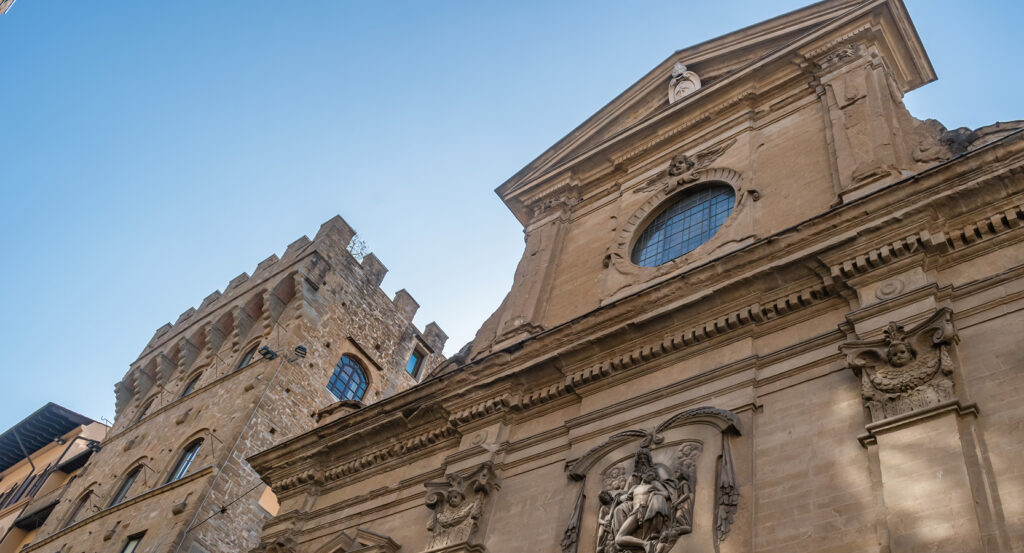
Why you should experience Santa Trinita in Florence, Italy.
Santa Trinita in Florence may stand quietly beside the Arno, but within its unassuming façade beats one of the richest hearts of Renaissance spirituality.
Step through its doorway from the bustle of Via Tornabuoni, the city's fashion thoroughfare, and the world softens into shadow and serenity. The dim light reveals soaring Gothic arches, delicate frescoes, and an atmosphere so intimate it feels like stepping into Florence's private soul. Built by the Vallombrosan monks in the 11th century and rebuilt in the 13th, Santa Trinita bridges centuries of faith and artistry. Its stone walls are a mosaic of transitions, Romanesque solidity giving way to early Renaissance grace. The church's façade, designed by Bernardo Buontalenti in the late 16th century, conceals an interior of quiet splendor, where stained glass glows like embers and frescoed chapels hum with devotion. Standing here, you realize that Florence's beauty isn't only in its grand cathedrals but also in these sacred corners, where artists, nobles, and monks converged in pursuit of transcendence.
What you should know about Santa Trinita.
Behind Santa Trinita's modest exterior lies an astonishing convergence of Florentine artistry, patronage, and history.
The church is best known for its Sassetti Chapel, a Renaissance masterpiece painted by Domenico Ghirlandaio between 1482 and 1485. Commissioned by the wealthy banker Francesco Sassetti, a close associate of Lorenzo de' Medici, the frescoes depict scenes from the life of St. Francis of Assisi, yet they unfold within the very streets and piazzas of 15th-century Florence. In them, you'll recognize familiar landmarks like Piazza della Signoria and the Palazzo Vecchio, captured with meticulous realism. Even more striking, Ghirlandaio included portraits of the Medici and Sassetti families themselves, immortalizing Florence's social elite amid scenes of divine narrative. Above the altar, his Adoration of the Shepherds radiates tender humanity, a fresco so perfectly balanced that it became a touchstone for later artists, including a young Michelangelo, who apprenticed in Ghirlandaio's workshop. But Santa Trinita holds more than one landmark. The Cappella Bartolini Salimbeni preserves frescoes by Lorenzo Monaco, ethereal works that mark the transition from Gothic spirituality to Renaissance naturalism. The Cappella Strozzi di Mantova glows with frescoes by Neri di Bicci, another family's offering to art and faith. Even the church's architecture bears witness to the city's evolution, from medieval austerity to the harmonious proportions of humanist design. Few realize that Santa Trinita once stood at the city's edge, a place of refuge for travelers entering Florence. Its very name, dedicated to the Holy Trinity, reflects a sense of divine unity mirrored in the city's art, philosophy, and ambition.
How to fold Santa Trinita into your trip.
To experience Santa Trinita fully, you must allow yourself to slow down, to breathe in its silence after the vibrancy of Florence's streets.
Begin by crossing the elegant Ponte Santa Trinita, itself a Renaissance marvel, and turn toward the church's simple stone façade. Step inside, and let your eyes adjust to the dim glow of candlelight flickering against frescoed walls. Start with the Sassetti Chapel on the right-hand side, Ghirlandaio's frescoes deserve your unhurried attention. Watch how the painter wove everyday Florence into sacred narrative, how faces of citizens and saints coexist within the same frame. Move toward the altar to admire Lorenzo Monaco's luminous Gothic frescoes, their gold accents shimmering like prayer itself. Pause often; this is a place where art feels alive, still whispering to those who listen. Then wander along the side aisles to discover centuries-old tombs, where noble families rest beneath sculpted effigies. The chapel ceilings gleam with faded blues and gilded stars, reminders that even time cannot dull devotion. When you leave, step back into Piazza Santa Trinita and look up at the Column of Justice standing before the church, a Roman relic brought from the Baths of Caracalla in Rome, a symbol of Florence's eternal discussion between antiquity and faith. End your visit with a slow walk down Via Tornabuoni, its modern boutiques framing a view of the very bridge and basilica you just explored. Santa Trinita may not command the crowds of Santa Croce or the Duomo, but that is its grace. It invites not performance, but stillness, a place where the Renaissance whispers instead of shouts, reminding you that Florence's genius has always been as much about quiet reflection as grandeur.
Where your story begins.
Foresyte Travel reveals places that feel extraordinary long before you arrive.
Experience premium editorial crafted for luxury travelers.




















































































































