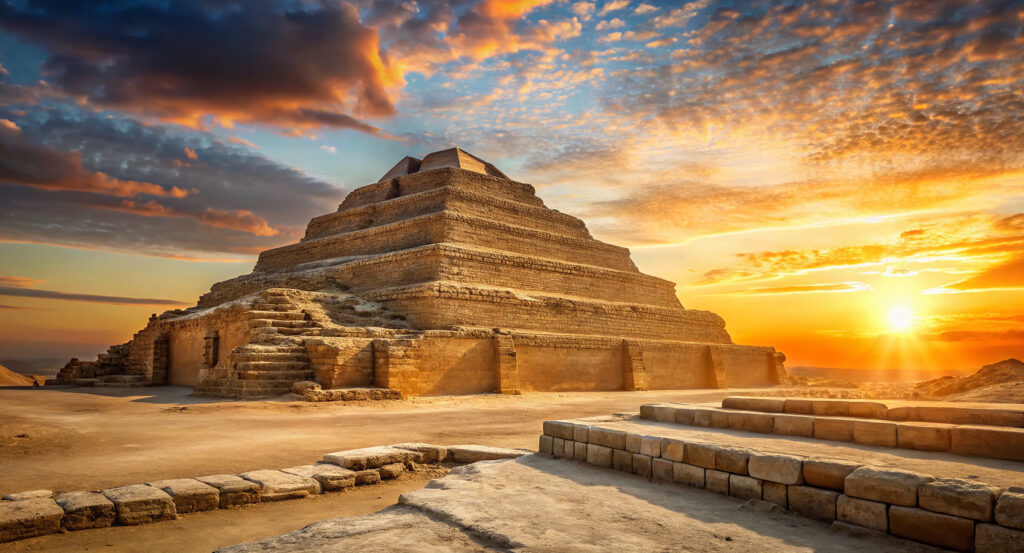
Why you should experience Imhotep Museum in Saqqara, Egypt.
The Imhotep Museum is Egypt's quiet triumph, a sanctuary of wisdom dedicated to the man who first taught humanity to build forever.
Nestled at the entrance to the Saqqara Necropolis, this museum bridges 4,700 years of innovation, honoring Imhotep, the architect, physician, and philosopher who designed the Pyramid of Djoser and reshaped the course of civilization. While Cairo's grand museums dazzle with scale, the Imhotep Museum humbles with intimacy. Its limestone façade mirrors the desert it guards, and its interior feels more like a temple than a gallery, a place for communion with genius. Step inside, and the air is still, scented faintly with dust and history. Artifacts glow softly beneath spotlights: fragments of faience tiles from Djoser's burial chamber, tools that carved the first pyramids, and delicate carvings that survived the birth of architecture itself. Every object here whispers of Imhotep's legacy, not just as builder of stone, but as the father of science, the first man in recorded history to turn imagination into immortality.
What you didn't know about Imhotep Museum.
Opened in 2006 by Egypt's Supreme Council of Antiquities, the Imhotep Museum was conceived as both tribute and teaching ground, a modern echo of the House of Life, the ancient academy where Imhotep himself once studied and healed.
The museum's five exhibition halls trace the evolution of architecture, medicine, and ritual through Saqqara's most significant discoveries. In the Entrance Gallery, visitors encounter artifacts unearthed from the Step Pyramid restoration, including the blue-glazed tiles that once lined Djoser's subterranean corridors, each piece evidence of Egypt's first use of decorative architecture. The Old Kingdom Hall houses statues of scribes and dignitaries, including a beautifully preserved limestone figure of Pharaoh Teti, Mereruka's father-in-law, his eyes inlaid with obsidian and crystal that still glint under the light. The New Kingdom and Late Period Gallery displays the funerary mask of Ptahemwia, high official under Ramesses II, whose burial was discovered only meters from Imhotep's own presumed resting place. Most haunting is the Serapeum Hall, where fragments of colossal granite sarcophagi remind visitors of the underground catacombs of the sacred Apis bulls nearby. The museum's crown jewel, however, is the bronze statue of Imhotep, shown seated with a papyrus scroll on his knees, one of the few surviving representations of a non-royal Egyptian deified after death. Its presence is electrifying, a reminder that intellect itself was once worshipped. Beyond artifacts, the museum is also a living archive: ongoing excavations continue to supply new finds, with climate-controlled storage areas preserving relics before they join the permanent collection. Designed by architect Gamal Bakry, the building's minimalist geometry mirrors the proportions of the Step Pyramid, aligning both structurally and symbolically with Imhotep's eternal blueprint.
How to fold Imhotep Museum into your trip.
A visit to the Imhotep Museum is the perfect threshold between modern Egypt and its ancient soul, a prologue to everything you'll witness across the Saqqara Plateau.
Located at the entrance to Saqqara, about 30 kilometers south of Cairo, it's typically your first or last stop on a day trip that includes the Pyramid of Djoser, Tomb of Mereruka, and Serapeum. The museum is open daily, usually from 9:00 AM to 5:00 PM, with the best visiting hours early morning before the tour buses arrive. Begin your exploration in the open-air forecourt, where panels outline the history of Saqqara's excavation, a moving chronicle of discovery spanning from Auguste Mariette's 19th-century work to present-day restorations. Inside, the museum is cool and contemplative, with carefully curated lighting that highlights texture. Take your time; the faience panels, the architectural tools, and the statuary fragments each hold quiet stories of invention. Don't miss the replica of Djoser's burial chamber ceiling, reconstructed in miniature to show the shimmering effect of the original tiles. If you're traveling with a guide, request a pause in the Imhotep Hall, where you can sit facing the bronze statue in silence, it's the rarest kind of encounter in Egypt, one that feels deeply personal. Allow 45, 60 minutes to explore fully, then step outside to the panoramic terrace that overlooks the desert and the rising form of the Step Pyramid beyond. It's a breathtaking view, a reminder that this museum doesn't just commemorate Egypt's first architect, but the moment when human thought itself learned to endure. The Imhotep Museum is the beating heart of Saqqara, a small building containing the infinite.
Hear it from the Foresyte community.
Just enough life around you not to be overwhelming. Right pace.
Where your story begins.
Start your planning journey with Foresyte Travel.
Experience immersive stories crafted for luxury travelers.