
Why Schermerhorn Row matters.
Schermerhorn Row is a rare mercantile ensemble where the Seaport's maritime character meets Federal-era counting houses, surviving waterfront commerce and an architectural block built during New York's ascent as the nation's dominant port.
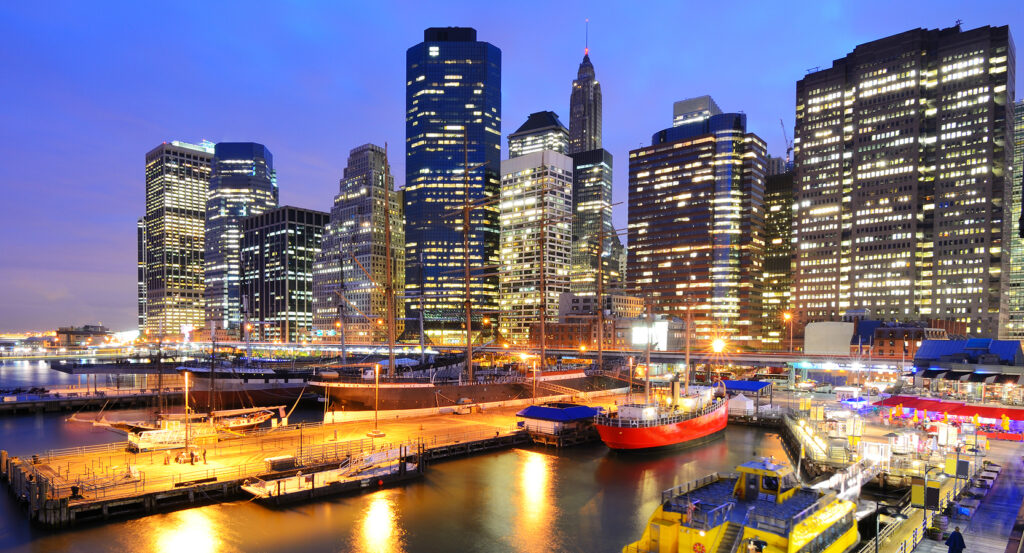
Set along Fulton Street near South Street and just steps from Titanic Memorial Park, the row occupies filled ground created from the East River during the opening years of the nineteenth century, placing its historic commercial buildings directly beside the former wharves they once supported. Twelve red-brick counting houses originally formed a continuous Georgian-Federal composition with high pitched roofs, dormers and tall chimneys, their upper stories retaining much of the architectural order established during construction. Storefronts and offices occupied the lower levels as warehouse floors rose above them, compressing several functions of maritime trade into buildings positioned for rapid movement between ships, merchants and the city. Later granite storefront piers, cast-iron columns, altered rooflines and changing windows reveal successive generations of commercial adaptation without erasing the early brick fabric above. The result is a surviving mercantile row whose brick facades, pitched forms, layered storefronts and waterfront position preserve the physical organization of commerce from the period when South Street was becoming the commercial edge of an expanding New York.
What defines Schermerhorn Row.
Schermerhorn Row is best known for concentrating the commercial ambitions of merchant Peter John Schermerhorn into one of early nineteenth-century New York's largest waterfront building projects, completed from 1810 to 1812 as the city accelerated toward national maritime supremacy. Schermerhorn, born in 1749, worked as a captain, merchant, investor and real-estate developer and belonged to a family already connected with Pearl Street property and waterfront commerce before he pursued the Fulton Street undertaking. Manhattan's original shoreline had run near present-day Pearl Street, but successive water grants pushed development outward, culminating locally in early nineteenth-century filling that created the ground beneath the row between the older city and South Street. New York had become the largest port in the United States by 1797, giving Schermerhorn's project an advantageous position before another commercial surge followed the War of 1812. The decade from 1815 through 1825 brought the end of that war and completion of the Erie Canal, intensifying New York's command of trade between the Atlantic world and the expanding American interior. Schermerhorn's buildings placed storefront, office and warehouse functions within the same structures, allowing merchants to conduct transactions and store cargo beside the East River piers. Handmade brick formed the facades and party walls, with the clay originating from communities along the Hudson River whose brick industries expanded substantially later in the century. Early occupants were predominantly merchants, tying the architecture directly to imported and domestic goods passing through the surrounding slips, streets and wharves. Subsequent tenants widened the commercial population to grocers, provisioners, tavern keepers, clothiers, bootmakers, barbers, clerks and other businesses as South Street changed around the buildings. The row survives as architecture produced during the decisive interval when landfill, maritime commerce, the Erie Canal economy and New York's expanding merchant class shifted the city's commercial center toward a harbor operating at national scale.
Waterfront hospitality created a separate historical layer inside the buildings as nineteenth-century restaurants and hotels occupied spaces originally created for mercantile trade. Rogers' Hotel and Dining Saloon opened at 4 Fulton Street in 1850 as a waterfront refectory and saloon serving the dense commercial district around the East River. Abraham Sweet assumed management in 1864, and successive generations of the Sweet family continued the business until 1992, eventually expanding into 6 Fulton Street and giving the operation an exceptional span across radically different eras of the waterfront. The Fulton Ferry Hotel developed at 92-93 South Street after Friederick and Henry Lemmermann purchased the earlier Mackinley Hotel in 1875, remaining in business into the 1930s. Surviving portions of those establishments include a corridor of former Rogers' Hotel rooms along with the Fulton Ferry Hotel's laundry room and elevator shaft, preserving domestic and service spaces associated with workers and travelers moving through the port. The upper floors escaped wholesale erasure even as the waterfront economy contracted and the surrounding district faced demolition during the twentieth century. Rehabilitation work during 2000 and 2001 exposed further physical traces, including nineteenth- and early twentieth-century graffiti inscribed by people who had occupied or worked within the buildings. The The Seaport Museum accessioned the surviving hotel interiors and graffiti into its permanent collections, shifting architectural remnants into preserved historical objects within the buildings that contain them. Joseph Mitchell had already given the vanished waterfront-hotel culture a major literary afterlife through his New Yorker writing, including the world associated with Up in the Old Hotel. The surviving rooms, service spaces and inscriptions deepen Schermerhorn Row beyond its original merchant architecture, preserving evidence of the cooks, hotel workers, sailors, laborers and transient populations who inhabited South Street after the counting houses entered a different commercial age.
How Schermerhorn Row fits.
Schermerhorn Row works as the anchor for a Lower Manhattan sequence connecting Revolutionary political life, the creation of the federal government and the recovery of an African sacred ground buried beneath centuries of urban construction.
Begin at Fraunces Tavern Museum, where merchant Etienne De Lancey built a residence in 1719 before Samuel Fraunces purchased the property in 1762 and converted it into the Queen's Head Tavern. The New York Sons of Liberty gathered there, HMS Asia cannon fire struck the building in 1775 and the Provincial Congress hosted George Washington and his officers in the Long Room in June 1776. A joint British-American commission later conducted the 1783 Birch Trials there during the process that secured evacuation for thousands of Black Loyalists, and Washington returned on December 4, 1783 to bid farewell to his officers before departing for Annapolis. Continue to Federal Hall National Memorial, where New York's colonial City Hall became the setting for John Peter Zenger's 1735 libel trial and the Stamp Act Congress of 1765 before Pierre L'Enfant remodeled the building for the new federal government in 1788. George Washington took the presidential oath there on April 30, 1789, and the First Congress created executive departments, organized the federal judiciary and proposed twelve constitutional amendments, ten of which became the Bill of Rights. The original structure disappeared in 1812; the present Greek Revival building opened as a United States Customs House in 1842 and later held the Sub-Treasury and its gold and silver vaults. Conclude at African Burial Ground National Monument, where construction of a federal office building in 1991 exposed a colonial cemetery used by free and enslaved Africans from the 1690s into the 1790s. Excavation removed 419 individuals from part of the original 6.6-acre ground before community action halted further disturbance, and Howard University subsequently undertook an extensive examination of the ancestral remains. The 2003 Rites of Ancestral Return carried them from Washington through several cities to Lower Manhattan, where hand-carved Ghanaian coffins lined with Kente cloth were reinterred near the original graves; presidential proclamation created the national monument in 2006, followed by dedication of the memorial in 2007. The progression moves from a Revolutionary tavern associated with Black Loyalist emancipation through the site where the First Congress constructed the machinery of the new federal government into the recovered African cemetery, connecting three Lower Manhattan places where national history remains inseparable from the physical ground of the early city.
Where your story begins.
Foresyte Travel reveals places that feel extraordinary long before you arrive.
Enjoy editorial crafted for luxury travelers.
Foresyte may earn a commission when you book.







































































































