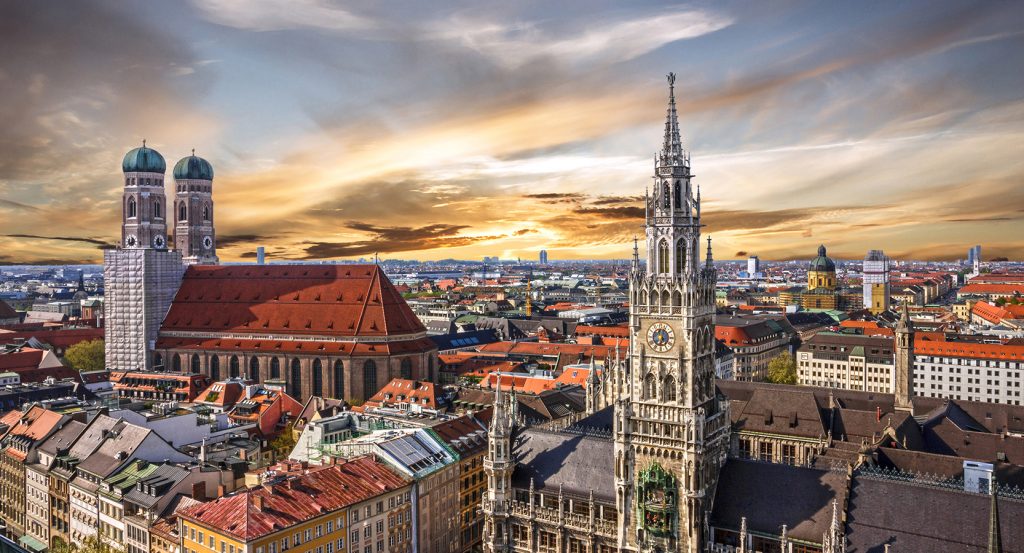
Why you should experience Schwabing-Freimann in Munich, Germany.
Schwabing-Freimann is among the city's most expansive and diverse districts, where historic village roots, modern business centers, and vast green landscapes converge across a neighborhood that showcases both Munich's past and future.
Corporate campuses, historic churches, riverside trails, research institutions, residential communities, cultural landmarks, and sprawling parklands create a district that balances economic importance with exceptional access to nature. Formed through the combination of historic Freimann and portions of Schwabing, the district evolved from rural settlements into one of Munich's most strategically important areas as the city expanded northward. Over time, major employers, research facilities, and cultural institutions established a presence alongside longstanding residential communities and protected green spaces. Today, visitors encounter a district that feels varied, forward-looking, and surprisingly spacious. To the south, Schwabing-West's elegant residential streets and architectural character provide a more intimate urban contrast to the broader landscapes and mixed-use developments that define much of Schwabing-Freimann. Every business campus, riverside path, and historic village center reflects a district shaped by innovation, growth, and continuity.
What you should know about Schwabing-Freimann.
Schwabing-Freimann is best known for being home to Allianz Arena, among the world's most recognizable football stadiums, renowned for its illuminated exterior and status as the home of FC Bayern Munich.
Since opening in 2005, the stadium has become an international symbol of modern sports architecture and one of Germany's most visited landmarks. Its distinctive façade, capable of glowing in different colors, transformed the skyline of northern Munich and helped redefine contemporary stadium design. Beyond hosting FC Bayern Munich matches, Allianz Arena has welcomed major international tournaments, championship matches, and millions of visitors from around the world. The stadium's influence extends beyond sports, contributing significantly to Munich's global profile and tourism appeal. Few neighborhoods in Europe possess such a direct connection to one of the most celebrated venues in world football.
How to fold Schwabing-Freimann into your trip.
Schwabing-Freimann works as an exploration of iconic landmarks, natural landscapes, and the institutions shaping modern Munich.
Begin at Allianz Arena, where the district's defining relationship with sport, architecture, and international recognition immediately comes into focus. Continue toward the northern reaches of the English Garden, whose expansive meadows, wooded paths, and riverside scenery reveal the natural character that distinguishes much of the district. From there, make your way to Freimann's historic village center, where traditional architecture, local businesses, and community landmarks provide a broader perspective on the area's origins before Munich's modern expansion. Along the route, you'll encounter research facilities, corporate headquarters, historic churches, recreational trails, residential neighborhoods, cultural institutions, and public green spaces that showcase the district's remarkable diversity. Together, these destinations reveal how Schwabing-Freimann evolved from rural settlements into one of the city's most influential and multifaceted districts.
Where your story begins.
Foresyte Travel reveals places that feel extraordinary long before you arrive.
Experience premium editorial crafted for luxury travelers.