
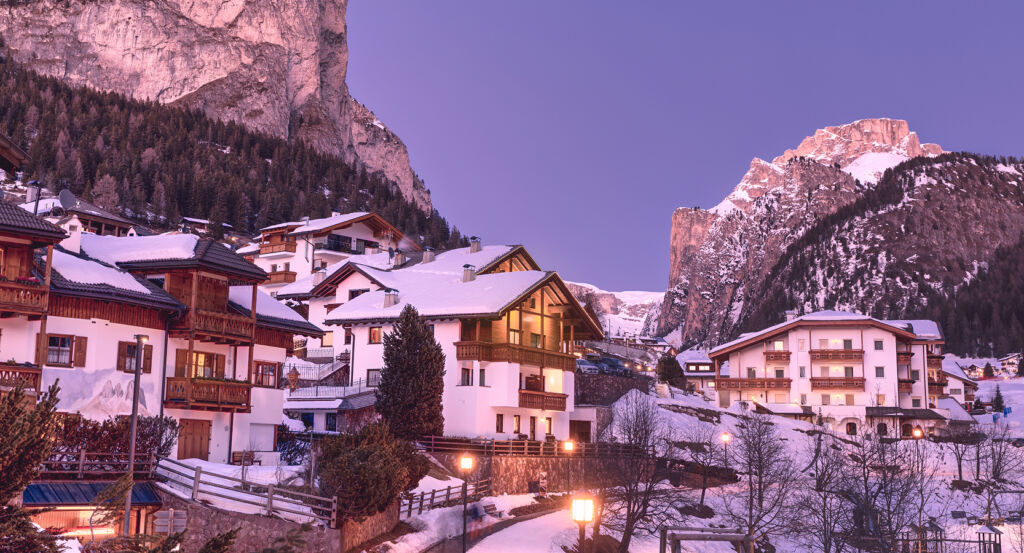
Why you should experience Sella Pass in Italy.
Sella Pass in Val Gardena, Italy, is where the Dolomites gather their strength, a breathtaking saddle between giants, where every curve of the road feels like an ascent into the heavens.
Perched at 2,240 meters between Val Gardena and Val di Fassa, this mountain pass connects the worlds of Trentino and South Tyrol, but its spirit belongs entirely to the sky. The moment you arrive, the landscape unfolds like a revelation, the Sella Group rising in serrated towers to one side, the Sassolungo massif dominating the other, and the vast sweep of alpine meadows spilling down toward the valleys below. The air is thin and sharp, perfumed with pine and snow, and the silence, when the wind pauses, feels absolute. Cyclists, hikers, and skiers all converge here, drawn not only by the terrain but by something intangible: the feeling of standing at the center of the Dolomites, surrounded by peaks so close you can almost touch them. At sunrise, the limestone cliffs catch fire in shades of coral and rose; at dusk, they fade into blue shadows that seem to hum with quiet awe. Whether you arrive by winding road, ski lift, or on foot, Sella Pass greets you with that unmistakable alpine clarity, the kind that makes the heart beat slower and the world suddenly feel vast again.
What you should know about Sella Pass.
Though it feels eternal, Sella Pass is a living threshold, shaped by glaciers, war, and the quiet persistence of life in the high Alps.
Geologically, the Sella massif is among the Dolomites' crown jewels: a towering block of fossilized coral reef that dates back over 230 million years, when this region was submerged beneath a prehistoric sea. Over time, tectonic uplift and glacial erosion carved out the dramatic cliffs that define the pass today. Human history here is no less rich. For centuries, shepherds and traders used the pass as a natural route between valleys, their footsteps later replaced by soldiers and ski pioneers. During World War I, Sella Pass sat near the Italian-Austrian front lines; remnants of old outposts and tunnels still linger beneath the snow. After the war, it became a gateway to modern alpine exploration, and by the 1930s, it was already attracting mountaineers from across Europe seeking new routes on its limestone towers. In the winter of 1947, the first ski lifts were installed, linking the pass to the slopes of Sassolungo, a move that would forever transform the region's destiny. Today, Sella Pass forms one of the key links in the renowned Sellaronda circuit, connecting four valleys and some of the most beautiful ski terrain in the world. Yet even amid its popularity, the area has retained its authenticity. Between its sharp ridgelines and rolling meadows, herds of chamois still roam, edelweiss bloom in summer crevices, and the sound of cowbells carries across the wind. It's a place where modern adventure meets ancient peace, and both feel at home.
How to fold Sella Pass into your trip.
Experiencing Sella Pass is less about arrival and more about movement, about tracing the curves of the earth itself until you find your rhythm in its grandeur.
In summer, the pass is a magnet for cyclists tackling one of the most iconic climbs in Europe. Each hairpin turn reveals another postcard view, valleys carved like green rivers, cliffs glowing in the morning light, and distant glaciers glittering on the horizon. Hikers can follow trails that lead to the Sassolungo plateau or across the high-altitude meadows toward the Puez-Odle Nature Park. One of the most rewarding routes begins at the pass and ascends to Rifugio Toni Demetz, perched between the peaks like a fortress in the clouds. From there, the panorama sweeps across the Dolomites in every direction, Marmolada to the south, the Odle Group to the north, and the endless labyrinth of ridges in between. In winter, Sella Pass becomes a skier's dream, forming one of the main gateways to the Sellaronda ski circuit. You can ski an entire day without repeating a slope, crossing valleys and summits linked by lifts and runs that feel more like art than infrastructure. For those who prefer slower adventures, snowshoe trails weave through quiet pine forests where fox tracks and frozen streams mark the path. Stop for lunch at one of the alpine refuges, Rifugio Salei or Friedrich August Hütte, where the food is as memorable as the view: barley soup, speck dumplings, and apple strudel served under sunlit peaks. As evening falls, linger until the last light hits the cliffs, the famous enrosadira, when the Dolomites blush pink as if the mountains themselves are alive. Then descend slowly toward Selva, headlights tracing ribbons of gold through the valley. Sella Pass isn't just a crossing point, it's a communion with the heart of the Dolomites, a reminder that the most powerful journeys often end where the earth meets the sky.
Where your story begins.
Foresyte Travel reveals places that feel extraordinary long before you arrive.
Experience premium editorial crafted for luxury travelers.




















































































































