Why you should experience the Sanctum Sanctorum of the Siddhivinayak Temple in Mumbai.
The Sanctum Sanctorum of the Siddhivinayak Temple in Mumbai is the radiant core of the city's devotion, a chamber where faith condenses into light, rhythm, and reverence.
As you step through the silver-clad doors into the Garbha Griha, the sound of the crowd fades into a low, resonant hum. The scent of sandalwood and rose fills the air. Before you, the idol of Lord Ganesha glows softly in the lamplight, carved from a single black stone, its right-curved trunk (Siddhi Vinayaka form) gleaming beneath a crown studded with diamonds and emeralds. The idol's eyes seem to meet your own, steady and compassionate, as though listening. Around it, priests move in practiced rhythm, offering flowers, chanting mantras, ringing brass bells that seem to echo through the very air. For a few seconds, time feels suspended. The sanctum holds not just a deity, but the collective heartbeat of millions who've stood here in prayer.
What you should know about the Sanctum Sanctorum of Siddhivinayak.
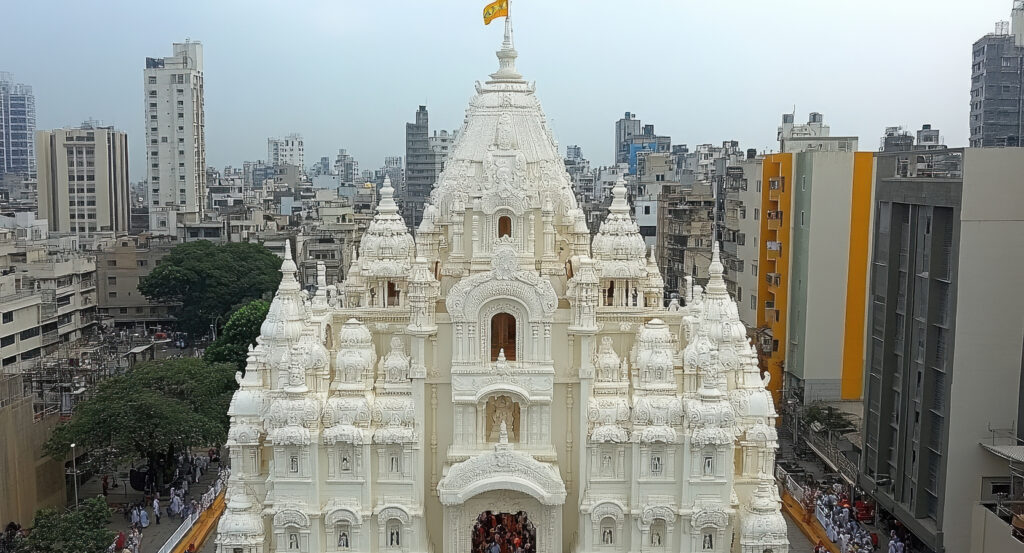
The Sanctum Sanctorum, or Garbha Griha, is the holiest part of the Siddhivinayak Temple, designed with extraordinary precision to focus spiritual energy and architectural symmetry.
The chamber was rebuilt in 1990 during the temple's major reconstruction, transforming the modest original shrine into a marble-and-gold sanctum that honors both tradition and modernity. The idol of Lord Ganesha sits on a silver throne beneath a gilded dome lined with lotus motifs, symbolizing purity and divine awakening. Its design follows Vaastu Shastra principles: the sanctum faces east, allowing the first rays of dawn to fall directly upon the deity's face. The right-turning trunk (Dakshinabhimukhi Ganesha) is exceptionally rare and regarded as highly auspicious but also demanding of strict ritual discipline, hence the continuous prayers and offerings maintained by priests throughout the day. The chamber's acoustics were engineered so that the chant of “Ganapati Bappa Morya” connects softly, amplified by the curved marble walls. The jewels adorning the idol, particularly the navaratna crown, symbolize the nine celestial bodies, invoking balance and prosperity. Even the flooring, made of white Makrana marble inlaid with saffron and red granite, reflects light upward, making the entire chamber glow as though lit from within. During Angaraki Chaturthi and Ganesh Chaturthi, the sanctum becomes a living vision, covered entirely in flowers and gold, with lines of lamps encircling the idol like constellations of devotion.
How to fold the Sanctum Sanctorum into your trip.
To experience the Sanctum Sanctorum at its most profound, plan the visit with intention, not just to see, but to feel.
Arrive early, ideally before 6:30 AM, when the temple opens for the Kakad Aarti. The queue moves slowly, wrapping around the temple's inner corridors before reaching the sanctum. As you step inside, silence your phone, still your thoughts, and let the moment take over. Spend a brief yet deliberate pause before the idol, even a few seconds can feel eternal under the sanctum's golden light. Offer a coconut, modak, or red hibiscus, traditional symbols of devotion to Ganesha. After darshan, exit through the inner pradakshina path, where you can circle the sanctum three times while offering silent prayers. For a quieter experience, visit on weekdays or non-festival evenings around 8 PM, when the crowd thins and the chamber glows under softer illumination. Allocate 20-30 minutes for the full experience, though the spiritual afterglow lasts far longer. The Sanctum Sanctorum of Siddhivinayak isn't merely a chamber of worship, it's a still point at the heart of Mumbai's chaos, a place where the city's unending noise meets the quiet voice of faith.
Where your story begins.
Foresyte Travel reveals places that feel extraordinary long before you arrive.
Experience premium editorial crafted for luxury travelers.