
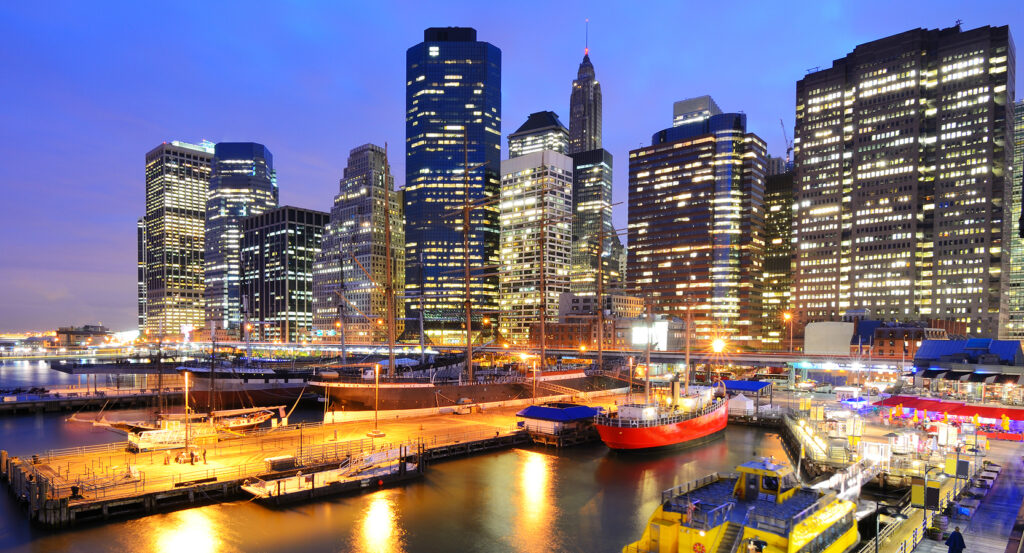
Why you should experience The Seaport Museum in New York, NY.
The Seaport Museum is an extraordinary maritime museum where the Seaport District's waterfront heritage, historic ships, commercial legacy, and architectural preservation create one of America's most important cultural institutions.
Set along Fulton Street and Pier 16 beside the East River near Schermerhorn Row and just steps from Pier 17, this nationally recognized museum immerses visitors in New York's remarkable maritime past through historic vessels, meticulously preserved Federal-era buildings, working exhibitions, interactive galleries, and one of the nation's finest collections of seafaring artifacts. Cobblestone streets, nineteenth-century warehouses, and commanding harbor views create an atmosphere where the story of New York's rise as a global port unfolds with remarkable authenticity. Every visit reveals how maritime commerce shaped one of the world's greatest cities. The result is an experience defined by historical preservation, maritime excellence, and one of the United States' premier waterfront museums.
What you should know about The Seaport Museum.
The Seaport Museum is best known for being founded in 1967 by preservationist Peter Stanford to protect the rapidly disappearing historic waterfront surrounding The Seaport, preserving the birthplace of New York's maritime economy before large-scale redevelopment erased one of America's most significant commercial districts. Today the museum encompasses a 12-square-block historic district, more than 30,000 square feet of exhibition and educational space, the 1811-1812 Schermerhorn Row merchant buildings, a nineteenth-century working print shop, maritime archives, conservation facilities, and the largest privately owned collection of historic vessels in the United States. The museum's fleet includes nationally significant ships such as the 1885 iron-hulled sailing ship Wavertree, the 1908 lightship Ambrose, the 1930 tugboat W.O. Decker, and the 1885 schooner Pioneer, allowing visitors to experience maritime history aboard authentic working vessels. Permanent exhibitions explore how the East River waterfront transformed New York from a modest colonial trading town into the nation's leading port through international commerce, immigration, shipbuilding, finance, and global trade, while the acclaimed Architecture of Trade: Schermerhorn Row and the Seaport exhibition examines Manhattan's only surviving row of Federal-style merchant counting houses and their role in shaping the city's commercial expansion. Designated by Congress in 1998 as part of America's National Maritime Museum, the institution continues preserving one of the world's most historically significant urban waterfronts through exhibitions, educational programming, vessel restoration, public sailing experiences, and ongoing historic preservation.
Beyond its extraordinary collections, The Seaport Museum functions as a living maritime campus where historic architecture, preserved ships, and active craftsmanship remain inseparable from public education. Working demonstrations inside the nineteenth-century print shop, guided walking tours, traditional rigging workshops, sailing excursions aboard historic vessels, and rotating exhibitions continually reconnect visitors with the skills, technologies, and communities that built New York into a global maritime capital. Its stewardship of Schermerhorn Row and the surrounding waterfront has become one of the nation's most influential historic preservation achievements, ensuring that Lower Manhattan's earliest commercial landscape continues educating future generations. Maritime archaeology, architectural preservation, historic ship conservation, public history, and waterfront revitalization combine to create one of America's most influential maritime museums.
How to fold The Seaport Museum into your trip.
The Seaport Museum works as the historical centerpiece of an exploration through the Seaport District.
Begin at Schermerhorn Row, where beautifully preserved Federal-style merchant buildings introduce the remarkable commercial landscape surrounding The Seaport Museum. Continue to Pier 17, whose revitalized waterfront complements the museum's maritime heritage with spectacular East River views. Conclude at the Tin Building by Jean-Georges, where one of New York's oldest marketplace traditions provides a memorable finale celebrating the remarkable relationship between commerce, preservation, and waterfront culture that defines Lower Manhattan. The progression moves naturally from historic mercantile architecture to maritime history before concluding through two defining Seaport landmarks, revealing why The Seaport Museum remains one of New York City's essential cultural experiences.
Where your story begins.
Foresyte Travel reveals places that feel extraordinary long before you arrive.
Experience premium editorial crafted for luxury travelers.







































































































