Why St. Peter's Church matters.
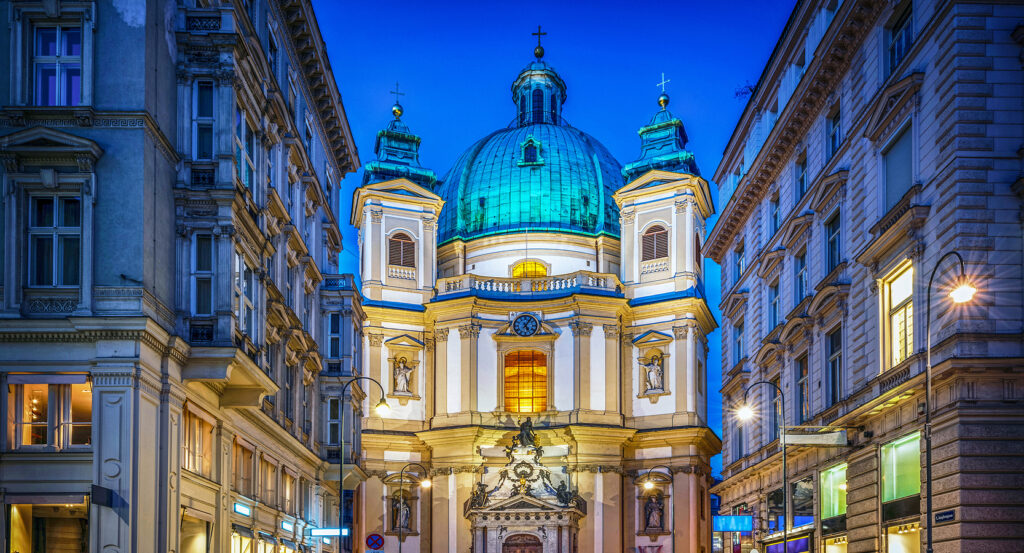
St. Peter's Church is a graceful Baroque church where Innere Stadt's sacred heritage, artistic mastery, centuries of worship, and imperial patronage preserve one of Vienna's finest ecclesiastical interiors.
Set along Petersplatz near Graben and just steps from Plague Column, this elegant church unfolds through soaring domes, gilded chapels, frescoed ceilings, sculpted altars, and richly ornamented sanctuaries where Baroque artistry and centuries of Catholic devotion converge within the historic heart of Vienna. Marble columns, elaborate stuccowork, dramatic light, and harmonious architectural proportions create an interior shaped by exceptional craftsmanship and enduring spiritual tradition. Faith, artistry, and history define every chapel and gallery.
What defines St. Peter's Church.
St. Peter's Church is best known for being constructed between 1701 and 1733 under the patronage of Emperor Leopold I following designs initiated by Gabriele Montani and completed by Johann Lukas von Hildebrandt, creating Vienna's first fully Baroque domed church inspired by St. Peter's Basilica in Rome while occupying one of the city's oldest Christian worship sites dating to the early medieval period. Tradition attributes the earliest church on the site to the late Roman era, while documentary evidence confirms the presence of a church by the twelfth century, making Petersplatz one of Vienna's oldest continuously occupied religious locations. Following severe structural deterioration of the medieval building, Emperor Leopold I commissioned a complete reconstruction after a vow made during the plague years of the late seventeenth century, resulting in a centrally planned Baroque masterpiece crowned by an elegant copper-clad dome. The interior showcases frescoes by Johann Michael Rottmayr, whose dome painting depicts the Coronation of the Virgin, while Lorenzo Mattielli contributed sculptural decoration and Martino Altomonte created the high altar painting depicting the Healing of the Lame by Saints Peter and John. Rich marble revetments, gilded stucco, finely carved pulpits, ornate side chapels, and an imposing pipe organ demonstrate the artistic achievements of Austria's High Baroque period. Throughout the eighteenth century the church became closely associated with imperial Vienna through liturgical celebrations, musical performances, and religious ceremonies, while extensive conservation campaigns during the twentieth and twenty-first centuries stabilized the structure, restored its frescoes, conserved decorative surfaces, modernized environmental systems, and preserved one of Vienna's most accomplished Baroque interiors. Today St. Peter's Church continues serving both as an active parish church and as a respected venue for sacred music performances, particularly concerts featuring the works of Mozart, Haydn, Schubert, and other composers closely associated with Vienna's musical heritage.
Masterful Baroque planning, harmonious spatial composition, and meticulous decorative craftsmanship reveal how architecture, painting, sculpture, and music combined to shape one of Vienna's most refined sacred interiors. Frescoed vaults, gilded capitals, marble altars, sculptural ensembles, richly decorated chapels, and carefully restored decorative programs demonstrate the collaborative achievements of architects, painters, sculptors, craftsmen, and conservators working across more than three centuries. Continuing conservation, architectural research, artistic restoration, and liturgical stewardship ensure the church remains among Vienna's foremost expressions of Baroque religious architecture. Sacred tradition, artistic excellence, and centuries of devotional life combine to create one of Vienna's finest historic churches.
How St. Peter's Church fits.
St. Peter's Church works as part of an exploration through Innere Stadt's historic core.
Begin at Graben, where one of Vienna's most celebrated streets establishes the city's historic atmosphere before visiting St. Peter's Church. Continue to Plague Column, whose richly sculpted Baroque design deepens appreciation for the era that shaped the church's reconstruction. Conclude at St. Stephen's Cathedral, where centuries of Gothic architecture provide a memorable finale celebrating another defining chapter of Vienna's religious and architectural history. The progression moves naturally from Vienna's historic streets to Baroque artistry before concluding through medieval architectural achievement, revealing why Innere Stadt remains the cultural heart of the Austrian capital.
Where your story begins.
Foresyte Travel reveals places that feel extraordinary long before you arrive.
Enjoy editorial crafted for luxury travelers.
Foresyte may earn a commission when you book.