Why The Mogamma matters.
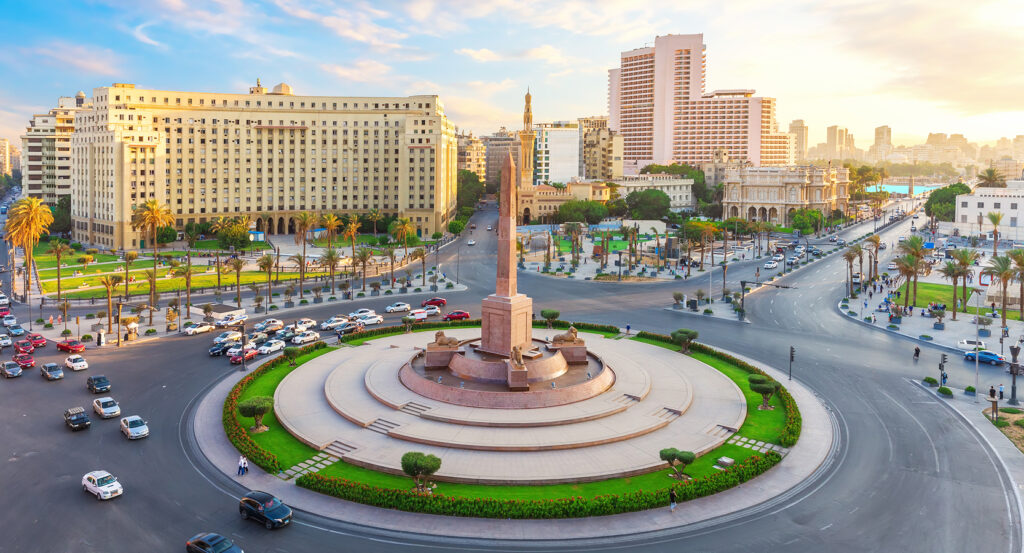
The Mogamma looms over Cairo's Tahrir Square like a relic of bureaucratic mythology, a towering monument to the state itself, as infamous as it is iconic.
For generations of Egyptians, The Mogamma was more than just a government complex; it was a rite of passage. A place where time seemed to slow, where thousands of citizens once queued for permits, passports, and endless stamps, all beneath the watchful gaze of mid-century architecture. Yet beyond its reputation for bureaucracy, The Mogamma tells the story of modern Cairo, a city caught between order and chaos, ambition and exhaustion, revolution and reform. Its immense façade of stone and concrete is an emblem of the state-building era that defined Egypt's post-colonial identity. Standing before it, with the Egyptian Museum on one side and the Nile Corniche on the other, you feel the tension and triumph of a city always in negotiation with itself.
What defines The Mogamma.
The Mogamma, whose name derives from the Arabic word for “complex” or “collection,” was commissioned in the late 1940s under King Farouk I and completed in 1952, just months before the Egyptian Revolution transformed the monarchy into a republic.
Designed by Mahmoud Riad, among Egypt's foremost modernist architects, the building captures the Soviet-inspired expansive style that dominated Cairo's early independence years. Rising over 14 stories and covering 36,000 square meters, it was once the largest administrative building in the Middle East, housing more than 18,000 civil servants across dozens of ministries. Its interior was a maze of corridors and offices, a world of ink stamps, typewriters, and paper trails that became renowned in Egyptian culture and satire. The Mogamma's reputation as the “cathedral of paperwork” was immortalized in the 1992 comedy film “Terrorism and Kebab”, which used it as a metaphor for bureaucratic absurdity. For decades, it remained the epicenter of state authority, every visa, birth certificate, and business license passed through its hands. In 2021, the government began relocating its ministries to Egypt's new Administrative Capital, and The Mogamma was closed for renovation. It is now being transformed into a mixed-use cultural and business complex, preserving its expansive exterior while reimagining the interior as a symbol of rebirth. When it reopens, it will mark not just a renovation, but a reinvention of Egypt's relationship with modernity itself.
How The Mogamma fits.
The Mogamma sits on the southern edge of Tahrir Square, an unmissable backdrop for anyone exploring Central Cairo's civic and historic landmarks.
Visit during daylight hours to appreciate the scale of its stone façade and geometric symmetry, best viewed from the open plaza across the street or the steps of the Egyptian Museum. Even though interior access is currently restricted due to redevelopment, the exterior alone is worth a visit, its weathered surfaces telling the story of decades of Egyptian life. Pair your stop with a stroll around Tahrir Square, then continue to the Nile Corniche, just a short walk away. Plan for 20-30 minutes here, or longer if photographing the building at golden hour, when the low sunlight transforms its stark lines into soft amber tones. For a panoramic view, head to the Nile Ritz-Carlton rooftop, from above, The Mogamma's gridlike form becomes a striking visual anchor amid the swirl of Cairo's chaos. Visiting The Mogamma isn't about beauty in the traditional sense, it's about standing before one of Cairo's most potent symbols of endurance, watching as it transforms from the heart of Egypt's bureaucracy into a monument of reinvention.
Where your story begins.
Foresyte Travel reveals places that feel extraordinary long before you arrive.
Enjoy editorial crafted for luxury travelers.
Foresyte may earn a commission when you book.