
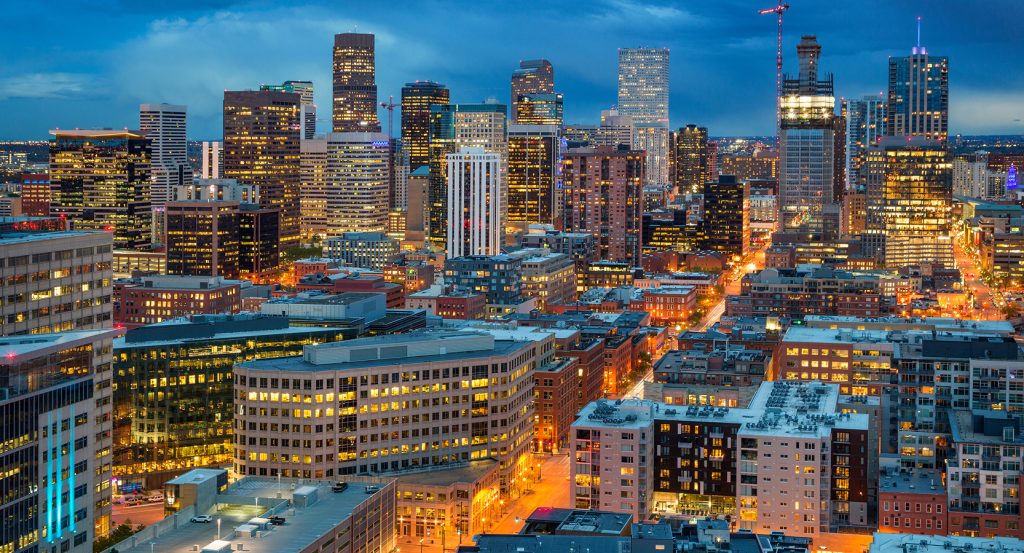
Why The Cookery at Myrtle Hill matters.
The Cookery at Myrtle Hill is a polished neighborhood restaurant where Washington Park's residential character meets Angela Pilloud's quarter-century on South Gaylord Street, scratch cooking and a collection of interconnected food and retail businesses.
Set along South Gaylord Street near Tennessee Avenue and just east of Washington Park, the restaurant occupies the center of the historic commercial block between the park's tree-lined eastern edge, the residential streets of Washington Park East and the transition toward Bonnie Brae beyond University Boulevard. A deep, narrow dining room runs back from the storefront, preserving the intimate proportions characteristic of the small businesses lining this stretch of Gaylord. Counter seating adds another layer along the room, with pastel finishes and domestic decorative elements carrying the property's post-pandemic redesign through a space long associated with breakfast and lunch. Devil's Food Bakery occupies a separate storefront a few doors away, keeping the restaurant physically connected to the larger cluster of businesses Angela Pilloud has assembled along the block. The result is a compact neighborhood restaurant whose intimate scale, domestic interior and relationship with surrounding independent businesses make it inseparable from the pedestrian commercial character of South Gaylord Street.
What defines The Cookery at Myrtle Hill.
The Cookery at Myrtle Hill is best known for carrying Angela Pilloud's Devil's Food from a small bakery founded in 1998 into a dedicated restaurant shaped by more than twenty-five years of business on South Gaylord Street. Pilloud established Devil's Food as a bakery before the operation expanded into breakfast, lunch and brunch five years later, gradually turning a pastry business into a full neighborhood restaurant. The food developed a stronger Southern accent after Pilloud hired Brian Crow as chef de cuisine in 2011, following his move from Asheville, North Carolina, and charged him with bringing Southern comfort cooking into the seasonal program. Chicken and waffles, grits and other preparations subsequently became important signatures within a business whose baking foundation remained intact. Growth eventually placed the café and restaurant functions in competition for the same small room, leading Pilloud to separate the bakery into its own nearby address and dedicate the original property to restaurant service. The pandemic forced another major interruption, closing the Cookery for eighteen months as Pilloud withheld reopening through the most unstable period of restaurant staffing. She used that closure to reconstruct the interior before reopening in September 2021 with expanded seating and a refreshed design. The pandemic period also sharpened the separation between the two sister operations, leaving Devil's Food as the dedicated bakery and coffee bar and the restaurant to emerge under The Cookery at Myrtle Hill name. Pilloud has since gathered Devil's Food, The Cookery at Myrtle Hill, Trunk Show, Chasing My Tale, Fern & Lois and Hawthorne beneath her Home Ec & Shop collection, turning a bakery begun in 1998 into the foundation of a broader group of South Denver businesses.
Scratch production connects the Cookery directly with its bakery origins, beginning with challah baked at Devil's Food and cut thick for French toast finished with berries, powdered sugar and maple syrup. Fried chicken and waffles develops the Southern thread through a house-made Belgian waffle, fried chicken breast, sausage gravy and chipotle-honey maple syrup, layering crisp batter, soft waffle, savory gravy and chile heat the same plate. The cornbread waffle moves deeper into that register by combining cornmeal batter with pork green chile, house-smoked pulled pork, eggs, cheddar and green onion, placing smoke, chile and corn at the center of the preparation. Myrtle Hill Hash builds another Colorado-inflected breakfast through bacon, poblano, red pepper, sweet potato, butternut squash, eggs and chipotle crema. The kitchen's pork green chile also becomes the sauce for a breakfast burrito filled with fire-roasted poblanos, eggs, Yukon potatoes, black beans and cheddar, allowing one long-cooked preparation to connect several dishes. House production continues beyond immediate service through meatloaf, lasagna, quiche, biscuits, cassoulet, goulash, green chile, gravies and sauces prepared for customers to finish at home. The Cookery's food carries its bakery ancestry into a broader scratch kitchen where house-made bread, waffles, smoked pork, green chile and slow-cooked comfort dishes provide the continuity across breakfast and lunch.
How The Cookery at Myrtle Hill fits.
The Cookery at Myrtle Hill works as the dining anchor for an outing connecting Denver's turn-of-the-century landscape ambitions, an Italian-inspired high school from the City Beautiful era and a residential district shaped by Saco DeBoer's rejection of the conventional street grid.
Begin at Washington Park, designed in 1899 by German-born landscape architect Reinhard Schuetze across 160 acres organized around Smith Lake, Grasmere Lake and a broad central meadow. Schuetze modeled the landscape through curving paths, open lawns, tree groves and water supplied by City Ditch, and George Kessler extended the design with new roads and planting schemes in 1908. The Olmsted Brothers subsequently developed Evergreen Hill, the Lily Pond and additional pedestrian features, and Denver landscape architect Saco Rienk DeBoer added the Perennial Garden in 1918 and the Mount Vernon Garden in 1926. National Register designation followed in 1986, protecting a park whose layered authorship preserves several major currents in American landscape design. Continue to Denver South High School, whose lineage reaches to the Grant School of 1883 before the growing south side required increasingly specialized facilities. William E. Fisher and Arthur A. Fisher designed the present building beside Washington Park, drawing architectural inspiration from Sant'Ambrogio in Milan and Santa Maria in Cosmedin in Rome. The cornerstone was laid in 1923, and classes entered the new school in January 1926. Sculptor Robert Garrison created the gargoyle above the entrance and other symbolic ornament, and Allen True added murals to the entrance hall in 1935, layering sculpture and painting into the Fishers' red-brick and terra-cotta composition. Conclude at Bonnie Brae Park, the centerpiece of a neighborhood George W. Olinger began assembling during the 1920s after encountering a Kansas City subdivision whose Gaelic name meant “pleasant hill.” Olinger's Associated Industries hired Saco DeBoer in 1923 to devise a street system of curves that broke dramatically from Denver's prevailing rectangular grid. Development gathered momentum after the elliptical park was completed in 1936, and custom houses subsequently filled the surrounding streets through the postwar period in Tudor, Spanish, Bauhaus, International and other architectural forms. The progression moves from Schuetze, Kessler, the Olmsteds and DeBoer shaping a major urban park through the Fishers and Garrison giving City Beautiful ambitions architectural form and culminates in DeBoer bending an entire residential district around an elliptical green, connecting three chapters of deliberate urban design surrounding South Gaylord Street.
Where your story begins.
Foresyte Travel reveals places that feel extraordinary long before you arrive.
Enjoy editorial crafted for luxury travelers.
Foresyte may earn a commission when you book.


























































































































