
Why The Fort matters.
The Fort is a historic Southwestern restaurant where Morrison's red-rock foothills meet Sam'l and Elizabeth Arnold's frontier scholarship, William Lumpkins's adobe architecture and a culinary institution that transformed a family residence into one of Colorado's most consequential dining destinations.
Situated along Colorado Highway 8 beneath the Dakota Hogback, The Fort occupies a sandstone-framed hillside near Turkey Creek, US Highway 285 and the approach to Morrison, with Mount Falcon rising to the south and the eastern foothills opening toward the Denver metropolitan plain. The restaurant inhabits a substantial adobe compound constructed from more than 80,000 handmade bricks, with rounded towers, timber gates and enclosed courtyards preserving the architectural character of a nineteenth-century Southwestern trading post. Entering through the heavy wooden gates reveals adobe-walled dining rooms, hand-carved furnishings and traditional decorative details created by artisans from Taos, New Mexico. Bison, elk and quail preparations connect the kitchen with regional hunting traditions and historic trade routes, accompanied by recipes developed through Sam Arnold's extensive research into early Western foodways. The result is a restaurant whose historical architecture, researched culinary traditions and exceptional foothill setting preserve a distinctive chapter of Colorado's hospitality history.
What defines The Fort, Morrison.
The Fort is best known for Sam'l and Elizabeth “Bay” Arnold transforming an ambitious family home into a celebrated restaurant devoted to the food and architecture of the nineteenth-century American West, establishing an institution that subsequently hosted a presidential state dinner and survived several consequential ownership transitions. Sam Arnold was a Yale-educated advertising executive with a longstanding interest in Western history when he and Bay acquired land near Morrison in 1961. Their plans changed after Bay encountered an illustration of Bent's Old Fort, the adobe trading post established along the Santa Fe Trail during the 1830s, and proposed recreating its architectural character as their family residence. The couple commissioned Santa Fe architect William Lumpkins, a leading practitioner of Pueblo Revival design, to develop the building. Construction required 80,000 handmade adobe bricks fashioned from local earth and straw, with Taos artisans producing hand-hewn beams, carved gates and furnishings inspired by early Southwestern craftsmanship. Escalating construction costs transformed the original domestic project into a commercial undertaking, prompting the Arnolds to establish a restaurant on the lower level and preserve their living quarters above. The Fort opened on February 1, 1963, introducing a culinary program Sam called “New Foods of the Old West,” developed through his research into frontier diaries, Indigenous food traditions and the cooking of mountain men and Santa Fe Trail travelers. Bison, elk, quail and unusual regional preparations became central to the menu, supported by historical recipes and Spanish-Mexican culinary influences. That same year, the Arnold family adopted Sissy, a Canadian black bear cub from the Denver Zoo who lived at the property for nineteen years and became closely associated with its public character. Arnold extended his historical interests into broadcasting through Frying Pans West, a public television series presented between 1968 and 1986, and subsequently published Eating Up the Santa Fe Trail, a cookbook demonstrated by his wife Carrie. He sold the restaurant in 1973 before reacquiring it following foreclosure in 1986, restoring family control after more than a decade. A defining national event followed in June 1997 when President Bill Clinton hosted a state dinner at The Fort for international leaders attending the Denver Summit of the Eight, placing Arnold's Western culinary project within the setting of international diplomacy. His daughter Holly Arnold Kinney purchased an interest in the business in 1999 and assumed an increasingly important management role, later becoming its sole owner following Arnold's death in 2006. She also established the Tesoro Cultural Center in 1999, developing educational programs and cultural gatherings interpreting the diverse communities connected with the historic Southwestern frontier. The building entered the National Register of Historic Places in July 2006, securing formal recognition for Lumpkins's architecture and the Arnold family's historical undertaking. Kinney subsequently received preservation and hospitality distinctions, including recognition from the Colorado Restaurant Association and Jefferson County's Hall of Fame. Following her retirement on January 6, 2026, Denver-based City Street Investors and Revesco Properties acquired the restaurant and eight acres for $4.5 million, ending sixty-three years of Arnold family ownership. The new partnership retained the restaurant's historical culinary foundations and introduced a Whiskey Library and tequila bar, with director of operations Sterling Robinson contributing professional beverage expertise. The Fort's development connects an unusually ambitious domestic architectural commission, Sam Arnold's culinary scholarship, presidential hospitality, multigenerational preservation and a major contemporary ownership transition within one of Colorado's most distinctive restaurant histories.
How The Fort, Morrison fits.
The Fort works as the evening destination for a Morrison-area exploration connecting the discoveries that transformed modern paleontology, the preservation of Colorado's prehistoric fossil record and the construction of one of America's most celebrated outdoor performance venues.
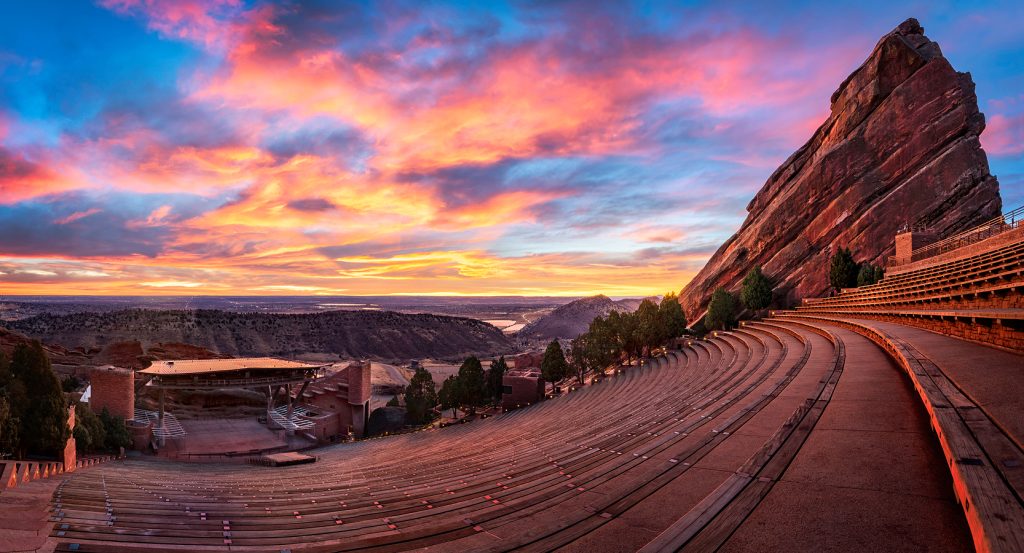
Begin at Dinosaur Ridge, where nineteenth-century fossil discoveries contributed to the scientific understanding of North America's great Jurassic dinosaurs. In 1877, geologist Arthur Lakes excavated fossils along the Dakota Hogback and corresponded with Yale paleontologist Othniel Charles Marsh, whose investigations contributed to the recognition of Apatosaurus, Stegosaurus and other prehistoric species. These excavations became part of the Bone Wars, the intense scientific rivalry between Marsh and Edward Drinker Cope. Road construction in 1937 exposed hundreds of Cretaceous dinosaur footprints along the ridge's eastern slopes, revealing another chapter of prehistoric activity separated from the original Jurassic discoveries by millions of years. The Morrison Fossil Area received National Natural Landmark recognition in November 1973. Continue to Morrison Natural History Museum, the local paleontological institution dedicated to the fossil discoveries that gave the Morrison Formation its scientific name. Its Jurassic exhibits include original Stegosaurus material associated with the earliest excavations and examples of the region's sauropod fossil record. The museum's research collection and preparation laboratory preserve an active connection between historic fossil discoveries and continuing scientific investigation. Exhibitions also interpret the Cretaceous environments that succeeded the Jurassic landscape, introducing specimens and reconstructions associated with Triceratops, Tyrannosaurus and other prehistoric animals. The museum grounds extend this educational undertaking into outdoor geological displays and demonstrations of fossil preparation. Conclude at Red Rocks Park and Amphitheatre, the natural sandstone performance setting whose development began through John Brisben Walker's ambitious recreational enterprise during the early twentieth century. Walker established the Garden of the Titans in 1906, and internationally acclaimed soprano Mary Garden performed there in 1911, recognizing the natural acoustic qualities of the surrounding formations. Denver acquired the parkland during the late 1920s, and architect Burnham Hoyt subsequently designed a permanent amphitheater whose construction involved the Civilian Conservation Corps and federal public-works programs. Dedicated on June 15, 1941, the venue developed into an internationally significant concert destination, hosting the Beatles in 1964 and generations of celebrated performers. National Historic Landmark designation followed in 2015, recognizing the architectural and cultural significance of the completed landscape. The progression moves from Arthur Lakes's foundational dinosaur discoveries through the scientific collections of Morrison Natural History Museum into the architectural achievement of Red Rocks Park and Amphitheatre, connecting prehistoric Colorado with the cultural development of its celebrated foothills.
Where your story begins.
Foresyte Travel reveals places that feel extraordinary long before you arrive.
Enjoy editorial crafted for luxury travelers.


























































































































