Why The Grey matters.
The Grey is a landmark Southern restaurant where Savannah Historic District's layered commercial history meets chef Mashama Bailey's interpretation of port-city cooking, the preservation of a segregated Greyhound terminal and one of America's most consequential contemporary culinary partnerships.
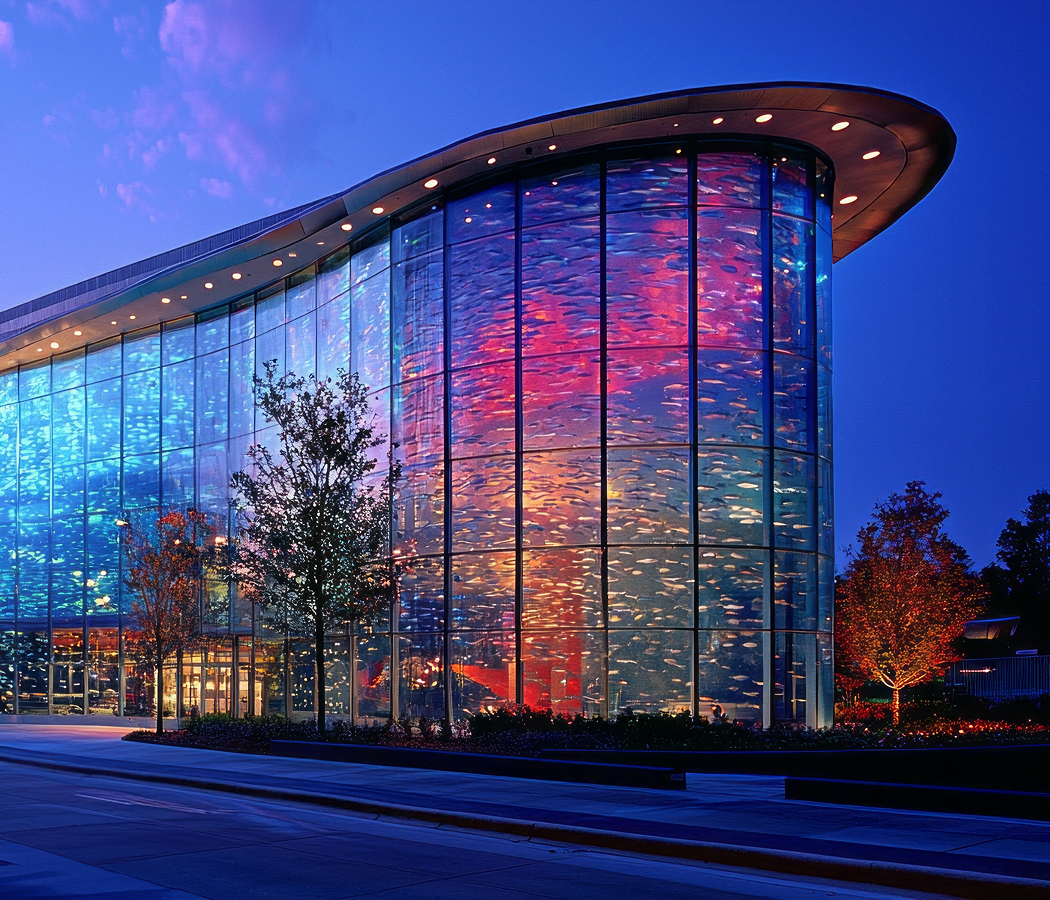
Positioned on Martin Luther King Jr. Boulevard near West Broughton Street and a short walk from the Savannah River waterfront, the restaurant occupies a historic transportation corridor connecting the city's commercial center with its western neighborhoods. Its sweeping Streamline Moderne façade combines blue glass, pale surfaces and rounded corners that recall the optimism of American transportation design during the 1930s. Inside, curved banquettes, terrazzo floors and a horseshoe-shaped bar preserve the spatial character of the former terminal. The open kitchen occupies the original ticket counter, allowing diners to watch chefs prepare food within a setting once organized around passenger departures. The result is an architecturally compelling restaurant where historic preservation and contemporary Southern hospitality give a former transportation landmark a remarkable second life.
What defines The Grey.
The Grey is best known for chef Mashama Bailey and restaurateur Johno Morisano transforming a former segregated bus terminal into a nationally celebrated restaurant that confronts Savannah's complicated history through food and hospitality. Morisano, a New York entrepreneur with a background in media startups, purchased a home in Savannah in 2011 and began searching for a project that would connect his interests in architecture, food and community. He acquired the former Greyhound station in March 2013 for $945,000, committing to the restoration of a building that had stood vacant for more than a decade. The terminal had opened in 1938 under the architectural direction of George D. Brown, a prominent designer of Greyhound stations whose streamlined buildings helped establish the company's recognizable national image. Its original operation included racially segregated waiting areas and restrooms, making the building's history inseparable from the Jim Crow laws that governed public transportation across the South. After intercity bus operations relocated in 1964, successive commercial uses altered the property before its eventual abandonment. Morisano enlisted Savannah architecture firm Felder & Associates and New York design studio Parts and Labor to recover the building's historic character, including the difficult recreation of its distinctive blue-and-white glass exterior. The restaurant's culinary direction emerged through Gabrielle Hamilton, whose celebrated New York restaurant Prune employed Bailey as a sous chef. Born in the Bronx and raised partly in Savannah, Bailey had studied at the Institute of Culinary Education and developed her cooking through professional kitchens in New York before accepting Morisano's invitation to return to the city of her childhood. Their partnership opened The Grey in December 2014, placing a Black woman chef and a white entrepreneur at the center of a business operating inside a building once defined by racial exclusion. National recognition followed rapidly, including a James Beard Award nomination for restaurant design and Eater's designation of The Grey as its 2017 Restaurant of the Year. Bailey received the James Beard Award for Best Chef: Southeast in 2019, strengthening her position among the country's leading interpreters of Southern food. The partners extended their collaboration into The Grey Market in 2018, combining the character of a New York bodega with the traditions of the Southern lunch counter. Their relationship became the subject of Black, White, and The Grey, a 2021 book examining the personal and cultural complexities of building their restaurant together. Bailey subsequently received the James Beard Foundation's Outstanding Chef award in 2022, becoming one of the most prominent culinary figures associated with contemporary Southern cooking. The Grey's importance rests on this intersection of historic preservation, racial history and a culinary partnership that has reshaped the national conversation surrounding food in the American South.
Mashama Bailey's cooking draws its defining character from Savannah's history as an Atlantic port, where West African foodways, European techniques and the agricultural traditions of coastal Georgia developed into a complex regional cuisine. Her approach begins with Southern ingredients whose familiar character becomes the foundation for deeper explorations of flavor and cultural exchange. Stone-ground grits provide a particularly revealing example, carrying the earthy sweetness of corn into preparations that incorporate the richness and precision of classical French cooking. Bailey's celebrated foie gras and grits demonstrates that relationship through the contrast between luxurious liver, softly cooked grain and the savory depth of country ham broth. The dish expresses a broader culinary mechanism in which humble regional staples retain their character alongside ingredients associated with European fine dining. Savannah's maritime connections extend that approach through seafood, spices and preservation techniques shaped by centuries of Atlantic commerce. The kitchen draws on African and Caribbean influences through ingredients such as peanuts, chile peppers and aromatic seasonings, allowing regional produce to carry flavors that reflect the city's trading history. Country Captain, the Southern chicken preparation associated with curry and tomatoes, demonstrates the longstanding influence of Indian spices on coastal cooking. Bailey's treatment of vegetables follows the same cultural logic, using braising, roasting and careful seasoning to develop the richness of greens, eggplant and seasonal produce. The restaurant's menu organizes ingredients around the agricultural categories of Dirt, Water, Pasture and Pantry, giving the meal a structure that reflects the sources of its food. European wines and spirits historically associated with Atlantic trade extend those relationships into the beverage program, connecting the dining room with Savannah's commercial inheritance. Service follows an approachable formality that allows the food's historical and cultural complexity to remain central to the evening. The Grey defines its culinary character through Bailey's ability to connect regional ingredients with the international influences that shaped Southern cooking, creating a restaurant whose flavors communicate Savannah's history as vividly as its restored architecture.
How The Grey fits.
The Grey works as the anchor for an outing connecting Savannah's African American religious heritage, the maritime commerce that established its international importance and the civil rights movement that reshaped the city's twentieth-century public life.
Begin at First African Baptist Church, the historic congregation whose origins reach to 1773 and the ministry of George Leile among enslaved African Americans in colonial Georgia. The congregation developed under Andrew Bryan and later Andrew C. Marshall, becoming one of the most consequential institutions in the early history of Black Christianity in the United States. Its present sanctuary was completed in 1859 using Savannah Grey brick, with free and enslaved congregants contributing labor to the construction. Reverend Emanuel K. Love subsequently helped advance African American education in Georgia, contributing to the movement that established what became Savannah State University. The church later welcomed prominent civil rights figures, including Martin Luther King Jr., preserving a direct connection between its eighteenth-century origins and the struggle for racial equality. Continue to Ships of the Sea Maritime Museum, housed inside the William Scarbrough House, an elegant mansion constructed in 1819 for one of Savannah's most influential shipping merchants. Architect William Jay designed the residence as an early example of Greek Revival domestic architecture in the American South, introducing architectural influences from his native England. Scarbrough served as president of the Savannah Steamship Company, whose vessel SS Savannah became the first steamship to cross the Atlantic Ocean in 1819. The mansion later served as the West Broad Street School for African American children, adding an important educational chapter to its commercial history. Its restoration as a maritime museum preserved the building and introduced collections of ship models, paintings and nautical artifacts that illuminate Savannah's relationship with international trade. Conclude at Ralph Mark Gilbert Civil Rights Museum, the institution occupying the former Wage Earners Savings Bank building constructed in 1914 along historic West Broad Street. The bank became one of the nation's largest Black-owned financial institutions, reflecting the commercial strength of Savannah's African American community during segregation. The museum honors Reverend Ralph Mark Gilbert, whose leadership helped revive the Savannah branch of the NAACP during the 1940s and strengthened organized civil rights activism in the city. Exhibitions examine the Savannah Movement, including the sit-ins, marches and economic boycotts that challenged segregation during the early 1960s. The building's preservation connects the economic institutions of the Black business district with the political movement that transformed Savannah's public life. The progression moves from the foundations of Black religious independence through the city's international maritime commerce and concludes with the organized struggle for civil rights, revealing the historical forces that give The Grey's transformation its deeper significance.
Where your story begins.
Foresyte Travel reveals places that feel extraordinary long before you arrive.
Enjoy editorial crafted for luxury travelers.
Foresyte may earn a commission when you book.