
Why Utah Olympic Park matters.
Utah Olympic Park is an international winter-sports complex where Kimball Junction's mountain recreation heritage meets the competitive achievements of the 2002 Winter Olympics, the engineering demands of elite sliding and jumping disciplines and Utah's continuing investment in Olympic athlete development.
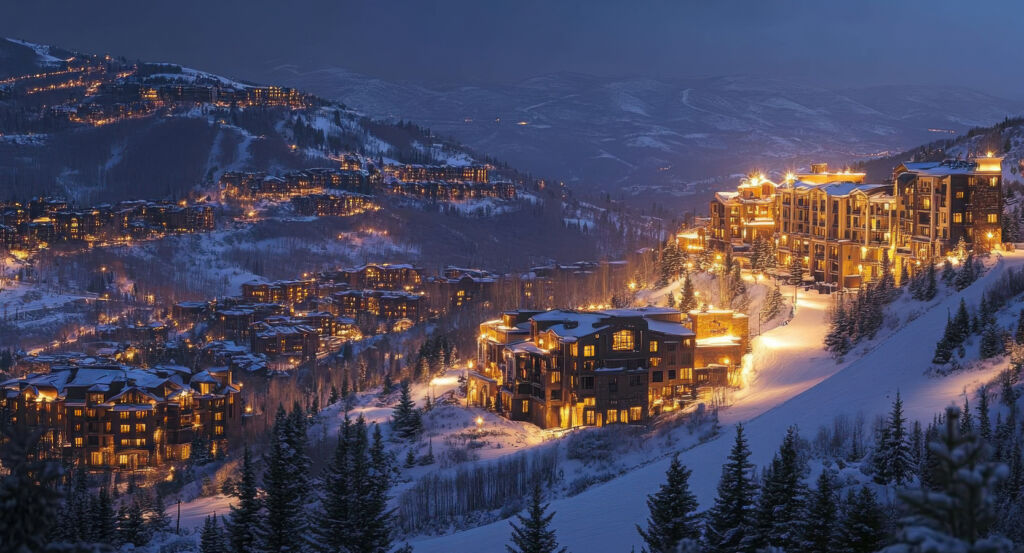
Climbing the eastern slopes of Bear Hollow above Kimball Junction, the complex occupies a mountainside reached from Olympic Parkway near the Interstate 80 and State Route 224 interchange, overlooking the commercial center of Snyderville Basin and the forested ridgelines extending toward the Wasatch Mountains. Its steep terrain incorporates substantial ski-jumping towers, engineered landing slopes and a winding concrete sliding course descending through the mountainside. The principal athletic structures rise above broad service roads, training facilities and spectator areas, creating a distinctive industrial-scale composition against the surrounding alpine vegetation. A substantial visitor center occupies the lower developed grounds, with contemporary mountain architecture connecting enclosed exhibition spaces to outdoor gathering areas and elevated views. The adjoining training landscape incorporates artificial turf, extensive safety systems and a large water pool, establishing specialized environments for aerial athletes during the summer season. The result is an imposing mountain sports facility whose engineered slopes, substantial competition structures and elevated geographical setting preserve the physical achievements of Utah's Olympic development.
What defines Utah Olympic Park.
Utah Olympic Park is best known for its central role in the 2002 Salt Lake City Winter Olympics and its subsequent development into a permanent international training center for bobsled, skeleton, luge, ski jumping and Nordic combined. Its origins emerged from Utah's sustained campaign to secure the Winter Olympic Games, an undertaking that required substantial investment in specialized competition facilities and the development of a coordinated regional sports infrastructure. Utah voters approved a $59 million sales-tax diversion in 1989, establishing a public financing mechanism intended to support Olympic facilities and strengthen the state's international bid. The proposed winter-sports complex originally carried the name Utah Winter Sports Park, reflecting its intended function as a permanent training and competition center. Construction began in 1991, initiating the transformation of a mountain site into a specialized athletic facility incorporating substantial earthworks, transportation infrastructure and engineered competition terrain. The first ski-jumping facilities opened in 1993, introducing dedicated hills for Nordic jumping and the development of athletes across successive levels of competition. The original construction program also incorporated a freestyle aerials training pool, allowing athletes to develop aerial maneuvers through controlled landings in water. The Utah Sports Authority supervised the development of the facilities during the initial period, coordinating construction with the technical requirements of international winter-sports federations. Salt Lake City secured the 2002 Winter Olympic Games in June 1995, establishing the competition deadline that subsequently shaped the park's expansion and technical modernization. The bobsled, skeleton and luge track became operational in 1997, introducing a substantial refrigerated sliding facility capable of accommodating the demanding speeds and structural loads associated with international competition. Its development represented one of the most technically demanding components of the Olympic construction program, requiring precise alignment, substantial concrete engineering and a comprehensive refrigeration system. The track cost $33 million, establishing the largest individual construction expenditure within the park's original sporting infrastructure. Ski-jumping construction accounted for another $21 million, demonstrating the substantial investment required to create competition facilities meeting international technical standards. Infrastructure improvements contributed $6 million, supporting the roads, utilities and operational systems necessary for a major international sporting venue. The Salt Lake Organizing Committee assumed ownership of the facility in July 1999, establishing a more direct administrative relationship between the park and the forthcoming Olympic Games. The transfer also introduced the Utah Olympic Park name, connecting the established training complex to its international competition role. Additional construction incorporated the K120 jumping hill and substantial modifications to the K90 facility, ensuring that the venue accommodated the technical requirements of the Olympic Nordic program. The design and engineering phase concluded in September 1999, and the principal competition improvements reached completion during the autumn of 2000. A substantial winter-sports center opened in 2001, providing facilities for the international media and supporting the logistical demands of the forthcoming competition. The building cost $10 million and became an important component of the park's permanent institutional infrastructure. The XIX Olympic Winter Games began on February 8, 2002, establishing a major international sporting occasion that brought 2,500 athletes from seventy-seven nations to Utah. The park hosted fourteen medal events across ski jumping, Nordic combined, bobsled, luge and skeleton, bringing together disciplines requiring fundamentally different combinations of speed, aerodynamics, strength and technical precision. Three events took place in ski jumping, three in Nordic combined, three in bobsled, three in luge and two in skeleton. More than 300,000 spectators attended the venue during sixteen days of competition, establishing its importance within the broader Olympic program. American athlete Jim Shea won the men's skeleton competition, becoming the first American gold medalist in the discipline since its return to the Winter Olympics. His achievement carried particular historical significance through his family's multigenerational association with Olympic winter sports. Tristan Gale won the inaugural women's skeleton competition, establishing another American victory during the discipline's Olympic return. German athletes dominated several sliding competitions, demonstrating the strength of the country's established technical and athletic programs. The conclusion of the Games initiated an important institutional transition as Utah sought to preserve the substantial public investment represented by its Olympic facilities. The Utah Olympic Legacy Foundation subsequently assumed responsibility for developing a permanent operational model connecting elite athlete training with public recreation and educational programming. The foundation established a year-round program incorporating national-team preparation, international competitions and youth development initiatives. The facility also hosted the 2005 World Luge Championships, demonstrating its continued capacity to accommodate major international sporting events after the Olympics. The park became an official United States Olympic training site, strengthening its relationship with national sporting organizations and the development of future Olympic athletes. Its institutional program expanded through the organization of development camps, junior competitions and specialized training opportunities intended to support participation across multiple winter disciplines. The park's long-term significance increased following the International Olympic Committee's decision in July 2024 to award the 2034 Winter Olympic and Paralympic Games to Salt Lake City and Utah. The decision established another major international competition horizon for the state's existing winter-sports infrastructure. The Utah Olympic Legacy Foundation subsequently advanced substantial modernization proposals intended to prepare the facility for the technical and operational requirements of the forthcoming Games. A program of sliding-track improvements scheduled between 2026 and 2030 incorporates additional roofing, integrated lighting and environmental controls intended to improve ice conditions and reduce maintenance requirements. Plans also include new hospitality and administrative facilities, extending the complex's operational capacity during major international events. Utah Olympic Park's historical importance derives from its sustained development through public financing, international competition, specialized engineering and the establishment of a permanent institutional foundation for American winter sports.
The park's athletic environment develops through a concentration of specialized facilities whose physical arrangements demonstrate the technical requirements of elite winter competition. The complex encompasses 389 acres, establishing an extensive mountain setting for training infrastructure, recreational attractions and visitor facilities. Its principal sliding track extends 1,335 meters down the mountainside, incorporating a carefully engineered sequence of straight sections, banked curves and substantial changes in elevation. Five starting positions accommodate different sliding disciplines and competitive categories, allowing athletes to enter the course at locations suited to their technical requirements. The concrete structure incorporates a sophisticated refrigeration system that maintains the ice surface during the winter season, supporting the demanding conditions required for international competition. Bobsled athletes descend in streamlined vehicles designed to minimize aerodynamic resistance, with steering mechanisms controlled through carefully coordinated movements by the crew. The sport's technical demands combine substantial acceleration, precise steering and the ability to maintain a stable racing line through successive curves. Skeleton introduces a contrasting approach through individual athletes descending headfirst on small sleds, controlling direction through subtle shifts in body position and pressure. Luge requires athletes to descend feetfirst in a supine position, using precise movements of the shoulders, legs and body to negotiate the track at substantial speed. The relationship between these disciplines establishes a distinctive technical environment in which small changes in posture and equipment alignment influence competitive performance. The Nordic jumping complex incorporates six hills designated K10, K20, K40, K64, K90 and K120, providing a structured series of training and competition environments. These designations refer to the construction points associated with individual jumping hills, establishing the scale of their landing slopes and the technical demands placed on athletes. The jumping structures rise across the mountainside at an elevation of 7,310 feet, establishing one of the highest-altitude Nordic jumping facilities in international winter sports. Athletes accelerate down steep inruns before leaving the takeoff table, converting gravitational potential energy into the speed required for controlled flight. Their aerodynamic position determines the relationship between lift, drag and forward momentum, establishing the physical principles governing distance and stability. The V-style jumping technique contributes to the generation of aerodynamic lift through the positioning of the skis and the carefully controlled orientation of the athlete's body. Landing slopes incorporate substantial gradients intended to reduce the vertical forces generated when athletes return to the snow. Nordic combined introduces an additional competitive dimension through the integration of ski jumping and cross-country skiing, requiring athletes to combine explosive technical performance with sustained aerobic endurance. The freestyle aerials facilities develop another specialized training environment through steep launch ramps and a substantial landing area designed for the preparation of complex aerial maneuvers. The summer training pool contains 750,000 gallons of water, providing a controlled environment for athletes practicing rotations, twists and other technically demanding movements. Its landing surface incorporates systems intended to reduce the impact associated with high-speed water entry, supporting repeated training sessions during the warmer months. The Flying Ace All-Stars performances introduce the athletic techniques of freestyle aerials through organized demonstrations that connect competitive skills to public programming. The Joe Quinney Winter Sports Center establishes the principal educational environment through substantial exhibition galleries devoted to the historical development of skiing and the achievements of the Olympic movement. The Alf Engen Ski Museum occupies 4,000 square feet, presenting the history of winter sports in the Intermountain West through original equipment, photographs and interactive installations. Its collection traces the development of cross-country skiing, Nordic jumping and alpine recreation, connecting traditional techniques to successive innovations in equipment and training. Historical skis demonstrate changes in construction, binding technology and the adaptation of equipment to different snow conditions. Interactive jumping installations introduce the physical requirements of Nordic competition, allowing participants to examine the relationship between takeoff, balance and landing. The Eccles 2002 Olympic Museum occupies the upper level of the building, preserving substantial objects associated with the Salt Lake City Games. Its exhibits incorporate athletic equipment used by Olympic competitors, ceremonial objects, official memorabilia and audiovisual presentations documenting major competition achievements. A collection of officially licensed Olympic pins preserves another aspect of the Games through the traditions of collecting and exchanging commemorative objects. The museum also incorporates an Olympic torch, connecting the exhibition program to the ceremonial traditions associated with the international sporting movement. Guided tours extend the educational program into the outdoor competition facilities, connecting the museum's historical presentations to the physical engineering of the surrounding mountainside. The park's recreational activities incorporate professionally piloted bobsled rides, allowing members of the public to descend portions of the historic competition course under specialized supervision. Seasonal summer programs introduce zip lines, an alpine slide and tubing facilities that adapt the surrounding terrain to controlled recreational activities. The zip-line installations descend across substantial changes in elevation, connecting the park's mountain geography to engineered systems of harnesses, cables and braking equipment. Extreme tubing uses the steep landing slopes of the jumping complex, introducing another recreational application of the terrain developed for competitive winter sports. The alpine slide incorporates individual wheeled sleds descending along a controlled track, providing a complementary attraction during the summer operating season. Hiking routes extend across the surrounding mountain landscape, connecting the athletic facilities to views of Snyderville Basin and the forested slopes of the Wasatch Range. The park's distinctive character emerges from the integration of Olympic competition infrastructure, technical training facilities, historical exhibitions and public recreation within a substantial mountain setting devoted to the continuing development of winter sports.
How Utah Olympic Park fits.
Utah Olympic Park works as the starting point for an exploration connecting the ecological preservation of Snyderville Basin, the development of Park City's visual-arts institutions and the industrial history of the silver-mining community that preceded its international sporting prominence.
Begin at Swaner Preserve and EcoCenter, the conservation and educational institution protecting 1,200 acres of wetlands, grassland and sagebrush habitat near Kimball Junction. The preserve incorporates 850 acres of wetland habitat and 350 acres of upland terrain, establishing a substantial ecological corridor supporting migratory birds and native wildlife. Utah State University administers the institution, connecting environmental education to long-term conservation and community programming. The EcoCenter became Utah's first newly constructed building to achieve LEED Platinum certification, incorporating environmentally responsible construction and energy systems. Its four-story observation tower overlooks the surrounding wetlands, and a 400-foot boardwalk extends into the protected landscape, providing access to an important natural environment within the developing Snyderville Basin. Continue to Kimball Art Center, the nonprofit cultural institution founded through the efforts of philanthropist Bill Kimball and Park City's expanding community of artists. Its origins reach back to a summer arts festival organized by local artists in 1969, establishing an annual cultural gathering during the mountain town's developing recreational economy. The center opened in 1976 within the renovated Eley Garage, introducing permanent exhibition and educational facilities devoted to the visual arts. Its institutional program expanded through exhibitions by internationally recognized artists, extensive community classes and educational partnerships serving schools throughout the surrounding region. The organization relocated to a renovated warehouse at The Yard in 2021, establishing 9,000 square feet of exhibition and educational space within Park City's developing arts district. Conclude at Park City Museum, the historical institution occupying the former municipal building constructed in 1885 at a cost of $6,400. The building originally accommodated municipal offices, the police department, the fire department and the territorial jail, establishing a substantial administrative center during the town's mining prosperity. The catastrophic fire of June 1898 destroyed much of the structure, leaving its principal façade, portions of the walls and the jail standing. The Park City Historical Society formed in 1981, and a centennial exhibition in 1984 established the foundation for a permanent historical museum. A restoration and expansion completed in 2009 cost $8.9 million, creating a substantial institution devoted to the preservation of the community's industrial, commercial and recreational history. The progression moves from Swaner Preserve and EcoCenter's protected wetlands through Kimball Art Center's cultural development and culminates in Park City Museum's mining-era collections, connecting the environmental, artistic and industrial foundations of the surrounding mountain community.
Where your story begins.
Foresyte Travel reveals places that feel extraordinary long before you arrive.
Enjoy editorial crafted for luxury travelers.
Foresyte may earn a commission when you book.


























































































































