
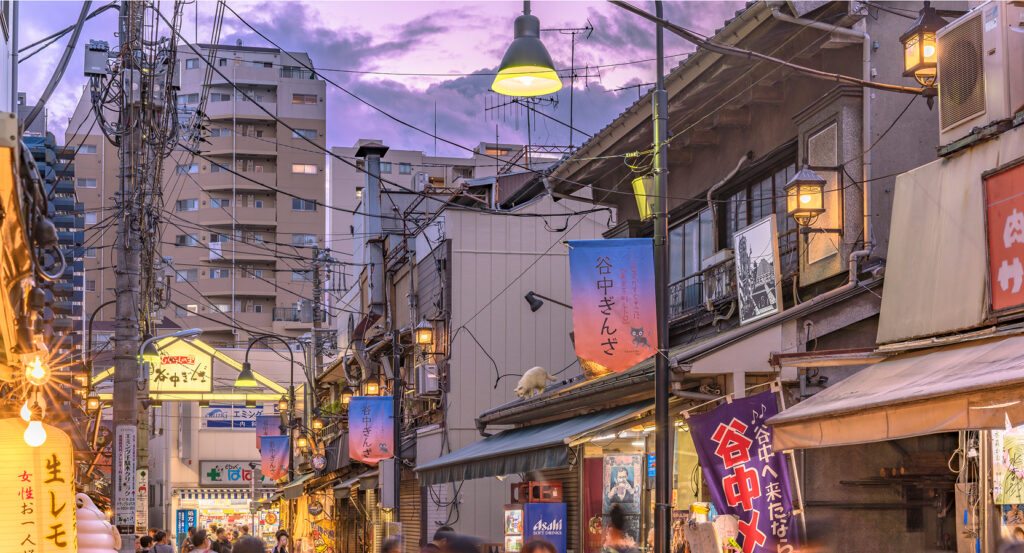
Why Yanaka Ginza matters.
Yanaka Ginza is a nostalgic shopping street where Yanaka's shitamachi character meets a compact corridor of independent merchants, low-rise storefronts and postwar neighborhood commerce.
Set along the lane descending west from Yuyake Dandan near Yomise-dori and just steps from the residential lanes of Yanaka, the shopping street occupies a narrow 170-meter corridor where small storefronts, projecting awnings, handwritten signs and upper-floor residences remain tightly pressed against the pedestrian route. Low building heights preserve long views through the street as the elevated Nippori side rises behind the famous staircase. Butchers, fishmongers, greengrocers, tea sellers and confectioners open almost directly onto the pavement, minimizing the physical separation between commercial interiors and the street. Yuyake Dandan creates a distinctive elevated entrance from the east, turning the descent into a broad view across the entire shopping corridor before the storefronts close around it. The result is a remarkably concentrated fragment of Tokyo in which neighborhood commerce and the physical scale of the older Yanaka streets remain inseparable.
What defines Yanaka Ginza.
Yanaka Ginza is best known for preserving the neighborhood-centered shotengai model that developed across Tokyo during the postwar period and later declined as supermarkets and large commercial centers absorbed local retail. The shopping street took shape 1945 as merchants gathered along a short route serving households in Yanaka and adjoining Sendagi. Its development benefited from the survival of the surrounding district through periods that erased older building fabrics elsewhere in Tokyo, leaving a fine-grained street network suited to independent stores. The commercial strip ultimately extended 170 meters, with 60 businesses occupying one of Tokyo's most concentrated surviving neighborhood shopping streets. Food remained fundamental to its economic role, with meat, fish, vegetables and household staples sold beside wagashi, tea and prepared dishes intended for immediate consumption. Independent ownership preserved an unusual variety of specialized trades within a corridor short enough to function as a single commercial community. The rise of supermarkets and chain retail placed this model under increasing pressure during the later twentieth century, a challenge shared by shotengai throughout Japan. Yanaka Ginza survived that shift through continued neighborhood use and adaptation toward prepared foods, specialty goods and customers arriving from outside Yanaka. A generational change among merchants during the opening decade of the twenty-first century strengthened collective promotion and new events without dissolving the small-store structure that had defined the street. Yanaka Ginza preserves more than a visual trace of postwar Tokyo: its compact commercial organization still demonstrates how specialized independent merchants once supplied daily needs at neighborhood scale.
Cats developed into a second defining element through an association rooted in the wider Yanaka district and subsequently cultivated by the shopping street itself. Yanaka's temple grounds, cemetery edges and low residential lanes supported a conspicuous street-cat population that became closely associated with the neighborhood in photography and popular culture. Merchants extended that connection into the commercial corridor through cat imagery, themed goods and sculptural interventions distributed among the storefronts. Seven carved wooden cats positioned above shops and around the street turned the animal association into a small public-art trail. Sen-chan later emerged as the shopping district's mascot and entered merchandise and stamp-rally programming organized by the merchant community. The feline theme now links older associations with Yanaka to coordinated contemporary promotion without requiring major alteration of the street's architecture. Its effectiveness rests on that continuity: small sculptural cats, independent shop signs and merchandise occupy the same intimate storefront scale as the businesses themselves. Yanaka Ginza converted an existing neighborhood association into a recognizable cultural marker embedded directly within its commercial fabric.
How Yanaka Ginza fits.
Yanaka Ginza works as the commercial anchor for a daytime exploration of Yanaka using three nearby sites that move from a sculptor's purpose-built home and studio through a cemetery containing major figures of modern Japan into a temple whose history reaches the medieval origins of the district.
Begin at Asakura Museum of Sculpture, the former residence, studio and teaching space of Fumio Asakura, who studied at the Tokyo Fine Arts School and became one of modern Japan's leading sculptors. Asakura lived on the site from 1907 until his death in 1964 and completed the present studio complex in 1935, combining reinforced-concrete working spaces with domestic rooms and a Japanese garden. His Asakura Choso Juku operated there as a sculpture school, making the property simultaneously a home, production site and center for artistic training. Asakura's Hakamori received the highest honor at the fourth Bunten exhibition, and its plaster master later became an Important Cultural Property. His wishes led to the residence opening as a museum in 1967; Taito City assumed ownership in 1986, the building entered the national register of tangible cultural properties in 2001 and the garden received designation as a national Place of Scenic Beauty in 2008. Continue to Yanaka Cemetery, where paths through one of the district's largest open spaces hold the graves of political, artistic and commercial figures central to modern Japan. Shibusawa Eiichi, whose activities extended across hundreds of enterprises and institutions during the Meiji and Taisho periods, is buried there among painters, writers, actors and politicians. Sakura-dori crosses the cemetery beneath rows of cherry trees, giving the burial ground a strong internal axis amid the dense concentration of temples surrounding Yanaka. Its scale and historical burials broaden the district beyond the intimate commercial world of Yanaka Ginza into the institutions and individuals associated with Japan's modernization after 1868. Conclude at Tennoji, whose history reaches the thirteenth century and the religious development that gave Yanaka its exceptional concentration of temple land. The temple became closely associated with the cemetery territory that developed around it, surviving successive political and physical changes as Edo became Tokyo. Its grounds preserve a large bronze Buddha created during the Edo period, establishing a physical link with Yanaka before the modern cemetery and postwar shopping street took their present forms. The progression moves from Asakura's integration of artistic production, teaching and domestic architecture through the burial ground of major Meiji-era figures into the older Buddhist foundation behind Yanaka's temple district, carrying the surrounding neighborhood backward through modern art, national modernization and medieval religious history.
Where your story begins.
Foresyte Travel reveals places that feel extraordinary long before you arrive.
Enjoy editorial crafted for luxury travelers.
Foresyte may earn a commission when you book.

















































































































