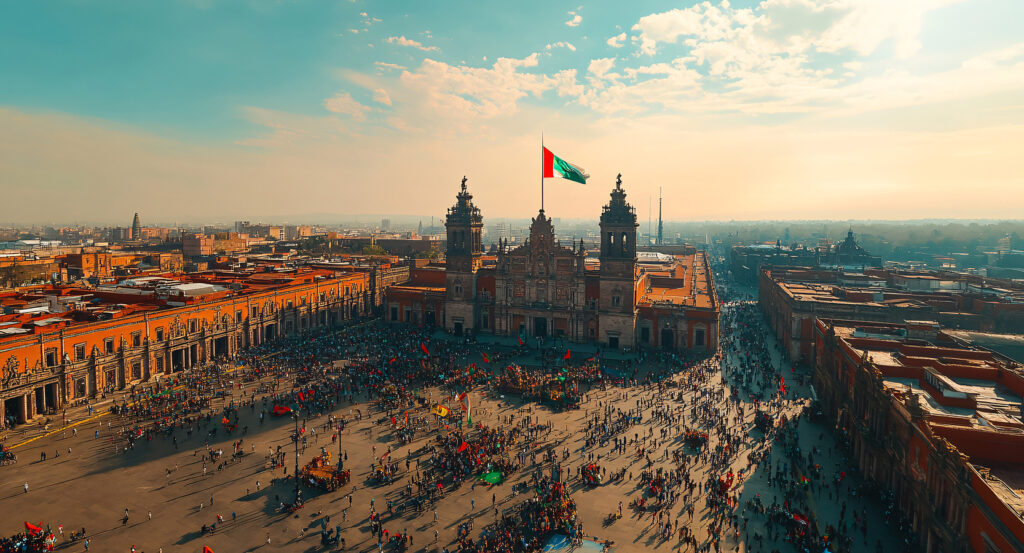
Why Constitution Plaza matters.
Constitution Plaza, known to locals as El Zócalo, is the beating heart of Mexico City, a living crossroads where centuries of history, faith, and revolution converge.
Covering 12 acres in the city's historic center, the Zócalo has been the stage for Mexico's greatest moments, from Aztec ceremonies atop the ancient Templo Mayor to the declaration of independence, political uprisings, papal visits, and jubilant national celebrations. It's one of the largest public squares in the world, yet it somehow feels intimate, a space that belongs equally to presidents, poets, and street vendors. Surrounded by expansive architecture, the Metropolitan Cathedral, the National Palace, and arcaded colonial façades, the plaza breathes with rhythm and contrast. At sunrise, its vast flag ripples in the soft morning light; by midday, the air thrums with music, chatter, and the scent of roasted corn and fresh tamales. In the evening, the surrounding buildings glow gold as the city's pulse slows to a collective exhale. The Zócalo isn't simply a landmark, it's Mexico City's soul laid bare, where the nation gathers to remember, protest, dance, and dream.
What defines Constitution Plaza.
Beneath its cobblestones lies the story of Mexico itself, an unbroken thread from empire to republic.
The Zócalo sits atop the sacred precinct of Tenochtitlan, the Aztec capital that once rose from the waters of Lake Texcoco. After the Spanish conquest in the early 1500s, Hernán Cortés ordered the city rebuilt, using stones from the razed temples to construct cathedrals and palaces, the ones that still line the plaza today. Its official name, Plaza de la Constitución, honors Spain's liberal constitution of 1812, though Mexicans long ago reclaimed it simply as El Zócalo. Through centuries, it has served as both a political and spiritual center: a site of royal proclamations, military parades, independence ceremonies, and mass protests. Beneath its surface, ongoing excavations continue to reveal fragments of the ancient Templo Mayor, reconnecting the modern capital to its pre-Hispanic roots. The plaza's flagpole, 300 feet high, flies one of the largest national flags on Earth, raised and lowered daily in a ceremony that draws locals and visitors alike. Even in stillness, the Zócalo feels alive, a symbol of endurance, built atop layers of conquest, resistance, and rebirth.
How Constitution Plaza fits.
To experience the Zócalo is to walk through the living heart of Mexico's story, a journey that moves through time as much as space.
Begin early in the morning, when the flag-raising ceremony fills the plaza with solemn grandeur and the first rays of sun strike the cathedral's twin towers. Step inside the Metropolitan Cathedral to see its baroque splendor and feel the slight tilt of its sinking foundations, a reminder that the city still rests on ancient lakebed. Then visit the National Palace to view Diego Rivera's grand murals depicting Mexico's tumultuous history, from Aztec civilization to revolution. Wander to the northeast corner to explore the Templo Mayor archaeological site and museum, where you can gaze upon the stones of the old Aztec temple just steps from colonial façades. As afternoon unfolds, stroll beneath the shaded arcades that frame the square, vendors selling crafts, mariachis tuning guitars, and locals gathering for conversation. Stay until evening, when the plaza transforms under soft illumination, the cathedral silhouetted against the sky and the flag gently folding into twilight. Constitution Plaza (Zócalo) in Mexico City isn't just a destination, it's a living symphony of past and present, a place where every heartbeat echoes the nation's eternal rhythm.
Where your story begins.
Foresyte Travel reveals places that feel extraordinary long before you arrive.
Enjoy editorial crafted for luxury travelers.
Foresyte may earn a commission when you book.