Why you should experience Palais de Tokyo in Paris, France.
Palais de Tokyo in Paris is a pulse, a living experiment where art dares to shed its boundaries and breathe in real time.
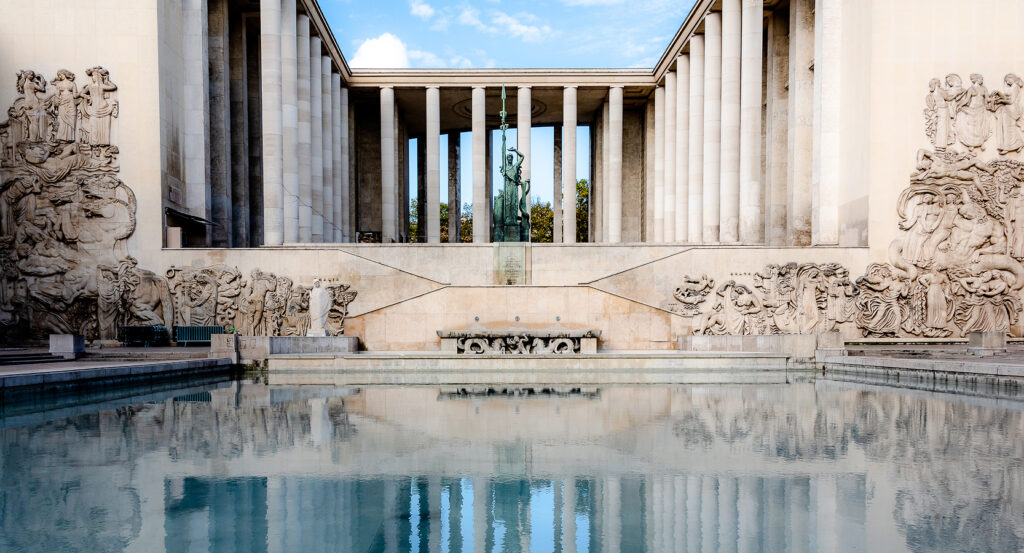
Perched between the Seine and the Eiffel Tower, this vast concrete cathedral of contemporary art feels raw, cinematic, and defiantly alive. Built for the 1937 Exposition Internationale des Arts et Techniques, its monumental façade suggests neoclassical restraint, but step inside, and that illusion shatters. The interiors stretch into cavernous spaces of bare concrete and shadow, a post-industrial dreamscape where the art seems to grow straight out of the building itself. Here, installations sprawl across floors, sounds echo like memories, and light feels sculpted as much as paint or stone. Every exhibition is temporary, and that's the point. Palais de Tokyo is less a museum and more a state of becoming, a place where creativity is never finished and nothing is sacred except risk. Visitors don't simply observe; they participate, sometimes without realizing it. You may walk through a forest of neon, an ocean of mirrors, or a room whispering in multiple languages. Each corner hums with the unpredictable, a reflection of Paris at its boldest and most restless.
What you didn’t know about Palais de Tokyo.
Palais de Tokyo's story is one of reinvention, an ongoing dialogue between architecture, rebellion, and the avant-garde.
Originally built as a dual pavilion for the 1937 World's Fair, it was designed to house both the Musée d'Art Moderne de la Ville de Paris and a space for contemporary exhibitions. Over the decades, its purpose morphed along with the spirit of the times: wartime storage, government offices, a neglected relic, until a seismic rebirth in 2002 transformed it into Europe's largest contemporary art center. Rather than polish its rough edges, the architects left the scars visible: peeling paint, exposed pipes, cracked stone. The result was radical honesty, an aesthetic manifesto that art doesn't need perfection, only authenticity. The name itself, “Palais de Tokyo,” nods to the Avenue de Tokyo (now Avenue de New York), but it also feels prophetic, a symbol of cross-cultural exchange and modernity. The museum's mission is equally expansive: to showcase art that speaks to the now, in forms that defy easy categorization. Exhibitions might merge performance, technology, fashion, and activism in ways that challenge both logic and emotion. Its rotating roster has featured boundary-pushers like Tino Sehgal, Kader Attia, and Camille Henrot, each reshaping how audiences engage with art. And unlike traditional institutions, the Palais remains open late into the night, an art temple that aligns more with the rhythm of the city's nightlife than its museums. That sense of rebellion, of creativity that refuses to end at closing time, is what makes it sacred ground for modern thinkers and dreamers.
How to fold Palais de Tokyo into your trip.
A visit to Palais de Tokyo is not about sightseeing, it's about surrender.
Begin with the façade itself, where monumental columns rise above fountains and sculptures that frame distant views of the Eiffel Tower. Step inside expecting nothing, and you'll receive everything. The exhibitions change constantly, so don't chase what's on display, let the building guide you instead. Wander through its immense galleries at your own rhythm, where silence and sound collide, and where visitors sometimes become part of the art. If an installation unsettles you, stay with it, that's the point. It's a place built on discomfort, curiosity, and awe. After exploring the exhibits, pause at the museum's restaurant, Les Grands Verres, where glass walls overlook the Seine, and minimalist design echoes the raw geometry of the space. If you're visiting in the evening, the Yoyo club downstairs transforms the museum's lower level into one of Paris's most creative nightlife venues, part art lab, part underground party. End your visit outside on the terrace, where locals gather with wine and cigarettes, and the Eiffel Tower flickers like an accomplice in the distance. Whether you spend an hour or an afternoon here, Palais de Tokyo won't just change how you see art, it will change how you experience space, silence, and the sublime. It's the rare museum where the unfinished feels eternal, and where creation itself is always in progress.
Where your story begins.
Start your planning journey with Foresyte Travel.
Experience immersive stories crafted for luxury travelers.